
How Does MLM Software Work? A Complete Step-by-Step Guide





MLM software automates the core operations of a network marketing business, including distributor management, genealogy tracking, commission calculations, payouts, sales monitoring, and reporting.
As networks grow, MLM software helps businesses manage operations efficiently with real-time automation and centralized control.
In this guide, you’ll learn how MLM software works, the key components behind the system, the compensation plans it supports, and the benefits it provides for both companies and distributors.
MLM software is a specialized network marketing software platform that automates distributor management, genealogy tracking, commission calculations, sales monitoring, and payout processing within an MLM business.
It helps companies manage large distributor networks efficiently by replacing manual processes with real-time automation.
MLM software works by tracking every distributor, sale, and network relationship in real time, then automatically calculating commissions and updating payouts based on predefined compensation rules.
Understanding how MLM software works becomes easier when you break it into individual operational stages. Here’s the complete step-by-step process.
The process begins when a distributor joins the network using a referral link, sponsor ID, or invitation code.
During registration, the MLM software collects user information, creates login credentials, generates a unique distributor ID, and activates a personal dashboard.
The software then automatically places the new member within the network structure according to the company’s compensation plan rules.
Once registration is complete, the platform automatically creates:
This automation removes manual placement errors and ensures the network structure remains accurate as the organization expands.
After registration, the MLM software updates the genealogy tree in real time.
A genealogy tree is a visual representation of the entire distributor network.
Every sponsor–recruit relationship is stored as a node within the structure. As new members join, the tree expands dynamically.
The genealogy tree allows both administrators and distributors to view:
This module is important because the compensation engine depends on genealogy data to determine who qualifies for commissions and bonuses.
Without a properly structured genealogy system, commission calculations would become unreliable and difficult to audit.
Many modern MLM software platforms include interactive genealogy trees with drag-and-drop navigation, mobile responsiveness, and live network updates.
Once distributors become active, they begin purchasing products, subscription packages, or membership plans through the integrated eCommerce system.
Modern MLM software typically integrates with payment gateways such as:
Every transaction is automatically recorded with a complete MLM audit trail that includes:
The system simultaneously tracks:
These metrics are essential because most MLM compensation plans calculate earnings based on sales volume thresholds and qualification criteria.
Automated transaction recording ensures transparency while reducing accounting and reporting errors.
The commission engine is the most technically advanced component of MLM software.
Whenever a qualifying sale occurs, the system automatically traverses the genealogy tree upward and applies predefined compensation rules.
The software calculates multiple MLM bonuses and commission types, including:
The engine evaluates several conditions before approving payouts:
Once calculations are completed, earnings are automatically credited to the distributor’s e-wallet either instantly or according to a scheduled payout cycle.
This automation dramatically reduces disputes, delays, and calculation inaccuracies.
After commissions are credited, distributors can request withdrawals from their integrated e-wallets.
Before approving payouts, the MLM software performs multiple verification checks, including:
Approved withdrawals can be processed through:
Administrators usually maintain final approval authority over payouts, although many systems also support fully automated withdrawals.
Advanced MLM software platforms also generate payout statements, tax reports, and accounting summaries for financial auditing purposes.
Modern MLM software continuously generates real-time reports and analytics for both administrators and distributors.
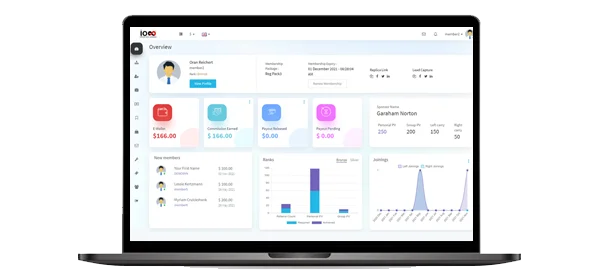
Admin dashboards typically include:
Distributor dashboards provide visibility into:
These analytics help companies identify top-performing teams, monitor inactive legs, forecast growth opportunities, and improve strategic decision-making.
Real-time reporting also increases distributor trust because earnings and sales data remain fully transparent.
Several core modules work together to automate and manage MLM business operations efficiently.
The compensation engine is the rule-processing core of MLM software.
Key Functions:
The genealogy tree manages the network structure and distributor relationships.
Key Functions:
This module manages distributor earnings and financial transactions.
Key Functions:
E-Pins help control distributor registration and account activation.
Key Functions:
Role-based dashboards provide different access levels for admins and distributors.
Admin Dashboard Features:
Distributor Dashboard Features:
The reporting system provides real-time business insights and compliance tracking.
Key Functions:
Modern MLM software supports multiple compensation plans, allowing businesses to choose or combine structures based on their growth strategy, commission model, and distributor engagement goals.
| Compensation Plan | Structure | How MLM Software Handles It |
|---|---|---|
| Binary Plan | 2 legs per distributor | Auto-places members into left/right legs, calculates pairing commissions, and manages spillover |
| Unilevel Plan | Unlimited frontline recruits | Tracks unlimited direct recruits and calculates level-based commissions |
| Matrix Plan | Fixed width and depth | Enforces position limits, handles overflow placement, and matrix cycling |
| Generation Plan | Generation-based hierarchy | Tracks leadership generations and calculates generation bonuses |
| Board Plan | Board or stage progression | Automates board cycling, upgrades, and payout distribution |
| Monoline Plan | Single-line structure | Places members sequentially in one line and manages linear commissions |
| Hybrid Plan | Combination of multiple plans | Supports multiple compensation structures simultaneously |
| Stairstep Breakaway Plan | Rank-based breakaway system | Tracks rank advancement and separates qualified leaders into breakaway groups |
| Gift Plan | Peer-to-peer gifting structure | Manages gifting cycles, eligibility, and member progression |
| Australian Binary Plan | Binary with broader payout logic | Calculates commissions using enhanced binary balancing rules |
| Donation Plan | Contribution-based network | Tracks donation flows and member qualification criteria |
| Party Plan | Event-based direct selling | Tracks host sales, event commissions, and group performance |
Businesses often prefer MLM software that supports multiple compensation plans because it provides flexibility for expansion, restructuring and custom commission strategies without rebuilding the platform.
MLM software eliminates the need for manual network management by automating distributor onboarding, commission calculations, reporting, and payouts.
This reduces operational costs, minimizes human errors, and improves scalability.
The software also creates compliance-ready audit trails that help businesses maintain financial transparency while supporting millions of distributors without increasing administrative workload.
Distributors benefit from transparent commission tracking, real-time genealogy visibility, and faster payouts through integrated e-wallet systems.
Mobile-friendly dashboards allow distributors to monitor team performance, track rank progression, and access earnings data from anywhere, improving engagement and retention.
MLM software helps network marketing businesses automate distributor management, genealogy tracking, commission calculations, payouts, reporting, and compliance from a centralized platform.
It improves accuracy, scalability, transparency, and operational efficiency while reducing manual work.
With support for multiple compensation plans, real-time analytics, and secure payment systems, MLM software enables businesses to manage growing networks efficiently and provide distributors with a better user experience.
MLM software is used to automate network marketing operations such as member management, commission calculations, genealogy tracking, product sales monitoring, and payout processing.
It helps businesses scale efficiently while reducing manual administrative work.
Yes. Most modern MLM software platforms support Binary, Unilevel, Matrix, Generation, Board, Monoline, and Hybrid compensation plans.
Many systems allow businesses to switch or customize plans without major development changes.
Enterprise-grade MLM software includes security features such as encrypted databases, role-based access control, two-factor authentication, KYC verification, fraud detection systems, and secure payment gateway integrations to protect financial and distributor data.
Distributors join through a referral link or sponsor ID. The software collects registration details, creates login credentials, assigns a unique distributor ID, places the member within the genealogy tree, and activates the dashboard and e-wallet automatically.
The distributor dashboard provides real-time access to earnings, commissions, team growth, sales activity, genealogy reports, rank progress, referral links, and withdrawal requests from a single centralized platform.
The commission engine tracks qualifying sales across the genealogy tree and applies compensation plan rules such as referral bonuses, level commissions, matching income, and rank-based rewards before crediting earnings to the distributor’s e-wallet.
A genealogy tree is a live visual structure of the distributor network that shows sponsor–recruit relationships, uplines, downlines, sales volume, and rank progression.
It forms the foundation for commission calculations.
Yes. Most modern MLM software platforms are mobile-responsive and allow distributors to manage earnings, monitor teams, share referral links, and access reports from smartphones or tablets.
MLM software includes security features such as KYC verification, two-factor authentication, duplicate account detection, IP monitoring, and fraud screening to prevent misuse and protect financial operations.
Product Specialist & Research Head | Leading Strategic Multilevel Marketing Software Initiatives | MLM Technology Expert


 May 19, 2026