
Expanding Into the Gulf: The Direct Selling Operator’s Guide to Halal Compliance, Arabic Localisation, and Local Payment Integration





Expanding into the Gulf Cooperation Council (GCC) requires more than a standard global rollout. Markets like Saudi Arabia, the UAE, and Kuwait demand a region-specific approach across compliance, localisation, and payments.
This guide covers the essentials of direct selling Gulf expansion, including halal compliance (product and compensation structures), Arabic localisation in MLM software (RTL interfaces and cultural adaptation), and GCC payment integration (mada, KNET, and regional gateways).
It also covers key regulations, essential MLM software requirements, and a practical readiness checklist to support a successful Gulf market launch and growth.
The GCC region that includes Saudi Arabia, UAE, Qatar, Kuwait, Bahrain and Oman represents one of the most promising growth frontiers for direct selling.
With a combined population of ~57 million, a median age under 30, and some of the highest smartphone penetration rates globally, the region is primed for digital-first, community-driven commerce models.
Direct selling fits naturally into this system. Social trust, family networks and community influence are deeply embedded in Gulf consumer behavior, making network marketing structurally aligned with local culture.
However, this is not a plug-and-play expansion.
Unlike other regions, the GCC introduces three simultaneous structural requirements:
Ignoring any one of these creates immediate friction:
See how leading MLM software supports Arabic localisation, local payment gateways, and UAE compliance.
Halal compliance in MLM refers to ensuring that both the products and the compensation model align with Islamic finance principles such as avoiding riba (interest) and gharar (uncertainty).
In GCC markets, halal compliance begins at the product level. Product-level halal compliance refers to certifying that ingredients, sourcing, and manufacturing processes meet approved halal standards.
This applies especially to:
Certification bodies such as:
are widely recognized across the region.
Your MLM software should track certification documents and expiry dates within the product catalog to prevent compliance risks.
It must also maintain an MLM audit trail of all certification changes, capturing updates, renewals, timestamps and user actions to ensure transparency and support regulatory audits.
Business model halal compliance in MLM refers to structuring compensation plans so that earnings are primarily driven by genuine product sales rather than recruitment.
Islamic finance introduces two key principles:
Riba concerns:
Gharar concerns:
Important: This area is interpretive and varies by scholars and regulators. Always seek Islamic finance counsel.
| Halal Compliance Requirements | |
|---|---|
| Halal certification from recognized bodies | |
| Compensation plan reviewed for riba and gharar exposure | |
| Arabic income disclosure statements prepared | |
| Retail sales ratio tracking enabled | |
| Certification expiry monitoring built into product systems |
Arabic localisation in MLM software refers to adapting the platform’s language, interface, and user experience to meet the cultural and linguistic needs of Arabic-speaking users.
To succeed in Gulf markets, MLM software must go beyond translation and support:
An RTL (right-to-left) interface refers to a system design where content is structured to be read from right to left, as required for Arabic language usability.
Your MLM software must natively support RTL across:
Common failure: LTR systems “mirrored” into RTL break layouts, distort hierarchies, and create unusable reports.
Genealogy trees, in particular, must be structurally rebuilt, not flipped.
Formal, used in legal/compliance content
Conversational, better for engagement
Best practice:
Direct translations from English often feel aggressive or unnatural. Cultural adaptation is important.
Key considerations:
| Localisation Features | |
|---|---|
| Native RTL support (not CSS-based) | |
| Arabic language across all system communications | |
| Multi-currency support (SAR, AED, QAR, KWD, BHD, OMR) | |
| Hijri + Gregorian calendar support | |
| Arabic-compatible customer support integrations |
Relying only on global payment gateways like Stripe or PayPal is not sufficient in the GCC.
Local payment networks dominate transactions, and without integrating them, MLM businesses risk losing a significant portion of potential distributors and customers.
Global gateways often have:
In contrast, local payment systems are widely adopted, regulated, and often mandatory for digital transactions.
Below is a country-wise breakdown of GCC payment networks relevant for MLM software integration:
| Country | Primary Payment Networks | Key Notes |
|---|---|---|
| Saudi Arabia | mada, STC Pay | mada is mandatory for debit transactions; STC Pay is widely used for digital wallets |
| UAE | UAE Instant Funds Transfer, Apple Pay, Google Pay (via banks) | Strong banking infrastructure; mobile wallets growing rapidly |
| Kuwait | KNET | Mandatory national switch; essential for all online payments |
| Qatar | QPay | Commonly used for government and utility-linked payments |
| Bahrain | BenefitPay | Dominant mobile payment app with high adoption |
| Oman | OmanNet | Primary gateway for card-based transactions |
To access the above local networks, MLM software typically integrates with regional aggregators:
| Gateway | Coverage | Key Advantage |
|---|---|---|
| PayTabs | Saudi Arabia, UAE, GCC | Strong local compliance and mada support |
| HyperPay | Saudi Arabia, UAE | Deep integration with regional banks |
| Telr | UAE, Saudi Arabia, Bahrain | Easy onboarding for SMEs |
| Checkout.com | UAE, Saudi Arabia | Enterprise-grade infrastructure and global + local support |
Payment collection is only half the system. Payout infrastructure is equally important in MLM operations.
VAT on MLM commissions refers to the tax applied to distributor earnings, which varies by country, such as 15% in Saudi Arabia and 5% in the UAE.
While not directly handled within MLM software, businesses operating in Saudi Arabia must consider:
Your system should at least support exportable financial data for compliance processes.
To operate successfully in the GCC, MLM software must:
Without these, even the most advanced MLM software will struggle to function effectively in the region.
Entering the GCC direct selling market requires strict compliance with country-specific licensing laws and evolving regulations.
MLM businesses must align with local authorities, avoid pyramid scheme violations, and follow data protection rules to operate legally and sustainably.
Important: Regulations change frequently. Always validate with local legal counsel before launch.
Expanding into the GCC requires MLM software that is purpose-built for regulatory compliance, cultural alignment, and regional infrastructure.
To operate effectively and grow sustainably, your software must be equipped with the following core MLM software features:
Launching in the GCC requires coordinated preparation across legal, technical, and market-entry dimensions.
This checklist ensures your MLM business is fully aligned before entering the region.
Expanding into the GCC is a high-reward opportunity, but only with the right foundation.
Halal compliance, Arabic localisation, and local payment integration are not optional; they are essential for success.
From compliant compensation structures to RTL-enabled MLM software and GCC-specific payment support like mada and KNET, every aspect must be tailored to the region.
Businesses that invest in the right technology and prepare for regulatory requirements are best positioned to scale effectively.
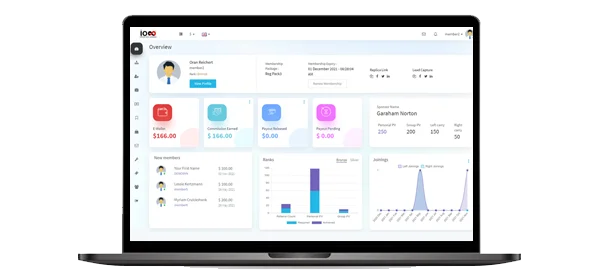
Infinite MLM Software supports:
– Native Arabic RTL interfaces
– GCC payment gateway integrations
– Compliance-ready compensation structures
If you’re planning your Gulf expansion, now is the time to ensure your MLM software is truly ready.
Power your growth in the GCC with MLM software built for halal compliance, Arabic RTL localisation and GCC payment integration.
Yes, direct selling is legal in both Saudi Arabia and the UAE, but it is regulated. Businesses must obtain proper licenses and comply with anti-pyramid and consumer protection laws.
MLM software in GCC markets must support halal compliance tracking, Arabic RTL interfaces, multi-currency, and local payment integrations like mada and KNET.
Yes, MLM compensation plans should align with Islamic finance principles such as avoiding riba (interest) and gharar (uncertainty), especially in GCC markets.
mada and STC Pay are essential payment methods in Saudi Arabia, as they dominate local transactions and are widely used by consumers and distributors.
Arabic RTL support ensures proper display of dashboards, genealogy trees, and reports, improving usability and adoption among Arabic-speaking distributors.
Stripe and PayPal have limited functionality in the GCC. Businesses must integrate regional payment gateways that support local networks like mada, KNET, and BenefitPay.
VAT applies to MLM commissions at 15% in Saudi Arabia and 5% in the UAE. MLM software must calculate and generate VAT-compliant reports.
Key requirements include Arabic language support, RTL interface design, cultural adaptation, Hijri calendar support, and multi-currency functionality.
Product Specialist & Research Head | Leading Strategic Multilevel Marketing Software Initiatives | MLM Technology Expert


 May 15, 2026