BigCommerce MLM Software Integration: How It Works and What to Look For





Running an MLM business on BigCommerce often creates a gap between the storefront and MLM back office, leading to manual work, delays, and commission issues.
MLM software integration solves this by syncing both systems so orders automatically generate accurate commissions.
In this guide, we’ll break down how this integration works and what you should evaluate before choosing a solution.
BigCommerce is an easy-to-use online platform that helps businesses create and manage their own online stores without needing advanced technical skills.
It provides everything required to sell products online, including website building tools, payment processing, product management, and order tracking.
In simple terms, BigCommerce is a complete solution that allows anyone to set up an online shop and start selling products on the internet efficiently.
The difference between BigCommerce and eCommerce is like the difference between a specific tool and the entire concept it belongs to.
eCommerce (electronic commerce) is a broad term. It refers to the process of buying and selling goods or services online.
It includes everything involved in online selling:
Examples of eCommerce in action:
So, eCommerce is the entire industry and activity, not a specific platform.
BigCommerce is a specific eCommerce platform, a software solution that helps businesses create and manage online stores.
It provides tools like:
It’s similar to platforms like:
So, BigCommerce is one way to do eCommerce.
| Aspect | eCommerce | BigCommerce |
|---|---|---|
| Meaning | Concept/industry | Specific platform/tool |
| Scope | Very broad | Narrow (one solution) |
| Includes | All online buying/selling activities | Tools to build an online store |
| Example | Online shopping | Software to run a store |
MLM businesses need more than a basic online store, they need a system that supports complex networks, commissions, and global MLM expansion. BigCommerce provides the flexibility and infrastructure needed to connect ecommerce with MLM operations effectively.
BigCommerce uses a headless setup that lets MLM systems connect without affecting the online store experience. This separation allows the storefront and backend MLM operations to work smoothly together while staying independently scalable and easy to manage.
Its open API structure enables fast and accurate data sharing between systems. For MLM businesses, this means every order, update, and transaction is reflected in real time, ensuring precise commission tracking and reliable distributor reporting.
BigCommerce supports multiple currencies and regional setups, making it suitable for MLM companies operating across different countries. It simplifies international expansion by handling global storefront needs without complex custom development.
Unlike many platforms, BigCommerce does not charge extra transaction fees on sales. This helps MLM businesses maintain clean financial structures where commissions and margins can be calculated without unexpected deductions.
The platform allows clear separation between customers and distributors. This dual-account structure helps MLM businesses manage retail buyers and network members efficiently while keeping workflows organized and easy to scale.
Before diving into the technical setup, it’s important to understand how data actually flows between the store and the MLM system.
This is the part no competitor explains. When an order is placed on a BigCommerce storefront, a precise sequence of events must occur in the MLM back office for commissions to be calculated correctly.
This entire flow happens automatically when the integration is built correctly. Without it, steps 3 through 7 require manual admin work after every single order.
Every product in BigCommerce must be mapped to BV (Business Volume) or PV (Point Value) inside the MLM system so commissions are calculated correctly. This mapping isn’t static, it must update automatically whenever products are added, edited, or removed.
For variants and bundles, each version of a product needs its own BV/PV value to avoid incorrect payouts, and a proper integration ensures bidirectional sync between the store and MLM engine.
A critical requirement in MLM ecommerce is distinguishing between:
When a distributor registers, their BigCommerce account must link directly to their MLM profile. This ensures that every purchase they make, or refer, is correctly attributed within the compensation structure.
At the same time, retail purchases must still be tracked for compliance purposes, particularly for retail sales ratio calculations.
Without this separation, commission errors and compliance risks increase significantly.
Connect your sales, commissions, and distributor network in one seamless system, built for accuracy, speed, and scale.
Not every compensation plan aligns equally well with an ecommerce-driven MLM model. The right choice depends on how your business generates revenue.
The unilevel plan works particularly well for ecommerce-first businesses. It allows unlimited direct referrals and focuses heavily on product sales rather than recruitment complexity.
Because commissions are tied directly to sales volume, it maps cleanly to BigCommerce order data. This makes it easier to implement and maintain.
Binary plans introduce more complexity but can be powerful for businesses that combine recruitment with product sales.
Commissions depend on balancing volume between two legs. This requires accurate, real-time BV tracking from BigCommerce orders. If order data is delayed or inconsistent, payout calculations become unreliable.
Refunds also play a bigger role here, as they can disrupt leg balance and require recalculations.
Matrix plans are often used in membership-based or subscription-driven models. They rely on fixed-width placement and spillover logic, which must align with how users register and place orders through BigCommerce.
Timing and placement accuracy are critical here, making integration precision essential.
Ultimately, the best plan depends on:
BigCommerce works best with plans that prioritize consistent product movement and clear volume tracking.
Choosing the right integration isn’t about how many features a platform offers, it’s about how reliably those features support real MLM operations at scale.
Commissions should be triggered instantly when an order is confirmed in BigCommerce. Real-time syncing ensures distributors see accurate earnings without delays, reducing confusion, support requests, and disputes over missing or late payouts.
Your product catalog and commission structure must stay perfectly aligned. Any updates to product pricing, variants, or availability should automatically reflect in the MLM system, ensuring BV/PV values remain accurate and commission calculations stay consistent.
The system must clearly separate retail customers from distributors while linking distributor accounts directly to their MLM profiles. This ensures smooth tracking of purchases, commissions, and network activity without mixing customer and distributor data.
When orders are refunded or canceled, the system should automatically reverse associated commissions. This prevents overpayments, maintains financial accuracy, and avoids complex manual adjustments later.
For global MLM networks, orders placed in different currencies must be converted accurately into a base value before commissions are calculated. This ensures fair payouts and consistent rank qualification across all regions.
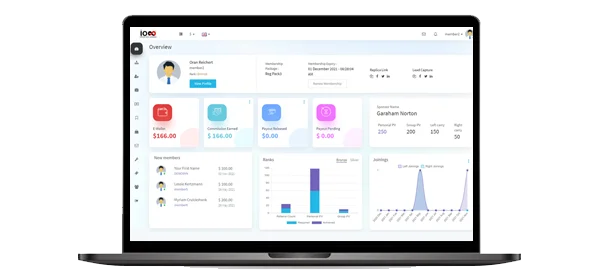
Distributors need clear visibility into their performance, including personal sales, team activity, rank progress, and commission history. All insights should be directly tied to real BigCommerce order data to ensure transparency and trust.
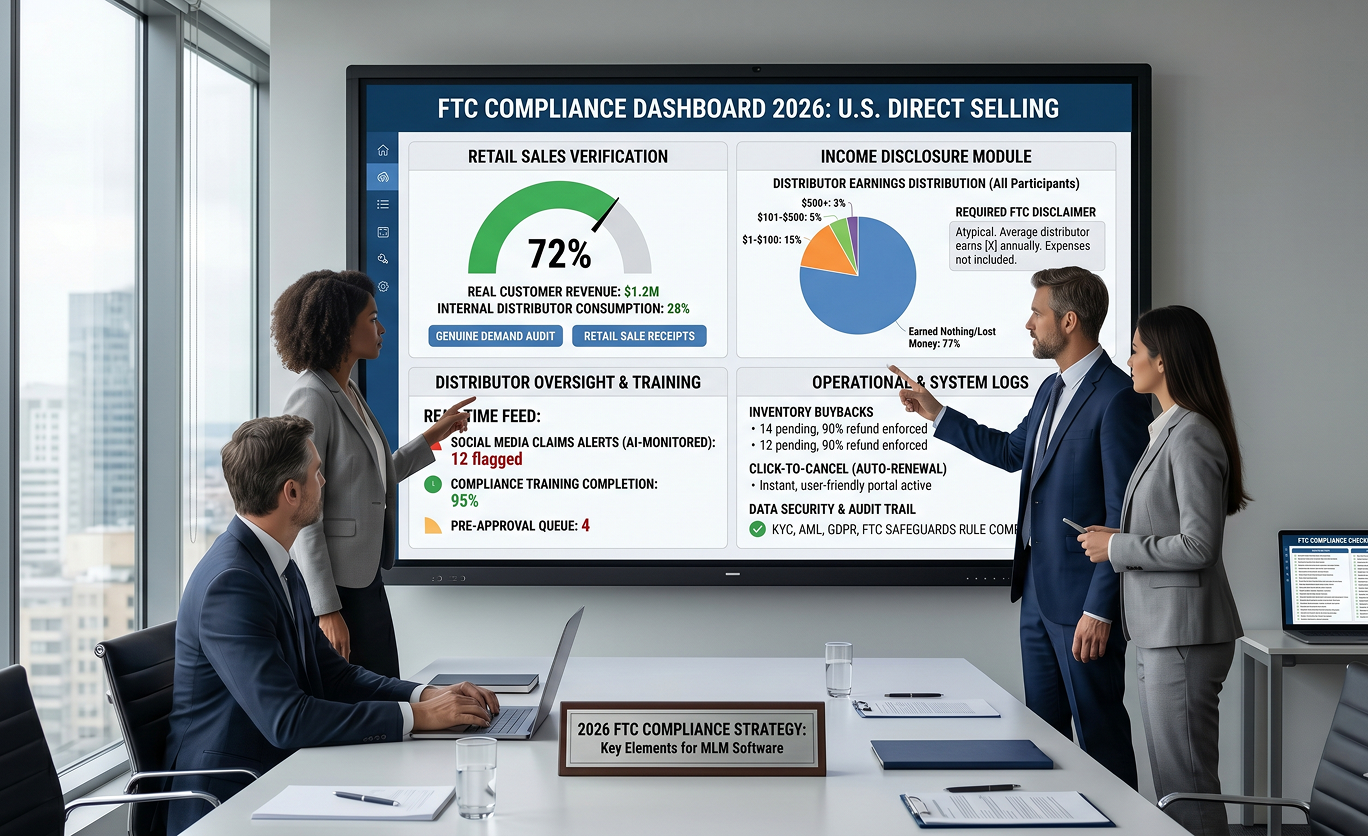
To meet regulatory requirements, the system must track how much revenue comes from retail customers versus distributors. Accurate reporting across both eCommerce and MLM systems is essential for maintaining compliance and long-term business stability.
Even with an advanced platform like BigCommerce, MLM integrations can break down if they are not thoughtfully designed. Most failures stem from weak data synchronization and a lack of alignment between ecommerce transactions and MLM commission logic.
Orders may be successfully completed in BigCommerce, but commissions don’t reflect instantly in the MLM back office. This usually happens when integrations rely on delayed webhooks or scheduled batch processing instead of real-time event triggers. The result is slow updates, confusion among distributors, and increased support queries due to missing or delayed earnings visibility.
When products with multiple variants (such as size, package, or subscription type) are assigned a single BV value, commission calculations become inaccurate. Each variant should have its own mapped BV/PV value to reflect its true contribution. Without this, businesses risk consistent underpayment or overpayment across the network.
If refund or cancellation events in BigCommerce are not synced back to the MLM system, commissions already paid out remain unchanged. This creates financial inconsistencies, as distributors retain earnings from invalid transactions. Automated reversal mechanisms are essential to maintain accurate payout records.
Duplicate accounts occur when the same user registers separately as a retail customer and later as a distributor without proper account linking. This leads to fragmented data, broken genealogy structures, and incorrect commission attribution within the network.
For global MLM operations, incorrect currency conversion can significantly impact commission calculations. If orders placed in different currencies are not converted using accurate and consistent rates, BV values may be inflated or reduced, affecting both payouts and rank qualifications across regions.
The common issue behind all these failures is surface-level integration that only transfers basic order data without understanding MLM-specific requirements. A reliable integration must be built with the compensation plan in mind, ensuring real-time synchronization, accurate value mapping, and complete alignment between ecommerce and MLM systems.
A reliable BigCommerce MLM integration follows a structured, step-by-step process to ensure both ecommerce and MLM systems work in sync without errors.
Every product SKU in BigCommerce is mapped to its BV and PV values within the MLM system. This includes detailed mapping for product variants and bundles, ensuring each item contributes accurately to commission calculations.
Existing distributor accounts are connected to their corresponding BigCommerce customer profiles. This step ensures historical order data, genealogy, and commission records remain intact and correctly linked.
The MLM compensation structure; including commission rules, rank qualifications, and bonus triggers, is configured in the back office. These rules are then connected directly to BigCommerce order events for accurate, automated payouts.
Before going live, a complete order cycle is tested in a staging environment. This helps verify commission accuracy, BV mapping, refund handling, and overall system behavior under real-world scenarios.
After launch, the system requires close monitoring, especially during the first 30 days. This phase helps identify edge cases, correct configuration gaps, and ensure commissions are calculated and distributed accurately.
Before committing, it’s important to evaluate the vendor’s approach. Ask what their test environment includes, how BV mapping updates are handled after launch, and what support is available if commission errors are discovered after payouts have already been processed.
Before choosing any platform, use this checklist to evaluate whether the integration is built to the standard your operation requires.
Running your MLM business on BigCommerce? Your results depend on how well your systems connect. Infinite MLM Software ensures real-time commission tracking, accurate catalog sync, and full support for complex compensation plans.
BigCommerce provides a powerful ecommerce foundation, but on its own, it doesn’t handle MLM complexity. The real value comes from how well it integrates with your commission engine.
A strong integration eliminates manual work, ensures accurate payouts, and gives distributors real-time visibility into their performance.
A weak one does the opposite.
If you’re running or planning to run an MLM business on BigCommerce, the decision isn’t just about choosing software.
It’s about choosing a system that understands how ecommerce and network marketing actually work together.
BigCommerce MLM software is an integration layer that connects your ecommerce store with an MLM commission engine. It automates the flow of order data so commissions, ranks, and distributor dashboards update instantly after each sale.
When an order is placed, BigCommerce sends an event through its API. The MLM system captures this data, identifies the buyer, maps product values (BV/PV), and calculates commissions across the distributor network in real time.
Unilevel, binary, and matrix plans all work with BigCommerce. Unilevel is best for retail-focused models, binary suits businesses balancing sales and recruitment, and matrix works well for subscription or membership-based structures.
Yes, with the help of an MLM engine. BigCommerce manages the storefront, while the MLM software handles genealogy, multi-level commissions, and rank progression across all defined levels.
In a proper integration, a refund triggers an automatic commission reversal. The associated BV/PV is adjusted, ensuring payouts and rank calculations remain accurate.
Yes, as long as the integration supports multi-currency conversion. Orders in different currencies must be converted into a base value before commissions are calculated to ensure fairness across regions.
A retail customer only purchases products, while a distributor both purchases and earns commissions. The system must track these separately to ensure correct commission calculations and maintain compliance with retail sales requirements.
Product Specialist & Research Head | Leading Strategic Multilevel Marketing Software Initiatives | MLM Technology Expert


 May 29, 2026