
FTC Compliance in MLM Software: What U.S. Direct Selling Companies Must Get Right in 2026



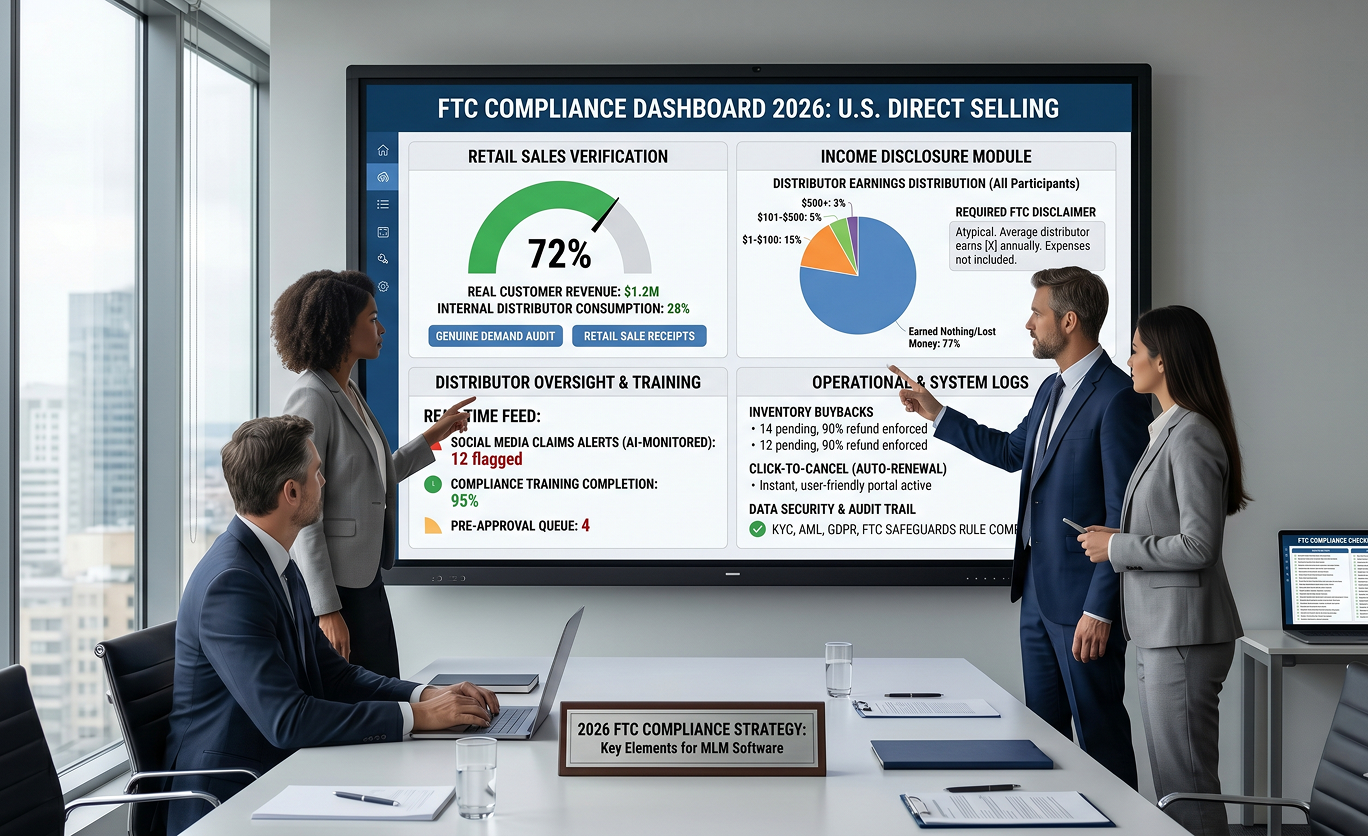

FTC scrutiny of the MLM industry has increased significantly as direct selling businesses expand through social media, influencer marketing, and large distributor networks. Today, the FTC evaluates not only corporate advertising, but also distributor earnings claims, recruitment practices, retail sales activity, and social media behavior.
As a result, modern FTC compliance MLM software has become essential for U.S. direct selling companies. Compliance now requires automated monitoring, system-level controls, audit-ready reporting, and real-time enforcement across the entire distributor network.
In this blog, we’ll cover:
We’ll also explore how modern MLM software platforms help businesses automate compliance and scale more safely.
FTC expectations for MLM companies have evolved dramatically over the past decade.
Regulators no longer accept compliance policies that exist only in distributor handbooks or training documents.
Instead, the FTC increasingly expects companies to actively enforce those policies through operational controls and documented oversight systems.
This is why direct selling compliance software has become a critical infrastructure investment for U.S. MLM businesses.
The FTC’s primary legitimacy test for MLM companies is whether compensation comes from genuine retail sales rather than recruitment activity.
If distributor income depends mainly on sign-ups, qualification purchases, or downline growth instead of customer sales, the structure may be viewed as a pyramid scheme.
Modern FTC compliance MLM software helps companies distinguish between:
The FTC also continues to reference core Amway safeguards, including:
Distributors should regularly sell products to at least 10 different retail customers each month to demonstrate genuine consumer demand.
Distributors should sell or personally use at least 70% of previously purchased inventory before placing new qualifying orders, helping prevent inventory loading.
Companies should offer reasonable buyback policies that allow distributors to return unsold inventory, reducing financial risk and discouraging excessive stock purchases.
Many companies now rely on pyramid scheme prevention software to monitor compensation patterns and reduce recruitment-driven compliance risk.
Earnings claims remain one of the FTC’s biggest enforcement priorities for MLM businesses.
Claims like “financial freedom” or “replace your full-time income” must be supported by documented evidence.
This is why earnings claim compliance software has become essential for modern MLM operations.
Companies often overlook distributor-generated content risk when asking how MLM software helps with FTC compliance.
With the rapid rise of social media marketing and social commerce, distributors now promote products heavily through TikTok, Instagram, Facebook Reels, YouTube Shorts, and livestream selling.
A misleading income claim made by a distributor on these platforms can still create liability for the parent company.
Leading MLM compliance software USA platforms now include social media monitoring, AI-driven content scanning, automated disclaimer insertion, marketing template controls, and compliance escalation workflows to close this gap.
The FTC’s proposed Business Opportunity Rule updates place major emphasis on enrollment transparency and cooling-off periods.
Before enrollment is completed, prospects must receive:
The proposed mandatory 7-day waiting period prevents immediate enrollment after recruitment contact.
This requirement must be enforced technically within the platform and not simply stated in policy documents.
Without system-level enforcement, companies may struggle to prove compliance during FTC investigations or audits.
This is why modern FTC compliance MLM software platforms maintain detailed MLM audit trails.
Modern FTC compliance MLM software must actively enforce regulatory safeguards, monitor distributor activity, maintain audit-ready records, and reduce legal risk across the entire network.
The following MLM features are now essential for compliant U.S. direct selling operations.
Modern automated income disclosure software platforms generate real-time Income Disclosure Statements using live compensation data instead of static PDFs.
A compliant IDS engine should include: Median earnings, Percentage earning $0, Earnings ranges, Participant counts, and Expense estimates.
A compliant IDS engine tracks which version was shown, when it was displayed, and whether acknowledgment occurred.
IDS disclosures should appear automatically before enrollment, near earnings claims, on compensation pages, and inside recruiting funnels.
A compliant MLM platform should enforce the FTC cooling-off period automatically through system-level controls.
Key workflow features include: Prospect registration timestamps, Enrollment lock periods, Disclosure delivery tracking, Consent capture, and Waiting-period countdowns.
These records are critical during regulatory audits and investigations.
Modern retail sales tracking software MLM compliance systems help companies verify legitimate customer demand.
The platform should classify: Retail customer orders, Distributor purchases, Qualification orders, and Recruitment-linked purchases.
Compliance dashboards should monitor customer-to-distributor ratios, retail revenue percentages, self-purchase dependency, and suspicious purchasing behavior.
Commission engines should restrict payout eligibility, require verified retail volume, and flag suspicious qualification activity.
Distributor-generated social media content is now a major FTC enforcement area. Modern social media MLM compliance software should provide:
Leading MLM distributor content compliance monitoring software also supports activity logs, escalation workflows, takedown management, and remediation tracking.
Modern MLM software should monitor: Excessive purchasing behavior, Qualification-driven orders, Bulk inventory accumulation, and Retail mismatch patterns.
Effective inventory management systems include purchase alerts, order caps, inventory risk scoring, and buyback workflows.
These controls help reduce compliance risk tied to inventory loading practices.
A compliant FTC compliance MLM software platform should maintain secure, immutable records for: Customer sales, Compensation calculations, IDS display logs, Enrollment workflows, and Social media compliance records.
Compliance dashboards should monitor retail sales ratios, waiting-period compliance, compensation anomalies, and distributor risk scores.
Advanced direct selling compliance software platforms also help identify recruitment-heavy distributors, repeated policy violations, and suspicious purchasing patterns.
The FTC’s updated Endorsement Guides have expanded compliance obligations around distributor-generated content and influencer marketing.
For MLM companies, even one misleading TikTok or Instagram post can trigger:
This is why social media compliance MLM infrastructure has become essential.
A compliant FTC compliant direct selling platform USA solution should monitor:
Modern compliance workflows now include: AI-driven content scanning, Real-time flagging, Risk scoring, Takedown workflows, and Corrective action tracking.
Leading MLM distributor content compliance monitoring systems also help enforce proper disclosure of: Paid partnerships, Sponsorships, Affiliate incentives, and Material business relationships.
As distributor networks grow, AI-driven moderation is becoming the only scalable way to manage social media compliance effectively.
FTC enforcement against MLM companies is no longer theoretical. Over the past decade, regulators have taken major action against direct selling companies accused of misleading income claims, recruitment-driven compensation structures, and inadequate compliance oversight.
Several high-profile cases highlight the scale of potential exposure:
The FTC often calculates financial penalties based on total revenue impact rather than company profit.
As a result, the consequences of FTC non-compliance MLM investigations can become financially devastating even for profitable organizations.
Beyond financial penalties, companies may also face:
For growing MLM businesses, the risk is highly asymmetric. A modern MLM compliance software USA platform may cost a fraction of what a single FTC investigation, lawsuit, or settlement could demand.
This is why compliance automation is increasingly viewed not as a legal overhead, but as a critical operational safeguard for sustainable direct selling growth.
Protect your business with FTC compliance MLM software built for retail sales verification, earnings claim monitoring, social media compliance, enrollment controls, and audit-ready reporting.
FTC compliance is now a core operational requirement for MLM businesses.
As scrutiny around earnings claims, retail sales, enrollment practices, and distributor social media activity increases, companies need more than manual oversight to stay compliant.
Throughout this blog, we covered the FTC’s key compliance expectations, the essential features of modern FTC compliance MLM software, and the growing importance of social media monitoring, retail verification, audit trails, and automated compliance workflows.
Modern MLM compliance software USA platforms help direct selling companies reduce regulatory risk, maintain audit-ready records, and scale their business more safely and efficiently.
FTC-compliant MLM software is a direct selling platform that automates FTC requirements for U.S. MLM businesses, including income disclosures, retail sales verification, distributor monitoring, enrollment compliance, and audit-ready recordkeeping.
Modern FTC compliance MLM software uses automated controls to block non-compliant enrollments, monitor distributor activity, flag misleading earnings claims, and enforce mandatory disclosures before sign-up.
A compliant IDS should include:
Under proposed FTC Business Opportunity Rule updates, the 7-day cooling-off period is expected to apply broadly to U.S. MLM enrollments.
Companies should prepare by implementing software-enforced waiting-period controls.
The FTC primarily evaluates whether compensation comes from genuine retail sales or recruitment activity.
If income depends mainly on recruiting participants instead of selling products to real customers, the structure may be considered a pyramid scheme.
Advanced MLM distributor content compliance monitoring systems scan distributor posts, videos, captions, and testimonials for non-compliant claims while enforcing required disclosures and maintaining activity logs.
Companies should maintain:
Inventory loading occurs when distributors purchase excessive product mainly to qualify for commissions or ranks rather than meet real customer demand.
Modern MLM software helps detect this through purchase monitoring and inventory risk scoring.
Companies should use pre-approved marketing templates, IDS-linked disclosures, AI-driven monitoring tools, and documented takedown workflows to reduce liability from misleading distributor claims.
FTC penalties can reach millions of dollars through settlements, restructuring requirements, executive bans, and compliance monitoring.
Compared to these risks, investing in MLM compliance software USA infrastructure is significantly more cost-effective.
Product Specialist & Research Head | Leading Strategic Multilevel Marketing Software Initiatives | MLM Technology Expert


 May 15, 2026