
The Direct Selling Industry in 2026: How Software Is Reshaping What a Network Marketing Business Looks Like

The global direct selling market hit $237 billion in 2025 and is projected to cross $407 billion by 2033, a 7.1% compound annual growth rate that shows no signs of slowing.
But here is what that number does not show: most network marketing companies are still running on tools built for a much smaller, slower version of this industry. The market is scaling. The operations behind most companies are not.
Five shifts are driving that gap right now, and each one comes with a direct software implication, highlighting why MLM software is no longer optional but essential for keeping pace with growth.
Before getting into what is changing, it helps to understand the scale of what the direct selling industry looks like today. These are not projections built on optimism. They are market realities that operators are already navigating.The industry is not just large. It is structurally complex, geographically distributed, and growing faster than most of the operational infrastructure supporting it. That is where the five shifts come in.
| Metric | Figure |
|---|---|
| Global market value (2025) | $237 billion |
| Projected market value (2033) | $407 billion |
| Market growth rate (CAGR) | 7.1% |
| Active independent representatives | 104.3 million |
| Largest regional market | Asia Pacific (45.9% share) |
| US market CAGR through 2033 | 6.4% |
| Health and wellness share of sales | 35.3% |
| Social commerce projection by 2030 | $8.5 trillion |
These are not future trends. They are already shaping how companies operate today, clearly separating those built to scale from those struggling to keep up. Each shift is redefining what modern network marketing operations and the MLM platforms behind them need to deliver.
Here are the five shifts driving that change:
The home party still exists, but it is no longer where most distributors recruit. TikTok, Instagram, and WhatsApp have replaced local events as the primary acquisition channels. Social commerce is heading toward $8.5 trillion globally by 2030, and network marketing is moving with it. Gen Z distributors recruit through content and community, not coffee meetings..
The problem is that most MLM platforms were not built for this. They were designed for distributors at desks, not distributors on phones. That gap shows up fast in recruitment drop-off, unattributed conversions, and distributor frustration with basic back-office tasks.
A dedicated MLM mobile app ensures fast load times, key data surfaced immediately, and the ability to onboard a new recruit end-to-end without touching a desktop. Not a shrunken desktop back office, but an experience built natively for the phone.
Recruiting happens across posts, stories, DMs, and storefronts simultaneously. Every distributor needs a unique referral link with attribution that holds regardless of where a prospect first clicks, and commission clarity that follows automatically. Without this, disputes are inevitable and trust erodes quietly.
A branded URL each distributor can share anywhere. It carries the company catalogue, converts prospects at any hour, and ties every purchase back to the right distributor in the commission software without manual intervention. It is the digital equivalent of a business card that also closes sales.
Why this matters now: Over 60% of Gen Z consumers discover products through social media creators. That same behaviour is reshaping how distributors recruit, and MLM companies without the right infrastructure are losing sign-ups they never even know they missed.
When those storefronts are live and recruits start coming in at scale, a different problem surfaces, one that spreadsheets were never equipped to handle.
There are 104.3 million independent representatives active in direct selling globally. Networks today span multiple countries, run hybrid compensation structures, and pay out in multiple currencies on different cycles. The spreadsheet model that worked for 500 distributors breaks down completely at 50,000.
A single calculation error at that scale does not produce one support ticket. It produces hundreds. Payout disputes are consistently among the top reasons distributors leave a company, which means commission accuracy is a retention issue, not just a finance one.
Every qualifying event, whether a sale, a rank advancement, or a volume threshold, should trigger an immediate calculation based on configured plan rules. No manual steps, no reconciliation runs, no errors introduced by human handling. The engine runs, the numbers are right, and the payouts go out on time.
Multi-currency payouts with conversion logic per market, and configurable pay cycles, whether weekly, bi-weekly, or monthly, set independently by region from a single admin view. What works for a high-velocity market in Southeast Asia will not be the right cadence for a slower-moving European market.
Most disputes do not start because the number is wrong. They start because the distributor cannot see how it was calculated. A line-by-line commission breakdown visible to every distributor in their dashboard eliminates that problem before it starts and reduces support volume significantly.
Why this matters now: As compensation structures grow more complex, combining binary, unilevel, and rank-based logic across markets, the risk of manual error compounds. Automation is not a convenience at this scale. It is a business continuity requirement.
Commission complexity grows with network size. But there is a parallel complexity that grows with what the network is actually selling.
Health and wellness leads at 35.3% of global sales, but financial services, utilities, digital products, and SaaS subscriptions are all active MLM categories in 2026. The product mix has diversified, and the commission logic required to support it has diversified with it.
A physical sale is a one-time transaction. A SaaS subscription generates a recurring commission on every renewal. A utility product triggers a commission on activation. These are not minor variations.
They require different trigger logic at the platform level, and software built only for product sales cannot handle this cleanly without creating reconciliation problems and commission errors.
Sale-based, renewal-based, activation-based, and digital access triggers, each configurable per product and per market without custom development every time a new category is added. A supplements company and a telecom reseller should both run their commission logic correctly on the same platform.
Autoship is not just billing. It is a rank qualification mechanism. Lapsed autoship can mean lapsed rank eligibility, and that directly affects a distributor’s earnings. That logic needs to live inside the platform, with automated alerts and retry logic the admin controls without developer involvement.
Physical SKUs, digital products, and service packages managed from a single interface. No separate systems, no reconciliation overhead, no commission errors introduced by switching between platforms. Everything in one place, with consistent logic applied across every product type.
Why this matters now: A direct selling company that adds a SaaS product to its catalogue without updating its commission engine will typically discover the problem at the first renewal cycle, when commissions either do not fire or fire incorrectly. By the time the error is caught and corrected, distributor trust is already damaged and disputes are already open. Getting the trigger logic right before launch costs far less than fixing it after.
Getting products and commissions right creates the foundation for growth. But as that growth happens, what distributors expect from the MLM business they have joined becomes harder to ignore.
The modern distributor measures their back office against every other app on their phone. Most MLM platforms fail that comparison immediately. They were built for administrators, not for the people actually using them daily.
Gen Z distributors will not wait 48 hours for commission data. They will not email a support agent to check their rank progress. They will not chase an approval for a withdrawal they have already earned.
If the platform cannot deliver basic transparency and self-service, they will find one that does, or they will find a different company. Distributor retention has become, in part, a UX problem.
Rank progress, commissions earned this cycle, team volume, and bonus proximity, all live, without waiting for a report or asking anyone. A distributor should open the app and immediately know where they stand. Anything less creates unnecessary friction in a relationship that is already entirely voluntary.
Withdrawal requests initiated by the distributor directly from the app. The admin retains control through configurable approval workflows, but the distributor does not wait for someone else to start the process. Multiple payout options, including bank transfer, e-wallet, and local payment platforms, selectable per request.
Rank advancement confirmations the moment a threshold is crossed. Bonus unlock alerts when a new tier opens. Team milestone updates for key downline activity. Specific, timely, and relevant, not broadcast messages that distributors learn to swipe away. Every notification should feel like useful information, not noise.
Why this matters now: Independent distributors have no contractual obligation to stay. The ease of using the platform, and the transparency it provides, is part of what makes staying worth it. Platforms that treat UX as secondary lose distributors to companies that do not.
A distributor experience that works in one market is table stakes. The harder problem is delivering that same standard of experience across a dozen markets simultaneously, each with its own language, currency, and compliance obligations.
Asia Pacific holds 45.9% of the global direct selling market. The US is growing at 6.4% CAGR through 2033. The Middle East and Southeast Asia are active and accelerating.
What companies consistently underestimate is the compliance surface area that comes with it. GDPR in Europe. FTC disclosure rules in the US. MCA guidelines in India. KYC and AML obligations that vary by country. Tax withholding rules for distributor payouts across markets that operate nothing like each other. None of this can be managed manually at scale, and cross-border compliance failures are among the most common operational risks for expanding direct selling companies.
KYC verification, AML screening, GDPR data handling, and local tax withholding logic built into the platform infrastructure, applied automatically at onboarding, commission calculation, and auto-payout, without manual intervention at every step. Compliance cannot be a checklist someone runs through before a market launch. It has to be structural.
Multi-language support across the distributor interface and admin panel. Local payment rails and country-specific payout methods. Currency display and conversion managed per market. A distributor in Indonesia should have an experience built for Indonesia, not a translated version of something designed for the US market.
Country-specific commission configurations, regional product catalogues, and market-level reporting, all from a single platform instance. The alternative is a collection of separate deployments that multiply admin overhead with every new market entered. That model does not scale, and the cost of maintaining it compounds quickly.
Why this matters now: Compliance failures in new markets do not just create regulatory exposure. They create reputational damage in markets where distributor trust is still being built, and rebuilding that trust takes far longer than getting the infrastructure right from the start.
Each of the five shifts described in this post points to a specific operational gap. Infinite MLM Software was built to close all of them from a single platform, without stitching together separate tools or managing workarounds that break under growth.
Here is how the platform maps directly to each shift:
| Industry Shift | What Infinite MLM Software Delivers |
|---|---|
| Social-first recruiting | Native mobile app, unique referral link tracking, and fully replicated distributor storefronts |
| Commission scale | Real-time automated commission engine supporting binary, unilevel, matrix, and hybrid plans |
| Product diversification | Configurable commission triggers for physical, digital, subscription, and service-based products |
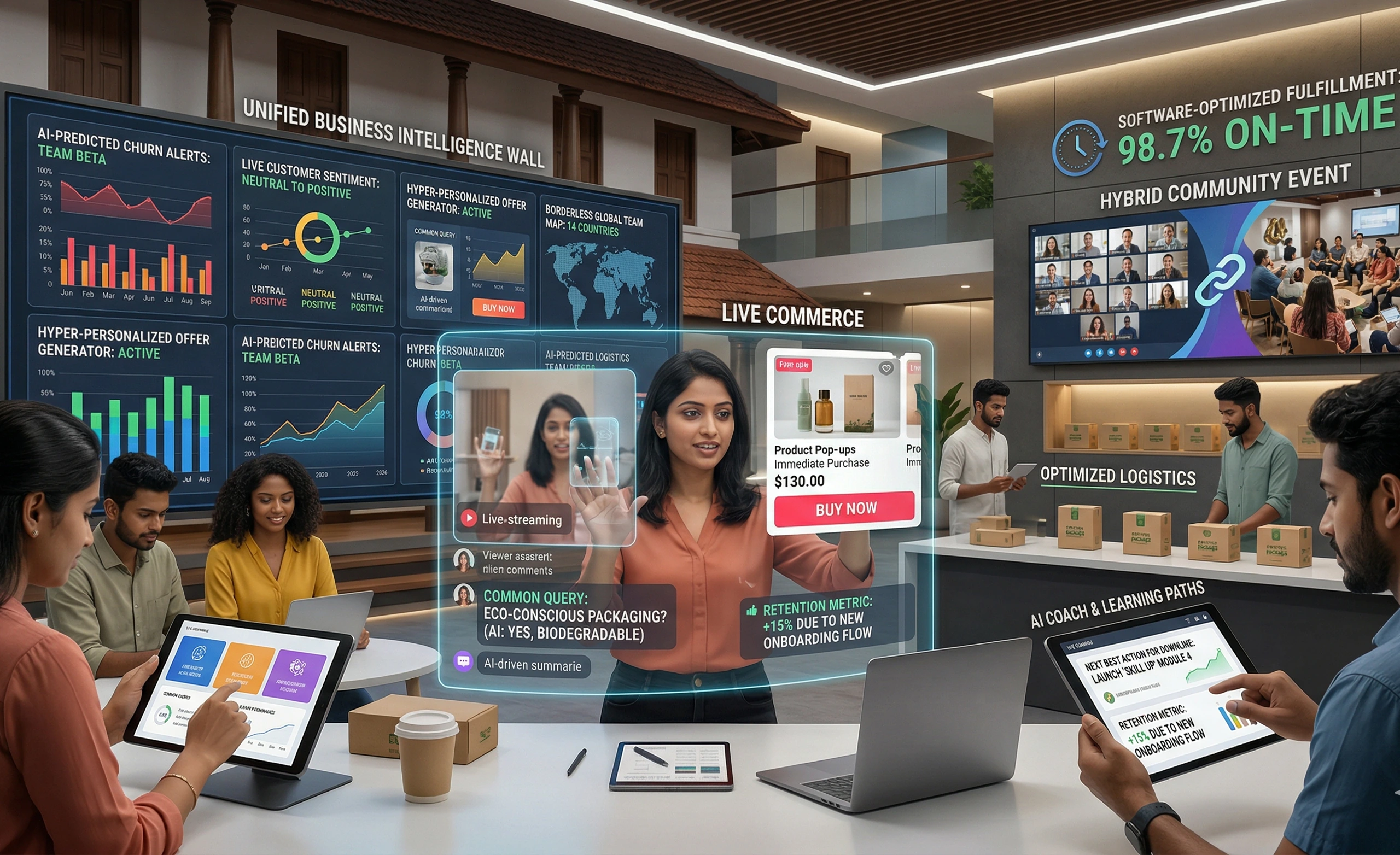
| Distributor experience | Live performance dashboards, self-service withdrawal, and role-based push notifications |
| Global compliance | Built-in KYC, AML, GDPR, multi-currency payouts, multi-language interface, and regional plan configuration |
The platform is not a generic MLM tool adapted for scale. It was designed from the ground up for companies that are already operating at scale, or building toward it, across multiple markets, multiple product types, and multiple compensation structures running simultaneously.
The companies positioned to capture this industry’s growth are the ones that have already solved these operational problems, not the ones patching them as they scale.
Social recruiting, commission automation, product flexibility, distributor experience, and global compliance are the baseline for competing in direct selling in 2026. The infrastructure behind the business has to match the ambition driving it.
You cannot build a $50 million direct selling operation on software designed for a $5 million one.
Most operators discover the gaps in their platform at the worst possible moment: mid-launch, during a rapid growth phase, or after a payout error has already damaged distributor trust. The right time to evaluate is before any of that happens.
If you want to see how Infinite MLM Software handles your specific compensation plan, product structure, and target markets, our team offers a free walkthrough built around your business, not a generic product tour.
Yes, and the numbers support it. The industry is growing at 7.1% annually and is on track to cross $407 billion by 2033. What has changed is how the model operates. Companies that have modernised their recruitment, technology, and distributor experience are growing faster than those still running on legacy processes.
Direct selling is the broader category. It covers any business model where products or services are sold directly to consumers outside of traditional retail. MLM, or multi-level marketing, is a specific type of direct selling where distributors earn income both from personal sales and from the sales activity of the people they recruit into the network.
Distributors earn through a combination of retail profit margins, personal sales commissions, and team-based bonuses tied to the performance of their downline. The exact structure depends on the compensation plan the company runs, whether that is binary, unilevel, matrix, or a hybrid of these. Rank qualifications and volume thresholds configured within that plan determine how earnings scale as a distributor grows their network.
The most cited reasons are delayed or incorrect payouts, lack of transparency around commission calculations, poor platform experience, and feeling unsupported after the initial onboarding period. Most of these are infrastructure problems before they are people problems.
Social commerce has fundamentally changed how distributors recruit and sell. Platforms like TikTok, Instagram, and WhatsApp have become primary acquisition channels, particularly for Gen Z distributors. This means the entire customer journey, from discovery to purchase, can now happen without any in-person interaction, which places entirely new demands on how a direct selling company’s technology is set up.
There is no universal answer. Unilevel plans are simpler to explain and administer, making them a common starting point for newer companies. Binary plans drive recruitment behaviour but require tighter volume balancing. The right structure depends on the product type, target market, and growth strategy. What matters most is that the compensation plan is fully supported by the software running it, because a plan that cannot be automated accurately will create problems at scale.
It varies by platform and complexity. A basic setup covering distributor onboarding, a single compensation plan, and one market can typically be configured in a matter of weeks. Multi-market deployments with hybrid compensation plans, localised compliance requirements, and custom integrations take longer. The key question is not how fast the setup is but how well the platform accommodates change as the business grows.
Automation is already embedded in how leading platforms handle commission calculations, payout processing, compliance checks, and distributor notifications. AI applications are emerging in areas like distributor performance prediction, churn risk identification, and personalised coaching prompts within back-office dashboards. These are not experimental features in 2026. They are becoming part of what distributors expect from a modern platform.
Digital Marketing Analyst at iOSS

Looking for a certified, enterprise-ready platform with advanced features for your MLM business? Infinite MLM Software might just be the thing for you.
Connect with Us