
Board Plan MLM Software: Everything Growing Networks Must Get Right


Board-based compensation models scale fast, but only with the right MLM software in place. As board cycles, re-entries, and payouts grow more complex, Board Plan MLM Software becomes essential for accurate execution and distributor trust.
This guide explains how board plans work, why they fail without automation, and how to choose the right system for scalable growth.
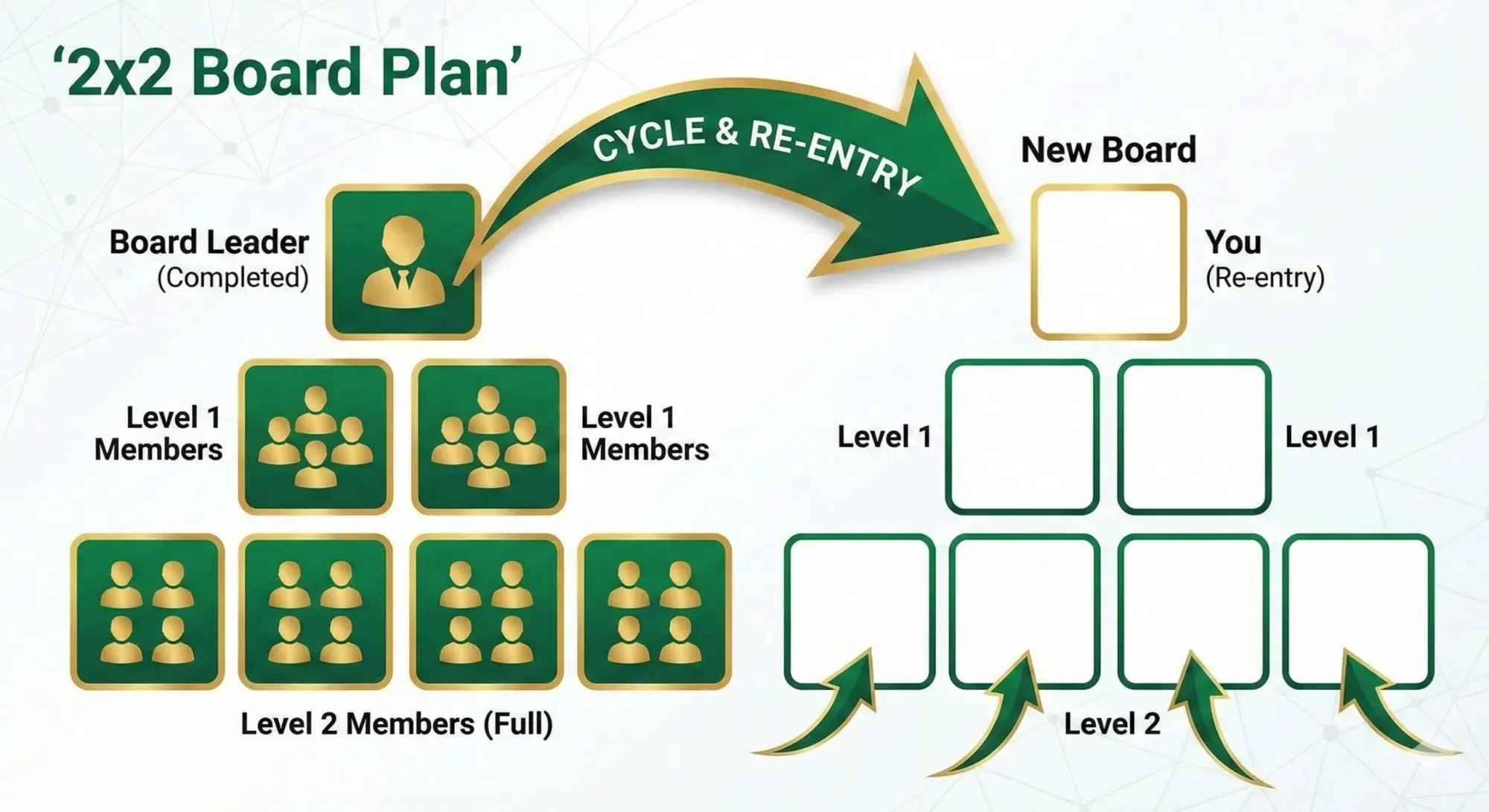
A board plan, also known as a revolving matrix plan, is a compensation structure where distributors are placed into fixed-size boards (typically 2x2 or 3x3 matrices) that fill through new recruitment or spillover. Once a board is completed, it "cycles," triggering payouts and often re-entry into a new board.
Board cycling follows predefined placement rules such as sponsor-based or forced spillover. While the concept is simple, managing cycles, overflow, and re-entries at scale is not. Board Plan MLM Software automates these processes, ensuring accurate placement, timely payouts, and smooth board progression without manual intervention.
Most board plan MLMs don’t fail because the compensation idea is flawed. They fail because the operational system behind the plan cannot keep up with growth.
The pattern is clear: failure is operational, not conceptual. Board Plan MLM Software exists to remove these structural risks entirely.
Not all MLM platforms are built to handle board-based compensation accurately.True Board Plan MLM Software is designed to manage continuous cycling, automated payouts, and scalable operations while supporting broader MLM compensation plans such as Binary, Unilevel, Matrix, or Hybrid-plan models.
The system should automatically create boards as new recruits join, track fill progress in real time, and trigger cycles instantly upon completion. This automation removes admin dependency and supports rapid downline growth.
Business impact: Faster cycles improve engagement, retention, and predictable commissions and bonuses.critical for high-momentum MLM companies.
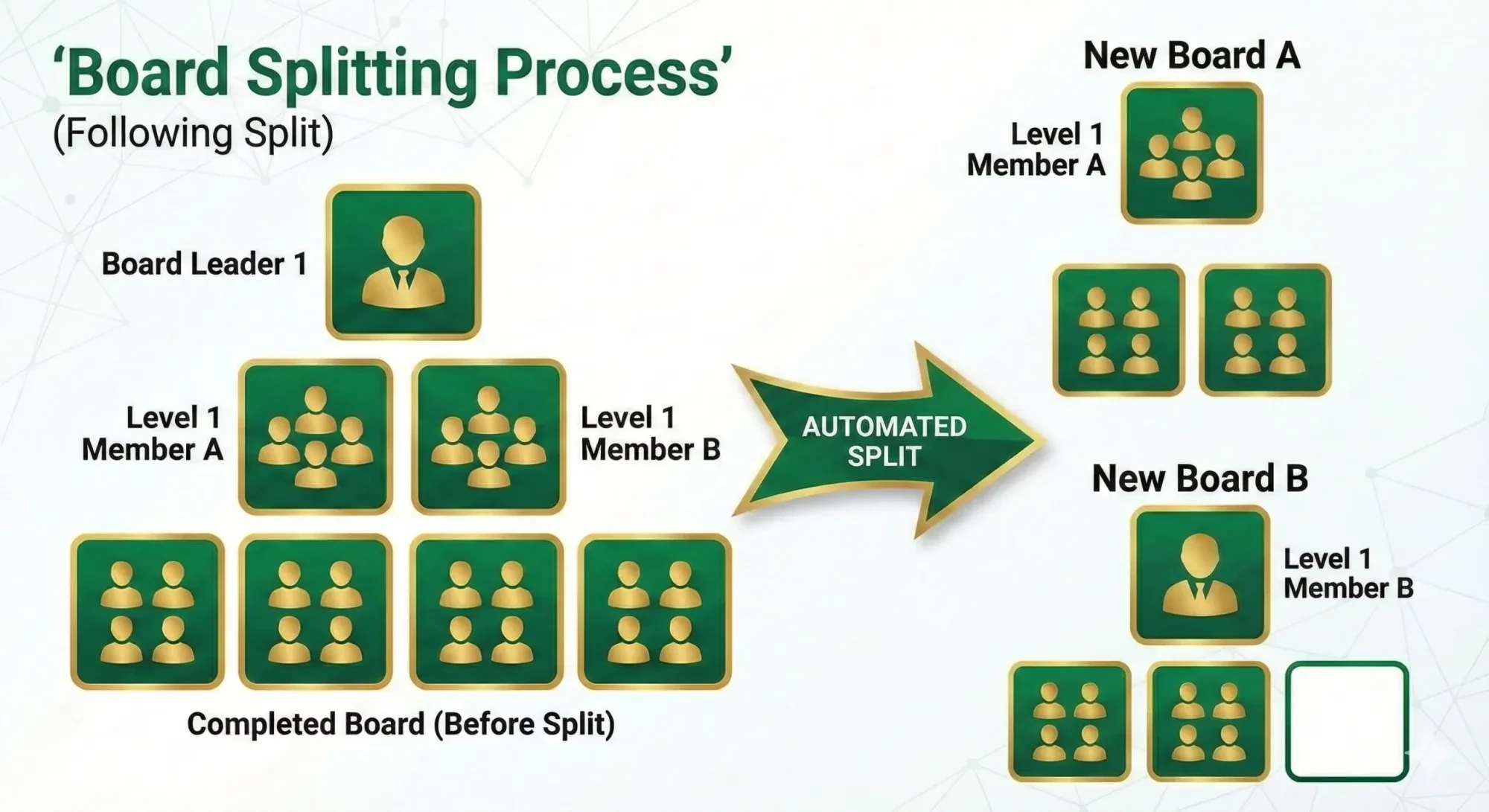
This is the most critical technical feature. The software must handle different splitting rules:
Business Impact: Proper splitting logic prevents "orphaned" distributors and maintains the integrity of the genealogy tree.
Effective board systems must implement the concept of spillover using sponsor-based, forced, or automatic placement rules. Advanced logic ensures fair positioning without disrupting the binary compensation plan or parallel structures like Binary MLM Software.
Business impact: Balanced placement prevents bottlenecks, supports rank progression, and maintains cycle integrity at scale.
Distributors and admins should access live dashboards showing board status, genealogy tree views, and cycle triggers. Transparency enhances customer experience and reduces disputes.
Business impact: Improves trust, motivation, and clarity across multi-level marketing networks.
Auto-payouts eliminate human error and ensure commissions are released the moment a cycle completes. The system must also handle automated re-entry logic, placing the distributor back into the start of the cycle without admin intervention.
Business impact: Strengthens brand credibility and protects the company during periods of global expansion.
Re-entry and auto-upgrade rules must be rule-driven, traceable, and instant. Manual handling is one of the biggest failure points in board models.
Business impact:Preserves momentum, ensures accurate earnings, and reinforces distributor trust.
Modern Board Plan MLM Software should integrate easily with eCommerce platforms like Woocommerce, Magento, Shopify and OpenCart, supported by an advanced system, autoship functionality, and replica websites that improve replicated-websites-impact.
Business impact: Advanced platforms also address data security issues, smooth data migration, API integration, third party integrations, essential for global MLM expansion.
See how real MLM networks cycle boards without admin delays.
Get a Free Live DemoAs MLM businesses grow, board plans rarely operate in isolation. Mature networks often run multiple boards, parallel cycles, and hybrid compensation structures simultaneously. Handling this manually is error-prone, time-consuming, and can erode distributor trust. Advanced Board Plan MLM Software must manage complexity easily while minimizing admin intervention and ensuring accurate payouts.
| Factor | Software-Driven | Manual Management |
|---|---|---|
| Accuracy | High, rule-based | Error-prone |
| Cycle Speed | Instant | Delayed |
| Scalability | Unlimited | Severely limited |
| Admin Workload | Minimal | Heavy |
| Distributor Trust | High | Low |
Manual board management might work for a few dozen members. Beyond that, it becomes a liability. Board Plan MLM Software replaces reactive administration with predictable automation.
Choosing the right system requires more than a feature checklist. Use the following evaluation points to assess whether a provider can support real-world board plan complexity at scale.
Cheap, template-based board systems often hide long-term costs, customization limits, payout errors, and forced migrations.
Custom board logic aligns the system with your business model rather than forcing your compensation plans to fit the software. Over time, this reduces operational risk, improves distributor confidence, and delivers better ROI.
This is where platforms like Infinite MLM Software position themselves in this space, offering affordable pricing while providing adaptable board plan logic built to support growth, accuracy, and long-term sustainability.
Before implementing a board-based compensation structure, it’s important to evaluate whether your operational foundation can support it. Before committing, assess readiness:
If most of these areas align with your current or planned operations, investing in reliable Board Plan MLM Software is not just appropriate, it’s a strategic safeguard for sustainable growth.
Choose platforms that prove live board cycling, not just features on paper.
Get Free DemoBoard plans reward speed, precision, and transparency. Without the right system, even the strongest compensation idea collapses under operational pressure. With the right Board Plan MLM Software, complexity becomes manageable and growth becomes sustainable.
Smaller board sizes tend to cycle faster, which keeps distributors engaged and creates frequent earning moments that drive momentum. Larger boards, on the other hand, offer higher payout potential per cycle but take longer to fill, which can slow motivation if recruitment is inconsistent. The ideal board size depends on expected recruitment velocity, distributor activity levels, and how often payouts are intended to occur.
Yes. Advanced board plan systems support multi-currency payouts by mapping board earnings to region-specific wallets and applying currency conversion rules automatically. This allows global distributors to participate in the same board structure while receiving accurate, compliant payouts based on their local currency, without disrupting board cycles or commission logic.
Re-entry payouts are triggered automatically when a distributor completes a board cycle. The software calculates earnings based on predefined compensation rules, releases the payout, and places the distributor into a new board position as configured. This automation ensures consistent calculations, prevents missed or duplicated entries, and maintains a complete audit trail for every cycle.
Yes, board plan MLM structures are legal when they are tied to genuine product or service sales, transparent compensation rules, and compliant commission tracking. Proper software enforces payout conditions, records transaction histories, and maintains visibility into board activity, helping businesses meet regulatory expectations across regions.
Deployment timelines depend on the complexity of the board structure. Standard board configurations with basic cycling rules can typically be launched within a few weeks. More complex setups, such as hybrid compensation plans, multiple board levels, or country-specific rules, require additional configuration, testing, and validation to ensure accuracy and scalability before going live.
Product Specialist & Research Head

Looking for a certified, enterprise-ready platform with advanced features for your MLM business? Infinite MLM Software might just be the thing for you.
Connect with Us