
SaaS MLM Software vs Licensed MLM Software: A Complete Comparison Guide for Modern Network Marketing Businesses

Your success in the network marketing space is shaped by the MLM software that runs your entire operation behind the scenes.
From onboarding distributors and managing genealogy to commissions, payouts, eCommerce and real-time analytics, your MLM software directly influences how smoothly your business grows. That is why choosing between SaaS MLM software vs licensed MLM software is a critical strategic decision. Although both offer similar core features, the right model determines your level of data control, customization, compliance readiness, global scalability and long-term growth potential.
This practical and easy-to-understand guide walks you through the real-world differences between SaaS MLM software vs licensed MLM software so you can select an MLM software model that not only helps you launch faster, but also protects your business, your distributors and your long-term vision.
Before comparing SaaS MLM software vs licensed MLM software, it is important to clearly understand what each model actually means in the context of MLM systems.
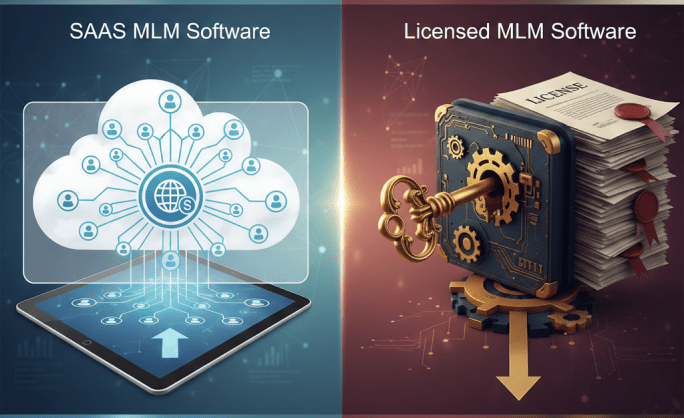
SaaS(Software as a Service) MLM software is a cloud-based MLM platform that is hosted, managed and maintained by the software provider. You access the system through a web browser or mobile app using a subscription.
In this model:
SaaS MLM software is often referred to as cloud-based MLM software and is widely used by startups and fast-growing network marketing companies that want quick deployment and low operational overhead.
Licensed MLM software is a deployment model where you purchase a one-time software license and host the MLM system on your own servers or private cloud environment.
In this model:
Licensed MLM software is often preferred by large enterprises, multi-country operations and companies that require extensive software customization or regulatory control.
At a high level, the main difference between SaaS MLM software vs licensed MLM software lies in ownership, control and responsibility.
| Feature | SaaS MLM Software | Licensed MLM Software |
|---|---|---|
| Deployment | Cloud hosted by vendor | Hosted on your servers / private cloud |
| Ownership | Software owned by vendor | License owned by client |
| Pricing | Subscription-based | One-time license fee |
| Hosting | Vendor managed | Client managed |
| Maintenance | Vendor responsibility | Client or support partner |
| Customization | Limited to modular options | Deep and source-level customization |
| Scalability | Auto-scaling cloud infrastructure | Manual or planned infrastructure scaling |
| Data ownership | Contract-based | Full operational control |
| Implementation speed | Very fast | Slower and project-driven |
Cost is often the first deciding factor when evaluating SaaS MLM software vs licensed MLM software, but long-term impact matters more than the initial price.
SaaS MLM software follows a subscription model, usually billed monthly or annually, with tier-based plans and optional add-on modules. It eliminates upfront infrastructure and internal IT costs and offers predictable operating expenses.
However, in the long-term comparison of SaaS MLM software vs licensed MLM software, subscriptions continue indefinitely, advanced features often require higher plans, and additional usage such as storage, APIs or transactions can increase costs as the network grows.
Licensed MLM software's pricing plan involves a one-time license fee along with infrastructure, customization and integration expenses, and optional annual support.
When assessing SaaS MLM software vs licensed MLM software, licensed platforms provide cost stability because there are no recurring platform subscriptions and no per-user or per-distributor charges.
In real-world scenarios of SaaS MLM software vs licensed MLM software, SaaS is more economical for startups and pilot programs, while licensed MLM software becomes more cost-effective for mature and enterprise networks.
Scalability plays a major role when choosing between SaaS MLM software vs licensed MLM software.
SaaS platforms automatically scale using cloud infrastructure, enabling smooth performance during peak traffic and rapid distributor onboarding. However, in the SaaS MLM software, resource allocation and performance tuning are controlled by the vendor.
Licensed deployments scale through planned infrastructure expansion and optimization. In the context of SaaS MLM software vs licensed MLM software, licensed platforms offer dedicated resources and superior control for large genealogy and high-volume commission processing.
Customization is one of the most visible differences in SaaS MLM software vs licensed MLM software.
SaaS platforms support pre-configured compensation plans, modular features and configurable workflows. Deep logic changes and complex hybrid plans are usually restricted.
Licensed platforms support fully customized compensation engines, regional business rules, custom workflows, advanced integrations and personalized reporting, enabling stronger business differentiation.
Data control is a critical concern when evaluating SaaS MLM software vs licensed MLM software.
SaaS providers deliver encrypted systems, certified cloud environments and managed backups. However, data is hosted in third-party infrastructure and audit flexibility depends on the vendor.
Licensed deployments allow full control over data location, access policies and backup strategies. This supports regional data residency rules, regulatory audits and internal governance.
Licensed MLM software is better suited for compliance-driven and multi-country organizations.
A key factor in SaaS MLM software vs licensed MLM software is who owns and manages the technical operations of the platform.
Updates, security patches and feature releases are handled automatically by the vendor, with minimal internal IT involvement.
Licensed systems require managed upgrades and infrastructure maintenance but allow controlled release cycles and long-term stability for customized modules.
Go-live timelines vary significantly when comparing SaaS MLM software vs licensed MLM software.
SaaS platforms usually go live within days or weeks due to ready infrastructure and standardized onboarding.
Licensed systems require infrastructure setup, security configuration and customization, resulting in longer implementation cycles but a fully custom solution.
Core functionality is similar, but advanced capabilities differ in SaaS MLM software vs licensed MLM software.
SaaS platforms typically include distributor onboarding, genealogy management, commission processing, wallets and payouts, e-commerce integration, dashboards and mobile-friendly portals.
Licensed platforms offer all core features along with advanced compensation engines, multi-brand structures, private APIs, enterprise integrations and localized tax and compliance logic.
System control and performance tuning are major technical differences in SaaS MLM software vs licensed MLM software.
SaaS vendors provide SLAs, cloud redundancy and uptime monitoring, but performance depends on shared infrastructure and vendor incident response.
Licensed deployments provide dedicated infrastructure, database optimization and custom performance tuning for large-scale reporting and commission processing.
Long-term platform dependency is an important strategic consideration in SaaS MLM software vs licensed MLM software.
SaaS models create dependency on vendor pricing, feature roadmaps and platform limitations, and data migration can be complex.
Licensed platforms provide long-term control, hosting flexibility and easier internal system evolution, reducing strategic risk.
Real-world business needs clearly highlight the practical differences in SaaS MLM software vs licensed MLM software.
SaaS is ideal for startups, fast launches, pilot programs, market testing and organizations without internal IT teams.
Licensed software is suitable for large or fast-scaling networks, multi-country operations, complex compensation plans and compliance-focused businesses.
| Category | SaaS MLM Software | Licensed MLM Software |
|---|---|---|
| Advantages |
|
|
| Disadvantages |
|
|
When deciding between SaaS and licensed MLM software, consider:
If your focus is speed, simplicity and low operational overhead, SaaS is an excellent starting point.
If your focus is control, differentiation, enterprise scalability and regulatory readiness, licensed deployment is the stronger foundation.
There is no universal answer to the SaaS vs licensed MLM software debate. The right choice depends on how you envision your network marketing business over the next five to ten years.
A short-term launch strategy favors SaaS.
A long-term platform strategy favors licensed ownership.
Modern MLM companies increasingly begin with SaaS platforms and later migrate to licensed enterprise systems as their operational complexity increases.
Choosing between SaaS MLM software vs licensed MLM software ultimately comes down to your business stage, growth strategy and long-term vision. SaaS MLM software offers a fast, cost-effective and low-maintenance way to launch and operate your network, making it ideal for startups and businesses that prioritize speed and simplicity. Licensed MLM software, on the other hand, delivers deeper customization, stronger data and infrastructure control, better compliance readiness and greater flexibility for complex, multi-country and enterprise-scale operations.
In summary, SaaS MLM software vs licensed MLM software is not a question of which platform is better—but which MLM software model aligns best with your operational needs, regulatory environment and future expansion plans. By carefully evaluating cost structure, scalability, customization, performance control, security and vendor dependency, you can confidently choose an MLM software foundation that supports both immediate success and long-term business sustainability.
Co-founder and Chief Marketing Officer at iOSS

Looking for a certified, enterprise-ready platform with advanced features for your MLM business? Infinite MLM Software might just be the thing for you.
Connect with Us