
Sou Sou Flower Money Scheme - A Complete Guide


Much like tending to a delicate flower, nurturing your financial stability requires care, attention, and the right environment. This is where the sou sou flower money scheme steps in. As the saying goes, "A penny saved is a penny earned," but the Sou-Sou Flower Money Scheme takes it a step further, allowing you to sow the seeds of your dreams alongside like-minded individuals. But here's where modern technology takes this concept to the next level. Excited? Well, incorporating MLM software can amplify the benefits of the sou sou flower money scheme. Just as a flower unfolds its petals to reveal its beauty, we'll uncover the layers of this scheme, while also discovering more about sou sou mlm software and sou sou mlm plan 🌱🤝

A traditional sou sou flower money plan is an informal savings group with a long history in West Africa and the Caribbean. It is otherwise known as susu or or osusu or asue. A sou sou was originally only a savings arrangement amongst a dependable group of family and friends. A sou sou member take turns receiving payments according to an established schedule after contributing a set, equal amount of money to their shared fund on a weekly, biweekly, or monthly basis. As such, incorporating a crucial sales tactic into promoting and growing a sou sou community can significantly boost its popularity and success. For instance: Each week, a participant will get a $1,000 hand or cash lump payment if there are ten members donating $100 each week. After 10 weeks, the cycle starts over. Anyone with the means to do so may also double their donation and receive two hands of payment in one cycle.
This Susu scheme follows two different models named
Both the models follow the same commission plan where the only difference is with the joining gift fee. The joining fee for the SuSu Flower Model A is $500, the payout gift for each month is $4000, and the member positions are represented with elements whereas in SuSu B: Diamond model, the joining fee is $100, the payout gift for each month is $800 and the member positions are represented with colors.
Let us look into the two models and the commission structure to understand both the models.
Here there 4 four elements named:
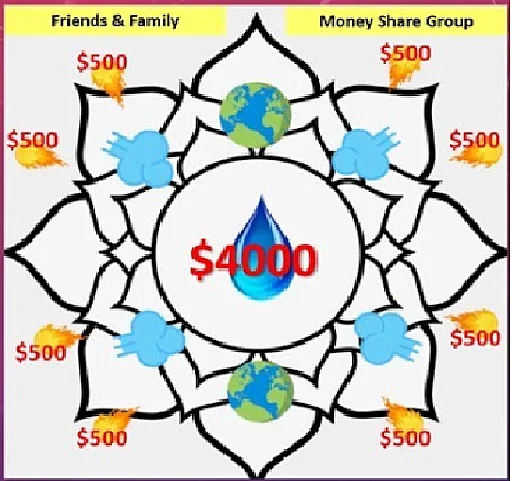
By referring the above mentioned sou-sou flower chart, you can see that, In the sou sou Flower model commission structure, Fire position is the entry position where there will be 8 positions and they need to pay $500 as a gift to the water position. The person who reaches the water position will gain $4000 from 8 fire members of each $500.
The person who reaches the water position would have joined this model 4 weeks before and would have started from a fire position by making two other members join this scheme with their gift money of $500 each. The two members can be either from family or friends circle. These two members, in turn, can ask their friends or family members to join with $500 each.
This continues and the next week the person who joined in the fire position will move to Air position and then the next week the member will be moved to Earth position and then to Water position. When the person reaches a water position in the 4th week, he gains $ 500 from each member at 8 fire positions and gains $4000.
Then the person who gained $4000 will keep $3500 and will again go back to the fire position and donate $500 to the person who reached the water position. This cycle continues until the scheme period. When the member goes back to the fire position from the water position, the person need not pay an additional $500 as a joining fee.
Here the only difference is joining fee i.e $100 and the gift payout i.e $800 and the elements are replaced by colors.
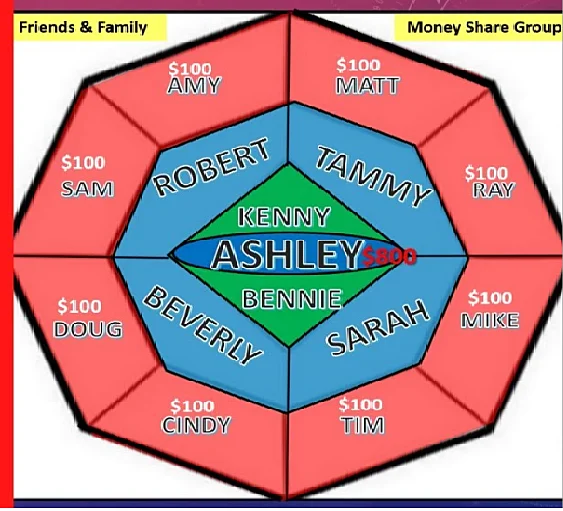
In the Diamond model commission structure, Red is the initial position like Fire position in the flower model and Blue is the final position like Water position in the sousou flower model and the process remains the same.
The Sou Sou Flower plan follows a structured cycle of contributions and payouts. Here is how each stage works in practice:
A new participant enters the scheme at the Fire position by making an initial gift contribution — typically $500 in the Flower Model (SuSu A). This payment goes directly to the member currently at the Water position. The new member must also introduce two new participants to the group to keep the cycle moving.
All members at the Fire level contribute their fixed amount to the shared pool. In a standard Flower Model board, there are 8 Fire positions, each contributing $500, creating a total payout of $4,000 for the Water position holder. Contributions are collected on a fixed schedule — weekly, biweekly, or monthly depending on the group's arrangement.
As new members join at the Fire level, existing members progress inward through the positions: from Fire to Air, then from Air to Earth, and finally from Earth to Water. This progression is tied directly to the recruitment of new members — without new Fire-level participants joining, the rotation stalls.
When a member reaches the Water position and all 8 Fire positions are filled, they receive the full pooled amount — $4,000 in the standard Flower Model. At this point, the board splits into two new boards, and the Water member typically rejoins at the Fire position of a new board, contributing $500 again to continue participating.
The scheme depends entirely on trust and consistent participation. If any member fails to contribute on schedule or if recruitment of new Fire-level members slows down, the payout cycle is disrupted. Participants should only join groups with people they know and trust, as there is no formal legal protection for contributions made in an informal Sou Sou arrangement.
Once the Water member has received their payout and the board has split, the process begins again with two new boards. Each board follows the same structure, allowing more members to progress toward the Water position over time. The total time to reach the Water position varies depending on how quickly new members are recruited.
Many participants choose to rejoin after receiving their payout by re-entering at the Fire position of a new board. Because they have already recouped their initial contribution and received a net gain, the $500 re-entry cost is effectively funded by their previous payout. This allows participants to continue cycling through the scheme across multiple rounds.
Every member contributes regularly, taking turns to receive collected funds. As the cycle progresses, each member benefits from the pooled resources.
This is a rotating fund where members contribute regularly and take turns receiving the pooled money until all have received their share.
Here, participants contribute more initially to receive a larger payout later. This strategy helps members achieve larger financial goals later.
This type allows for variations in contribution amounts or frequency to accommodate participants with different financial capacities or goals.
Thanks to technology, Sou-Sou schemes are now online. Online platforms make it easier for participants to join and manage contributions.
These are pooled funds directed towards business ventures, not personal use. Members take turns receiving funds to support their entrepreneurial ventures.
Geared towards educational expenses, this is designed to help members save for educational pursuits, such as tuition fees or professional courses.
Here, people contribute to a pooled fund that is then donated to a good cause or utilized for neighborhood improvement initiatives.
This sou sou flowermoney scheme lets participants pool their money to save for vacations. Each participant takes a turn contributing to their ideal getaway.
Participants make regular contributions, and they have access to the pooled funds in the event of an emergency.
Members share in the returns after making contributions toward the purchase of real estate or real estate investments.
The purpose of this type of fund is to help members pay for unforeseen medical bills by pooling resources.
This kind of strategy can be used by couples or individuals who are planning to marry to help save money for the big day.
A long-term variant that participants contribute to, ensuring a stable financial future through their retirement savings.
Customers can apply to make use of this scheme via their online portal. They can use either their mobile phones or personal system to access this online portal. In this scheme, customers will be able to engage their family members or friends to invest their money.
SuSu Money scheme prompts you to deposit a specific amount of money within the specified time ( either monthly or weekly or bi-weekly) into their account. It is like a rotating club, where all the customers or the created group of customers deposit a certain amount of money within the specified time or monthly and it builds the total fund required as per the plan. Then periodically the amount will be distributed to any single person from the group. In this way, it allows all the customers to get a chance to earn the total fund each month or as per the timeline.
Look into the important specifications of Sou Sou scheme:
The Sou Sou Flower scheme is often compared to a pyramid scheme because of its recruitment-driven structure — new members join at the Fire level and contribute money that flows upward to the Water position. On the surface, this resembles a classic pyramid arrangement. However, there is a key structural difference: in a traditional Sou Sou, every member is expected to eventually reach the payout position through rotation, not through indefinite recruitment of others.
A pyramid scheme is illegal because it generates returns primarily through recruitment rather than any real product, service, or savings value. In a legitimate Sou Sou, the pool consists of real contributions from real members, and payouts are a return of pooled savings — not manufactured returns from an endless chain of new recruits.
That said, the legitimacy of any Sou Sou arrangement depends heavily on how it is run:
Legally, Sou Sou schemes occupy a grey area in many countries. They are not formally regulated as financial products in most jurisdictions, which means participants have limited legal recourse if contributions are not paid out. In some countries, including the United States, certain forms of gifting circles have been prosecuted as pyramid schemes when they involve cash payments without a tangible product or service exchange.
If you are considering joining or running a Sou Sou Flower plan, it is advisable to participate only within a trusted network, keep group sizes manageable, document all contributions, and consult local financial regulations before proceeding.
Remember, "In the garden of finance, the sou sou flower money scheme is the rarest of blooms." As we conclude this blog, keep in mind the words of Warren Buffett: "Do not save what is left after spending, but spend what is left after saving." With Sou-Sou, you're not just saving; you're sowing the seeds of a prosperous future, one petal at a time. So go ahead, let your financial garden flourish!
Product Specialist & Research Head

Looking for a certified, enterprise-ready platform with advanced features for your MLM business? Infinite MLM Software might just be the thing for you.
Connect with Us