
Multi-Company MLM Management: Running Multiple Direct Selling Brands on One Platform

The second brand always looks manageable at first.
The holding group already has the infrastructure. The compensation engine is configured, the back office is live, and the admin team knows the system. So when Brand B is acquired, the instinct is to replicate: spin up a new instance, assign a fresh admin team, configure payouts again.
Six months later, the structure is breaking down. Two back offices with no unified control. Two payout cycles running independently. Two distributor databases with no shared identity or visibility. Two support queues where the same questions are answered twice by different teams with no shared context. The cost has more than doubled. The operational complexity has tripled.
This is the default for most holding groups running multiple direct selling brands, and it is entirely avoidable.
This post explains exactly what changes when you consolidate multiple brands onto a single MLM software instance: what it solves, what the architecture actually looks like, what admin capabilities matter, and what to verify before choosing a platform.
Running each brand separately works at first, but only up to a point. As soon as a holding group expands beyond one brand, inefficiencies begin to appear. By the time you are managing three, they become part of daily operations.
Each brand needs its own operational setup: admin staff, payout configuration, support workflows, and compliance checks. A three-brand group is not running one system. It is running three parallel systems with separate teams for commissions, separate teams for support tickets, and multiple configurations to maintain. There is no shared resource pool. The same work is repeated across every brand, and the overhead compounds with every acquisition.
Distributors often participate in more than one brand within the same group. When systems are isolated, their identities are split. A top performer in Brand A who joins Brand B appears as a new user. KYC must be submitted again. Support history does not carry over. Performance context is lost. Leadership cannot see the full value of a distributor across brands, and support teams lack the context to serve them properly.
Each month, commission payouts, refunds, and tax records are generated from different systems. Data must be exported and combined manually. Reconciliation is done line by line. As more brands are added, the risk of errors increases with every merge. There is no single source of truth, only assembled reports that require someone to stitch them together before leadership can act on them.
Making changes to a compensation plan requires repeating the same work across every platform instance. Each update must be configured, tested, and validated independently. Missing a step in one brand creates inconsistencies. What should be a single update becomes a coordination task across systems, and the risk of an error that affects payouts grows with every brand added.
At scale, this model does not fail outright. It slows down operations and limits growth.
One system for compensation, distributors and payouts.
“Running multiple brands on one platform” is often misunderstood.
It is not just a shared login. It is not multiple websites using the same backend. And it is not separate systems hosted on the same server.
A true multi-company MLM software is built on three clear layers.
Each brand runs independently within its own environment.
Brand A has its own distributor network, compensation plan, product catalogue and front-end experience. Brand B operates with its own structure and rules. Data stays fully isolated, and distributors only see their own brand.
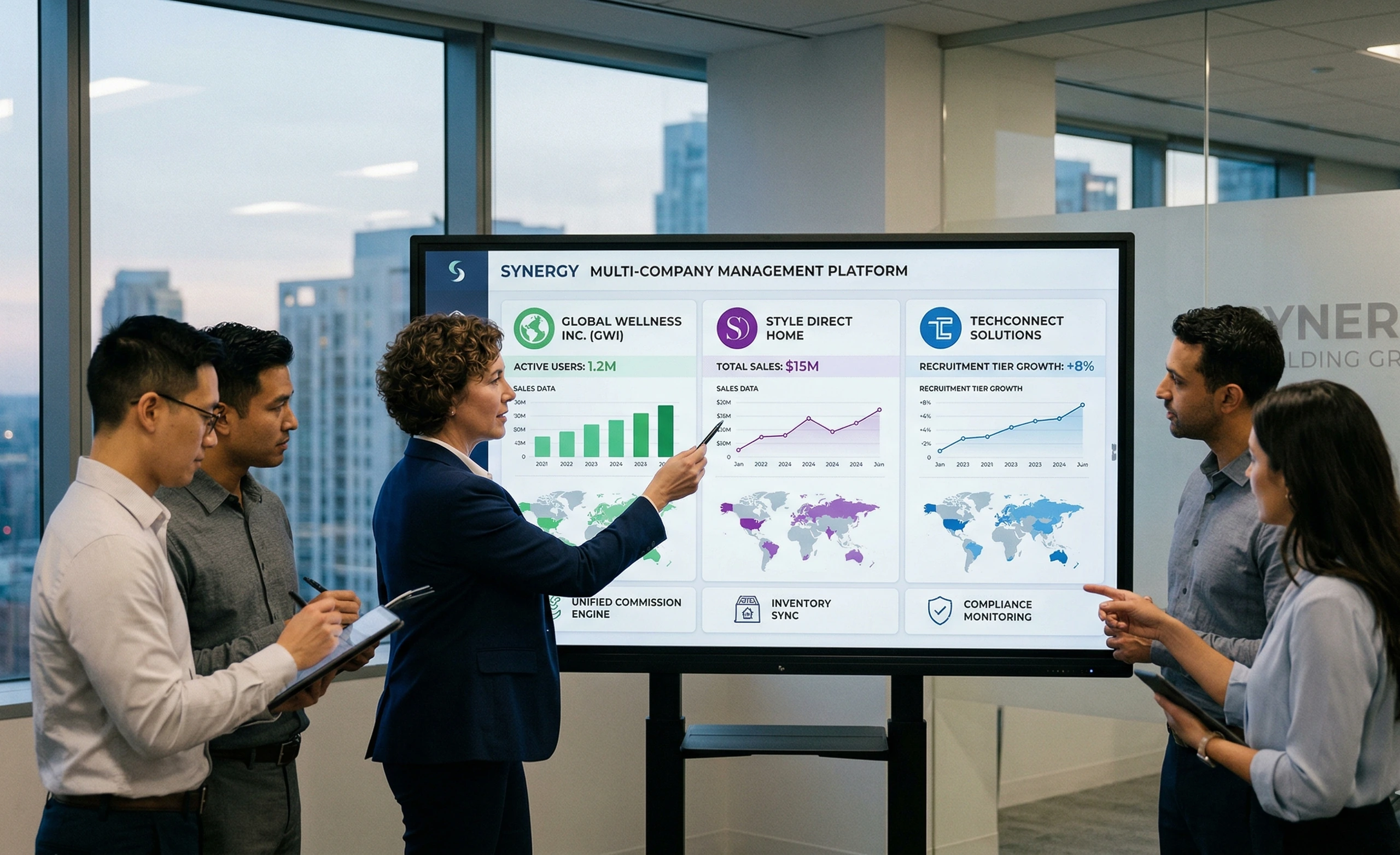
At the same time, the holding group manages everything from one unified admin dashboard. This provides full visibility and control across all brands without switching systems. It follows a multi-tenant approach. Each brand is separate, but all are managed under one roof.
All financial operations run through a single system.
Commissions across brands are processed by one engine. The finance team runs a single consolidated payout cycle instead of handling each brand separately. Tax documentation, withdrawal approvals, and audit logs are all managed in one place.
Reporting is generated from a unified dataset, removing the need for manual reconciliation. The complexity still exists, but the platform handles it centrally.
Shared infrastructure does not limit flexibility.
Each brand has full control over its own compensation plan, rank structure, product rules, and onboarding flow. Different plan types can run side by side without conflict.
The holding group decides what is shared, such as admin access, reporting, and finance, and what remains independent, such as brand identity, distributor experience, and plan logic.
Avoid costly mistakes and make a decision that supports long-term growth. Check out this detailed guide on how to choose the right MLM software to learn more.
A platform may claim multi-brand support, but without the right admin capabilities, it will not perform in real-world operations.
Here are the MLM features and capabilities that actually matter.
A single dashboard should provide real-time visibility across all brands. This includes active distributors, commission volume, withdrawals, and rank progression.
This is not about exported reports or delayed summaries. It is a live interface where leadership can view data and instantly drill down into any brand.
Access must be clearly defined for each role.
Super-admins have full visibility across all brands. Brand managers see only their own brand. Support teams handle tickets assigned to them. Finance teams can access payout data without unnecessary exposure to distributor personal information.
This level of control is essential for both security and operational clarity.
Each brand must have full control over its compensation structure.
Commission logic, rank criteria, caps, and bonuses should be configured independently. A change in one brand must not affect another.
If plan logic is shared or dependent, the platform cannot support true multi-brand operations.
Reporting should provide both a complete and detailed view.
Leadership needs to see total commissions, withdrawals, and distributor activity across all brands. At the same time, they should be able to break this data down by brand within the same report.
Outputs should align directly with accounting workflows, without the need for manual restructuring.
Each distributor should have a single identity across the platform.
KYC verification and authentication are handled once. However, their activity such as earnings, genealogy, and rank remains separate within each brand.
This ensures efficiency without compromising data isolation.
The value of a consolidated platform becomes clear in real operational scenarios.
A holding group operating a health and wellness MLM acquires a beauty brand running on a different system.
Instead of maintaining separate platforms, the beauty brand is migrated into a new environment within the existing system. Distributor data, genealogy structures and historical records are imported.
The new brand operates independently but the holding group now manages both from a single admin panel and runs one payout cycle across both.
A group launches a second brand targeting a different product category.
A new environment is configured within the platform: separate compensation plan, separate onboarding flow, separate distributor network.
Brand A continues unaffected. Brand B launches without infrastructure duplication. Finance processes payouts for both brands in one cycle, with clean separation in reporting.
A top distributor from Brand A joins Brand B as an early member.
Their identity is already verified. No duplicate KYC process. They receive a new account within Brand B’s environment with new genealogy, new earnings, new rank.
From the admin side, both accounts are visible under a single identity. From the distributor’s perspective, the brands remain distinct.
Not every platform that claims multi-company support delivers it in practice. Here are six questions to ask before committing.
Ask whether all brands operate within a single admin panel with live cross-brand reporting. If it requires separate logins, it’s not true consolidation.
Request a live demonstration of configuring different plan structures across two brands simultaneously. Confirm that changes in one do not affect the other.
Verify whether KYC and identity verification can be centralised. Requiring full re-verification per brand creates friction and duplication.
Don’t rely on screenshots. Ask for a live walkthrough of a multi-brand payout report. If it can’t be demonstrated in real time, it likely depends on manual processes.
Clarify how distributor data, genealogy trees, and historical commissions are imported. Poor migration capability forces operational resets.
The answers determine whether the platform scales with your business or against it.
Managing multiple MLM brands on separate platforms may seem workable at first, but it quickly leads to inefficiencies, duplicated effort, and limited visibility as you scale. What begins as a practical approach becomes a constraint on growth.
A true multi-brand MLM software solves this by combining centralized control with brand-level independence. With unified admin access, shared financial infrastructure and isolated brand environments, holding groups can operate efficiently without sacrificing flexibility.
The difference comes down to structure. The right platform removes operational friction, improves visibility and allows teams to focus on growth instead of managing complexity.
For holding groups planning to scale, consolidation is not just an upgrade. It is a necessary step toward sustainable, long-term operations.
Multi-company MLM management refers to the ability to operate and manage multiple direct selling or network marketing brands using a single MLM software platform. Each brand runs independently with its own compensation plan, distributor network, and product setup, while the holding group manages everything from one centralized system.
Running multiple MLM brands on separate platforms leads to duplicated admin work, disconnected distributor data, and manual financial processes. As more brands are added, operational complexity increases, making it harder to manage payouts, reporting, and performance tracking efficiently.
Yes, a properly designed MLM software platform uses a multi-tenant architecture where each brand operates in an isolated environment. This ensures that distributor data, compensation plans, and operations remain separate, while the admin team maintains centralized control.
A unified MLM software improves efficiency by consolidating admin control, automating commission processing, and providing real-time visibility across all brands. It eliminates the need for multiple systems, reduces manual work and enables faster decision-making with accurate data.
No, each brand has its own independent compensation plan. Modern MLM software allows full customization of commission structures, rank criteria, bonuses, and rules per brand, ensuring that changes in one brand do not affect others.
In a multi-brand MLM system, each distributor has a single verified identity for login and KYC purposes. However, their activity, earnings, genealogy, and rank are maintained separately within each brand, ensuring both efficiency and data isolation.
Financial reporting is centralized within a single platform, allowing businesses to view total commissions, withdrawals, and performance across all brands. At the same time, reports can be broken down by individual brands, eliminating the need for manual data merging and reconciliation.
Yes. Most advanced MLM software solutions support smooth data migration, including importing distributor records, genealogy structures, historical commissions, and transaction records into a new brand environment within the unified platform.
Product Specialist & Research Head

Looking for a certified, enterprise-ready platform with advanced features for your MLM business? Infinite MLM Software might just be the thing for you.
Connect with Us