

White-Labeling vs. Custom Builds: Why Your Distributor Dashboard Is Your Most Valuable Retention Tool

In 2026, direct selling success hinges not only on what you sell but on how distributors engage with the opportunity. Distributors invest in growth, income and community, and the central tool shaping that experience is your MLM software.
Too often, companies treat software as a back-office utility rather than a 24/7 digital headquarters. Generic dashboards create confusion, frustration and feature fatigue, driving distributors away because the platform feels unprofessional, slow, or impersonal.
Choosing between white-label MLM software and a custom-built solution is a huge choice that impacts retention, loyalty and lifetime distributor value. This blog explores the advantages, limitations and long-term impact of each approach. Let’s look into it!
The dashboard is the primary workspace for every distributor. It manages their income tracking, onboarding, rank progression, ordering, support and team visibility. Every interaction inside this environment influences engagement, trust, productivity, and retention.
Key impact areas of the dashboard:
Intuitive dashboards with quick-order buttons and personalized tasks keep distributors active daily.
A smooth, branded interface signals professionalism and builds confidence in leadership.
Refined workflows and easy access to commissions and reports let distributors focus on sales, not admin.
Features like one-click ordering, auto-ship, mobile access and gamified progress reduce friction and promote loyalty.
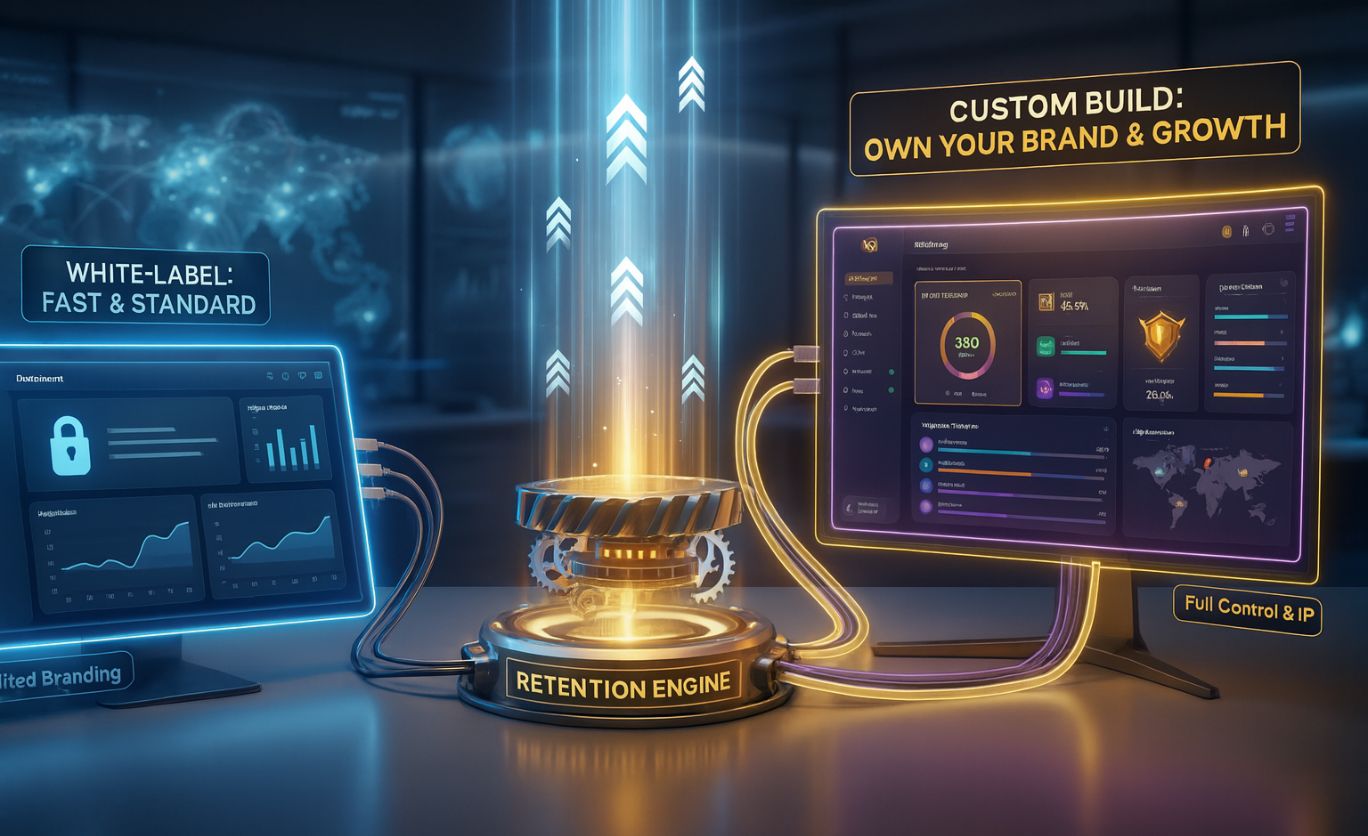
White-label MLM software are pre-built solutions you subscribe to. They come with standard features like commission engines, downline tracking, wallet, product ordering and predictable pricing. Vendors handle infrastructure, hosting, updates and compliance, making this a low-risk path to launch.
Only logos and colors can be customized.
Multiple clients share the same interface, diluting brand identity.
Restricted customization and scalability. Pricing, roadmap, and support are controlled externally (Vendor Dependency).
Distributors may perceive it as “just another MLM tool.”
A custom-built MLM software gives you complete ownership of your technology and brand experience. Every workflow, every click, every element of gamification can be intentionally designed to match how your leadership wants the business to grow.
Your dashboard reflects your unique identity and culture.
Ownership of the code improved company valuation and long-term asset value.
Real-time commission tracking, rank achievement nudges, onboarding journeys, and gamified milestones.
A highly personalized interface becomes part of the distributor experience.
Native apps with push notifications and offline access improve usability and engagement.
Book a demo and let our team show you how a personalized, engaging dashboard keeps distributors motivated, productive and connected.
Your dashboard is the operational heart of your distributor network. A well-designed dashboard keeps actions simple, progress visible and the brand experience strong, resulting in higher loyalty.
Distributors instantly form opinions about a company based on how polished and intuitive their dashboard feels. When the interface is buggy, slow, or visually inconsistent, it sends a message of instability. But when navigation is smooth, features are easy to use, and branding is consistent, the platform reinforces trust.
Momentum is everything in Network Marketing. Even small disruptions like extra clicks or complicated ordering can frustrate distributors. When workflows are simple, commissions update on time, and tools are easy to find, distributors can stay focused on selling and team-building.
Motivation increases when distributors can clearly see how their actions translate into earnings. Real-time dashboards that show rank proximity, team performance, and milestones turn data into encouragement. With many white-label systems, this customization is limited, reducing the motivational impact.
Distributors build their business on the go, so the dashboard must be just as powerful on mobile as it is on desktop. Responsive web versions alone often feel slower. A strong MLM mobile app reinforces professionalism and ensures the platform becomes part of daily behavior.
The dashboard is the number one retention driver because it influences how distributors feel every day while running their business. When the experience is smooth, motivating, and accessible from anywhere, distributors stay active longer, support needs drop, and top performers become deeply committed to the platform. Strong dashboard experiences directly reduce early churn, improve productivity and make the business more resilient as it grows.
Your choice between white-label and custom MLM software directly shapes your brand’s long-term growth. Use this quick comparison to identify which approach best supports your business goals:
| Factor | White-Label | Custom Build |
|---|---|---|
| Budget | < $50k | > $150k |
| Launch timeline | < 2 months | 6–12 months |
| Branding depth | Surface-level | Total control + custom backend |
| Feature flexibility | Limited | Unlimited |
| Retention impact | Moderate | Very high |
| Scalability & IP value | Low | High |
| Best for | Idea validation, Phase-1 startups | Enterprise-grade growth & valuation |
Every business is unique, and so is your ideal dashboard. Explore flexible pricing options for white-label or custom-built MLM software.
Your distributor dashboard is where your network checks their progress, tracks earnings, learns, connects, and plans their future. If that experience feels clunky, slow, or disconnected from your brand, motivation drops.
But when the interface is smooth, personal, and truly supports their goals, it builds confidence and keeps them excited to move forward. Whether you want to launch quickly with a white-label platform or invest in a fully custom build, choose a path that brings your vision to life.
With smart white label app development, you can deliver a polished, branded experience without starting from scratch.
White-label MLM software is a pre-built, vendor-hosted solution that offers standard features and quick launch, while custom-built MLM software gives you full control over UI/UX, brand identity, functionality and backend logic, ideal for long-term growth and retention.
White-label is best for early-stage startups or businesses validating their concept, especially if budget (< $50k) or time-to-market (< 2 months) is top priority, or if the comp plan is standard and minimal customization is needed.
The drawbacks include limited branding and customization, generic look shared with other companies, feature ceilings, vendor dependency and lower potential for building distributor loyalty and retention.
Custom platforms allow personalised user experiences, brand-aligned dashboards, real-time analytics, gamified progress tracking, mobile-first interfaces, and proprietary IP, all of which deepen distributor engagement, trust and long-term loyalty.
When dashboards show real-time rank progress, team performance, bonuses, and milestones, distributors feel more engaged and motivated, turning routine tasks into goal-driven activity and improving long-term retention.
Yes. A native mobile experience ensures faster access, push notifications, offline support, and higher engagement compared to generic responsive web views, making your platform part of their daily routine.
If you’re validating a business idea with limited resources and simple needs, white-label may suffice. If you aim to scale, build a brand, retain top distributors, and differentiate in the long run, a custom or hybrid build is the better strategic choice.