

OpenCart MLM Integration: How to Connect E-Commerce Orders with MLM Commissions

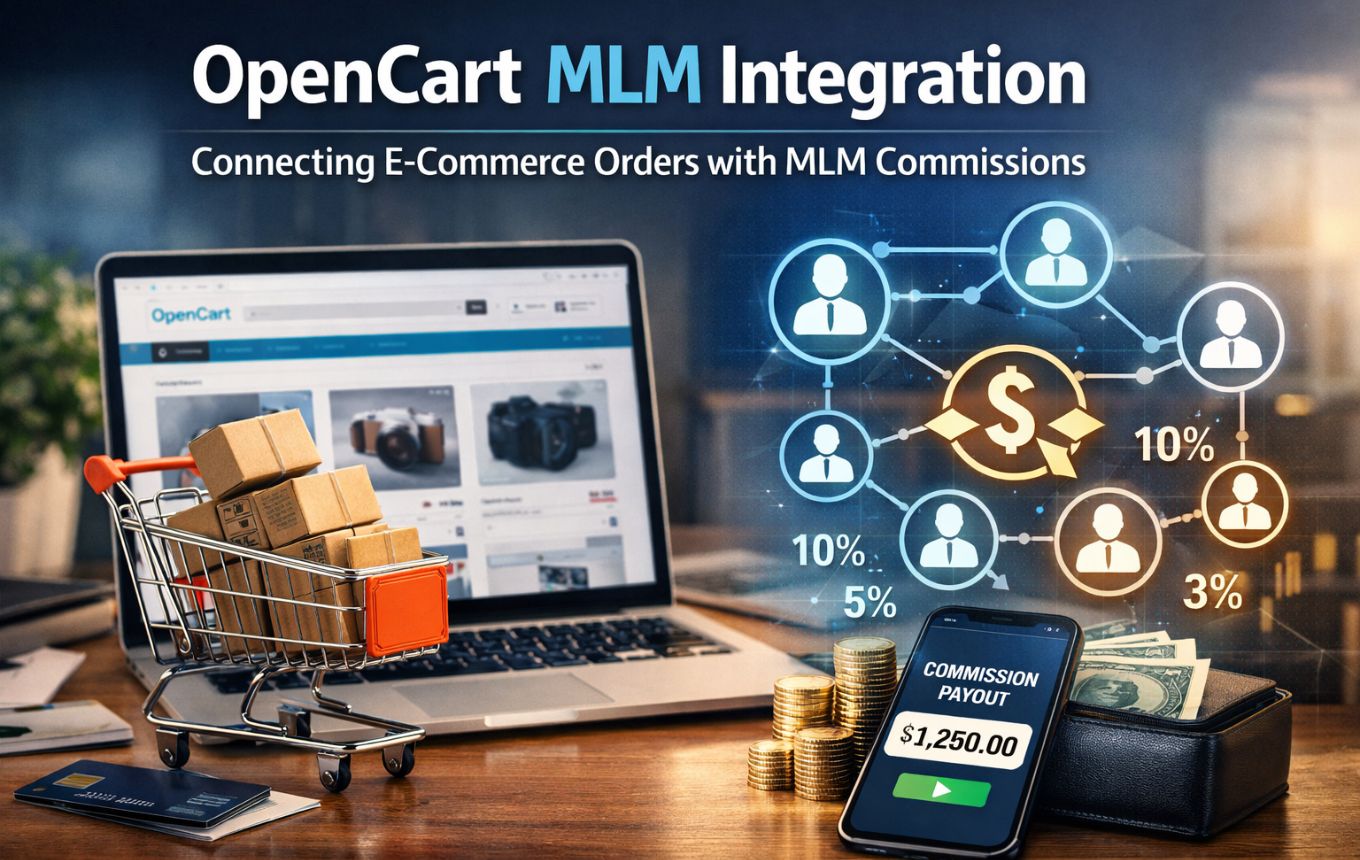
E-commerce has become the backbone of modern direct selling. Today’s MLM businesses no longer rely solely on offline enrollments or manual order processing; instead, they run high-volume product sales through online stores, mobile apps, and global payment gateways. OpenCart, with its lightweight architecture and flexibility, has emerged as a popular choice for MLM companies seeking seamless e-commerce integration within their MLM software ecosystem to manage online sales efficiently.
But there’s a catch. While OpenCart handles products, carts, orders, and payments extremely well, it was never designed to manage multi-level commission logic. Standard affiliate or referral modules can reward a single referrer, but they fall apart the moment you introduce binary legs, matrix spillover, rank qualifications, volume carry-forward, or deep genealogy tracking.
This is where most MLM businesses hit a wall:
The real goal of OpenCart MLM integration is simple but powerful: Every completed product order should instantly trigger accurate commission distribution across multiple levels, without manual intervention. When done right, a single checkout action can:
To achieve this, businesses typically choose between two integration approaches, each with very different implications for cost, performance, and scalability.
Choosing the right integration method is one of the most important technical decisions you’ll make. It determines how well your system performs today and whether it can scale tomorrow. Let’s break down the two dominant approaches used in OpenCart MLM integration.
Native MLM extensions are plugins installed directly inside the OpenCart environment. They extend OpenCart’s core functionality by adding referral tracking, commission rules, and basic genealogy logic.
How it works: The MLM logic lives inside OpenCart itself. When an order is placed, the extension intercepts the order event and calculates commissions based on predefined rules.
Pros:
Cons:
Native extensions work best when the network size is small, commission logic is straightforward, traffic and order volume are moderate, and speed and scalability are not yet critical. For early-stage MLM businesses, this can be a practical starting point, but it’s rarely the long-term solution.
The second and more scalable approach is integrating OpenCart with a dedicated MLM software platform using APIs.
How it works: OpenCart remains responsible for e-commerce operations (products, orders, payments), while the MLM software handles:
When an order reaches a defined status (usually “Complete”), OpenCart sends order data to the MLM system through secure APIs. The MLM engine processes the commission logic and returns confirmation.
Pros:
Cons:
This approach is ideal for:
In practice, most mature MLM companies eventually migrate to an API-based architecture, even if they start with a plugin.
| Business Stage | Recommended Approach |
|---|---|
| Startup / MVP | Native OpenCart Extension |
| Growing Network | API Bridge |
| Enterprise / Global | API Bridge (Mandatory) |
A reliable OpenCart MLM integration is not just about connecting orders to commissions, it’s about ensuring that every operational layer works together without friction. From distributor acquisition to inventory accuracy and user experience, the right feature set determines whether the system supports growth or becomes a bottleneck
.The following features are essential for any serious MLM-driven OpenCart store.
Replicated websites are the primary mechanism through which MLM sales are attributed to distributors. Each distributor receives a unique referral URL that routes customers through the OpenCart store while preserving sponsor identification.
A well-built integration ensures that:
Without persistent referral tracking, commissions can easily be misassigned, leading to disputes and loss of distributor trust. Advanced setups also support SEO-friendly URLs and landing pages, ensuring distributors can promote products without compromising store performance or search rankings.
Inventory mismatches are one of the most common operational issues in MLM e-commerce. Since MLM businesses often sell bundles, starter kits, and promotional packs, inaccurate stock data can quickly lead to overselling and fulfillment failures.
A seamless OpenCart MLM integration must:
This level of synchronization ensures that commission calculations are always based on fulfilled sales, not theoretical ones. It also protects the business from reputational damage during high-volume promotions or distributor-led campaigns.
Distributors operate best when systems feel unified. If users are required to log into OpenCart for shopping and a separate platform for genealogy and earnings, friction increases and engagement drops.
Single Sign-On solves this by allowing:
From a technical perspective, SSO also ensures:
For distributors, this translates into faster access, fewer login issues, and a more professional brand experience.
Modern MLM businesses no longer rely solely on manual enrollment. Many convert retail customers into distributors automatically when predefined conditions are met.
An effective OpenCart MLM integration supports:
This automation removes the need for manual approvals and accelerates network growth. It also ensures that no sales volume is lost during the transition from customer to distributor—every order continues to contribute to commissions and rank progression.
As MLM businesses expand globally, financial complexity increases. Orders may be placed in one currency, commissions calculated in another, and payouts issued locally.
An advanced integration must:
Without proper normalization, discrepancies between order totals and commission values can arise, creating reconciliation issues and compliance risks.
Once the feature requirements are clear, the next step is implementation. A structured setup process ensures accuracy from day one.
Before installation, a complete backup is essential. This includes:
Backing up allows you to:
Skipping this step increases risk during deployment.
For native OpenCart extensions, installation typically involves uploading files and enabling modifications through OCMOD or VQMOD. After installation, caches must be refreshed to apply changes.
For API-based integrations, configuration includes:
This step establishes the communication layer between OpenCart and the MLM commission engine.
Commission logic must be configured carefully to reflect the business model. This includes:
Best practice is to start with a simplified configuration and gradually introduce advanced incentives. This approach reduces calculation errors and simplifies validation during testing.
Each product sold through OpenCart must be mapped to a commission value. This mapping ensures that:
Advanced systems allow mapping by:
This flexibility reduces manual maintenance as catalogs grow.
Not every order should generate commissions. Selecting the correct trigger status is critical.
Most integrations use:
This protects the business from paying commissions on canceled or refunded orders and ensures financial accuracy.
Before going live, comprehensive testing is mandatory. This includes:
Testing verifies that commissions, wallet entries, and rank updates behave exactly as intended, before real money is involved.
Why This Level of Detail Matters? A properly implemented OpenCart MLM integration: Prevents commission disputes, Improves distributor confidence, Reduces operational overhead, and Supports long-term scalability. Most system failures happen not because of weak software, but because critical setup steps are rushed or skipped.
Even with the right architecture and features in place, OpenCart MLM integrations face real-world challenges as transaction volume, distributor networks, and regulatory requirements grow. Understanding these issues early and designing for them, separates stable MLM platforms from fragile ones. Below are the most common challenges encountered during OpenCart MLM integration, along with practical solutions that experienced MLM businesses adopt.
As MLM businesses expand globally, tax compliance becomes increasingly complex. Orders may originate in one country, commissions may be earned in another, and payouts may be issued through local banking systems.
Key challenges include:
How to solve it:
A mature integration separates order taxation from commission taxation. OpenCart handles customer-facing taxes during checkout, while the MLM system:
This separation ensures regulatory compliance without slowing down the checkout process.
One of the biggest technical risks is slowing down OpenCart’s checkout flow due to MLM calculations.
If commission logic runs synchronously during checkout:
How to solve it:
High-performance integrations:
Caching frequently accessed genealogy paths and using optimized data structures ensures the checkout experience remains fast, even during peak traffic.
MLM genealogies grow exponentially. A structure that works for 1,000 distributors may collapse at 50,000.
Common risks:
How to solve it:
Scalable integrations:
This allows the MLM system to process commissions efficiently without overloading OpenCart’s database.
Refunds are inevitable in e-commerce, but in MLM, they introduce financial complexity. Every refunded order potentially affects multiple uplines.
Key risks:
How to solve it:
A reliable integration:
This ensures financial integrity while preserving a transparent audit trail.
APIs can fail. Networks go down. Payloads time out.
When data synchronization fails:
How to solve it:
Production-grade systems implement:
Periodic reconciliation ensures that every eligible order is eventually processed, even if the initial API call fails.
Even minor commission discrepancies can erode distributor confidence.
Common complaints include:
How to solve it:
The MLM system should provide:
Transparency reduces disputes and increases distributor engagement.
MLM platforms are frequent targets for:
How to solve it:
A secure integration includes:
Security must be enforced at both OpenCart and MLM system levels.
Why These Challenges Matter: Most MLM integration failures don’t happen at launch, they happen during growth. Businesses that plan for these challenges: Scale faster, Reduce operational risk, Retain distributors longer, and Maintain financial accuracy. Ignoring them leads to technical debt that’s expensive to fix later.
Integrating OpenCart with an MLM commission system is no longer a technical upgrade, it’s a business-critical decision. As direct selling models increasingly rely on e-commerce, the ability to accurately connect product orders with multi-level commissions determines how efficiently a network can scale. At its core, OpenCart excels at managing products, carts, and payments. What it lacks is the deep commission intelligence required to support modern MLM structures. Successful businesses bridge this gap by pairing OpenCart with the right MLM architecture, one that aligns with their growth stage, operational complexity, and long-term vision.
OpenCart can manage basic referrals but lacks built-in support for multi-level commission logic. Features like binary structures, rank-based payouts, and deep genealogy are not supported natively. This is why external MLM extensions or API-based integrations are required for accurate commission management.
The best approach depends on business scale. Native OpenCart extensions work for small networks with simple plans, while API-based integrations are ideal for growing or enterprise MLM businesses. API bridges offer better performance, flexibility, and long-term scalability.
Commissions should be triggered only after an order reaches a final, non-reversible status such as “Complete” or “Delivered.” This prevents payouts on failed, canceled, or refunded orders and ensures financial accuracy.
Sponsors are typically tracked using replicated URLs, referral IDs, or auto-assigned sponsor links during registration. Once captured, the sponsor relationship is permanently linked to the customer or distributor account to ensure consistent commission attribution.
Yes, but only through advanced MLM software or API-based integration. Native OpenCart extensions usually support limited unilevel structures, while external MLM platforms can handle binary, matrix, hybrid, and custom compensation plans.
When a refund occurs, the MLM system automatically reverses the related commissions through clawback entries. Instead of deleting records, negative wallet entries are created to maintain a transparent audit trail and financial accuracy.
Yes. OpenCart MLM integrations can auto-register customers as distributors when they purchase a starter kit or meet specific criteria. The system assigns a sponsor, activates genealogy placement, and enables commission eligibility instantly.
A well-designed integration will not affect checkout speed. Best practices involve triggering commission calculations asynchronously after order completion, keeping all heavy processing outside the live checkout flow.