
Amway in the US Market: How the World's Largest MLM Company Operates Across 50 States as a Single Sales Region

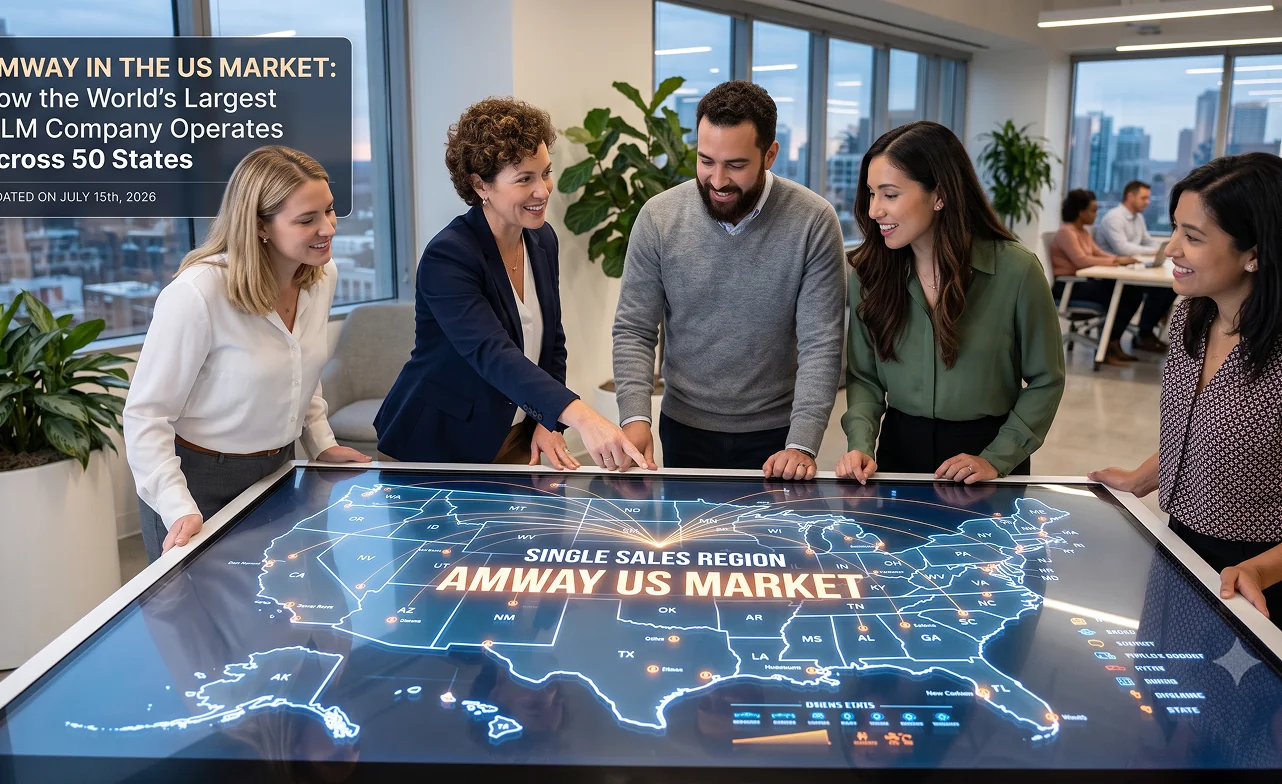
Amway is the world's largest direct selling company and one of the most established names in the MLM industry. While many network marketing companies divide large markets into multiple sales regions, Amway operates the entire United States as a single sales region.
This means Independent Business Owners (IBOs) across all 50 states follow the same compensation plan, pricing structure, product catalog, and business policies.
Managing a distributor network of this scale requires strong operational infrastructure and reliable MLM software to handle commissions, genealogy, sales volume, and payouts accurately across the country.
In this article, we'll examine how Amway's single-region model works, why the company adopted this structure and what it means for current and prospective IBOs.
In multi-level marketing (MLM), a sales region is a defined geographic or administrative area where a company manages its business operations. A sales region typically determines how an MLM company handles:
Many global MLM companies divide large countries or international markets into multiple sales regions because business conditions can vary significantly from one location to another.
Each region may therefore operate with its own pricing, product availability, promotional campaigns, or even slight variations in compensation policies to meet local business needs.
A single sales region takes a different approach. Instead of dividing a market into multiple territories, the company manages the entire market under one unified system
. For Amway USA, this means every Independent Business Owner (IBO) operates under the same business framework. Regardless of where they live, all US IBOs work with:
There are no state-based territories, regional compensation plans, or location-specific business rules that affect how IBOs build their businesses. An IBO can sponsor distributors anywhere in the United States, and their team members are integrated into the same compensation structure without regional restrictions or administrative barriers.
This unified model simplifies business operations, ensures consistency across the country, and allows Amway to manage its US market as one cohesive national sales region rather than a collection of separate territories.
Amway's decision to operate the entire United States as a single sales region is based on both practical and historical factors. A unified structure simplifies operations, creates consistency for Independent Business Owners (IBOs), and allows the company to manage one of its largest markets more efficiently.
Amway was founded in Ada, Michigan, by Jay Van Andel and Rich DeVos in 1959. From the beginning, the company expanded across the United States as a single organization rather than through separate regional subsidiaries or acquisitions.
Because its growth was centrally managed, there was no operational need to divide the country into multiple sales regions. This national foundation continues to support a unified business model today.
Unlike international markets, the United States functions as a largely integrated commercial market. State borders do not create the same operational challenges found between different countries.
Operating across all 50 states allows Amway to benefit from:
These factors enable the company to maintain consistent product pricing, policies, and business operations throughout the country without creating separate regional systems.
A single national compensation plan makes it easier for both Amway and its IBOs to manage business growth.
Since all distributors operate under the same plan, IBOs can sponsor people anywhere in the United States without worrying about:
Regardless of where team members are located, their sales volume flows through the same compensation structure, creating a smooth nationwide network.
Operating as one sales region also simplifies regulatory compliance and business administration.
Instead of maintaining separate operating policies for different regions, Amway applies a consistent interpretation of:
While individual IBOs may still need to meet state-specific requirements such as business registration, licensing, or sales tax obligations, the company's overall compensation plan and operating framework remain consistent across all 50 states.
Amway operates a single national compensation plan for all Independent Business Owners (IBOs) in the United States. Regardless of where an IBO is located, the same qualification criteria, commission structure and bonus system apply. The compensation plan is based on two key metrics:
IBOs earn income through retail profit, performance bonuses, team volume incentives, and leadership bonuses. Since the compensation plan is national, distributors can build teams anywhere in the US, with sales volume and bonus calculations remaining consistent across all states.
Note: Amway periodically updates its compensation plan and qualification requirements. IBOs should refer to Amway's official resources for the latest information.
Managing one nationwide sales region requires significant operational infrastructure. Amway continues to operate from its headquarters in Ada, Michigan, while supporting nationwide distribution through US-based manufacturing and logistics. Between 2012 and 2017, the company reported investing more than $300 million in domestic manufacturing. This centralized production and distribution system enables:
Unlike international markets, the US operation doesn't require separate regional warehouses because it doesn't face currency or import-related barriers. Beyond manufacturing and logistics, managing a single national compensation plan also requires good technology. Tracking Point Value (PV), Business Volume (BV), commission payouts, and IBO genealogy across a nationwide distributor network depends on an MLM software capable of processing high transaction volumes accurately. This type of centralized back-end infrastructure enables companies like Amway to efficiently manage a single-region compensation model while maintaining consistency across all 50 states.
Manage genealogy, commissions, e-commerce, compliance, and distributor operations from a single, scalable platform.
Amway's US operations have long been shaped by regulatory oversight. One of the most significant milestones came when the Federal Trade Commission (FTC) concluded that Amway operated as a legitimate direct selling company rather than an illegal pyramid scheme, provided it followed specific business practices. That decision has remained an important reference point within the direct selling industry. However, like many large MLM companies, Amway has also faced regulatory scrutiny and settlements over distributor practices in different markets over the years.
A single national sales region provides several benefits for Amway Independent Business Owners (IBOs), making it easier to build and manage their businesses across the United States.
All IBOs operate under the same compensation plan, pricing structure, product catalog, and company policies, regardless of their location. This creates a consistent business environment nationwide.
IBOs can recruit, sponsor, and support distributors anywhere in the US without regional restrictions. Team members in different states are integrated into the same compensation structure.
Training programs, business tools, and compensation guidelines remain consistent across the country, making it easier for distributors to learn and grow their businesses.
A unified system eliminates the need to manage different regional policies, qualification requirements, or compensation structures, simplifying business operations for both Amway and its IBOs.
While a single sales region offers many advantages, it also comes with certain challenges.
Since all IBOs operate within one market, distributors compete for customers and recruits across the same nationwide opportunity rather than within separate territories.
With more than six decades of operations in the US, many areas already have well-established Amway distributor networks, making some markets more competitive.
As a mature direct selling market, growth opportunities may vary by location. Prospective IBOs should set realistic expectations and focus on building strong customer relationships and effective teams rather than relying on geographic advantages.
Amway is widely recognized as the world's largest direct selling company by revenue.
Its long history, extensive product portfolio that includes health, beauty, nutrition, and home care and nationwide business model have made it one of the most influential companies in the MLM industry.
Its decision to operate the entire United States as one sales region remains one of the defining characteristics of its business structure.
Amway's decision to operate the entire United States as a single sales region reflects its long-standing national business strategy and the efficiencies of managing one unified market.
By using a single compensation plan, consistent pricing, standardized policies, and centralized operations, the company enables Independent Business Owners (IBOs) to build businesses anywhere in the country without regional restrictions.
This unified approach simplifies team building, compensation management, and business operations while relying on strong logistics and technology to support a nationwide distributor network. Although IBOs compete within a mature market, the consistency offered by a single-region model provides a straightforward and scalable framework for growing an Amway business across all 50 states.
Understanding how this structure works gives current and prospective IBOs a clearer picture of Amway's US operations and the systems that support one of the world's largest direct selling networks.
No. Amway operates the entire United States as a single sales region, using one national compensation plan and consistent policies across all 50 states.
Yes. Because the US functions as one sales region, IBOs can sponsor and build teams with individuals anywhere in the country without regional restrictions.
Outside the US, Amway often uses separate legal entities or region-specific structures to accommodate different currencies, languages, tax systems, and direct selling regulations. The US operates under a single national framework instead.
Yes. Amway has operated throughout the United States for more than six decades and is recognized as a legitimate direct selling company. Individual IBOs should still comply with applicable state and local business registration and tax requirements.
No. Whether an IBO is located in California, Texas, Florida, New York, or any other state, compensation is calculated using the same national plan, provided qualification requirements are met.
Point Value (PV) is used to measure sales activity and determine bonus eligibility, while Business Volume (BV) is used to calculate commissions and performance-based bonuses. Both apply uniformly across the national compensation plan.
Because the US functions as a single integrated commercial market with one currency, one primary business language, and one federal regulatory framework, there's little operational need to divide it the way Amway divides markets with different currencies, languages, or direct selling laws.
Managing PV, BV, commission payouts, and IBO genealogy across a nationwide network depends on MLM software capable of processing high transaction volumes accurately, which allows Amway to maintain consistency across all 50 states.
Since all IBOs operate within one national market, distributors compete for customers and recruits nationwide rather than within separate territories, and many areas already have established distributor networks after decades of Amway's US presence.
Yes. While Amway's compensation plan and policies are unified nationally, individual IBOs may still need to meet state-level requirements such as business registration, licensing, and sales tax collection.
Co-founder and Chief Marketing Officer at iOSS

Are you on the lookout for a cost-effective software solution with advanced features for your MLM business? Infinite MLM software might just be the thing for you.
Connect with Us