
FTC Compliance MLM Software: What U.S. Companies Need

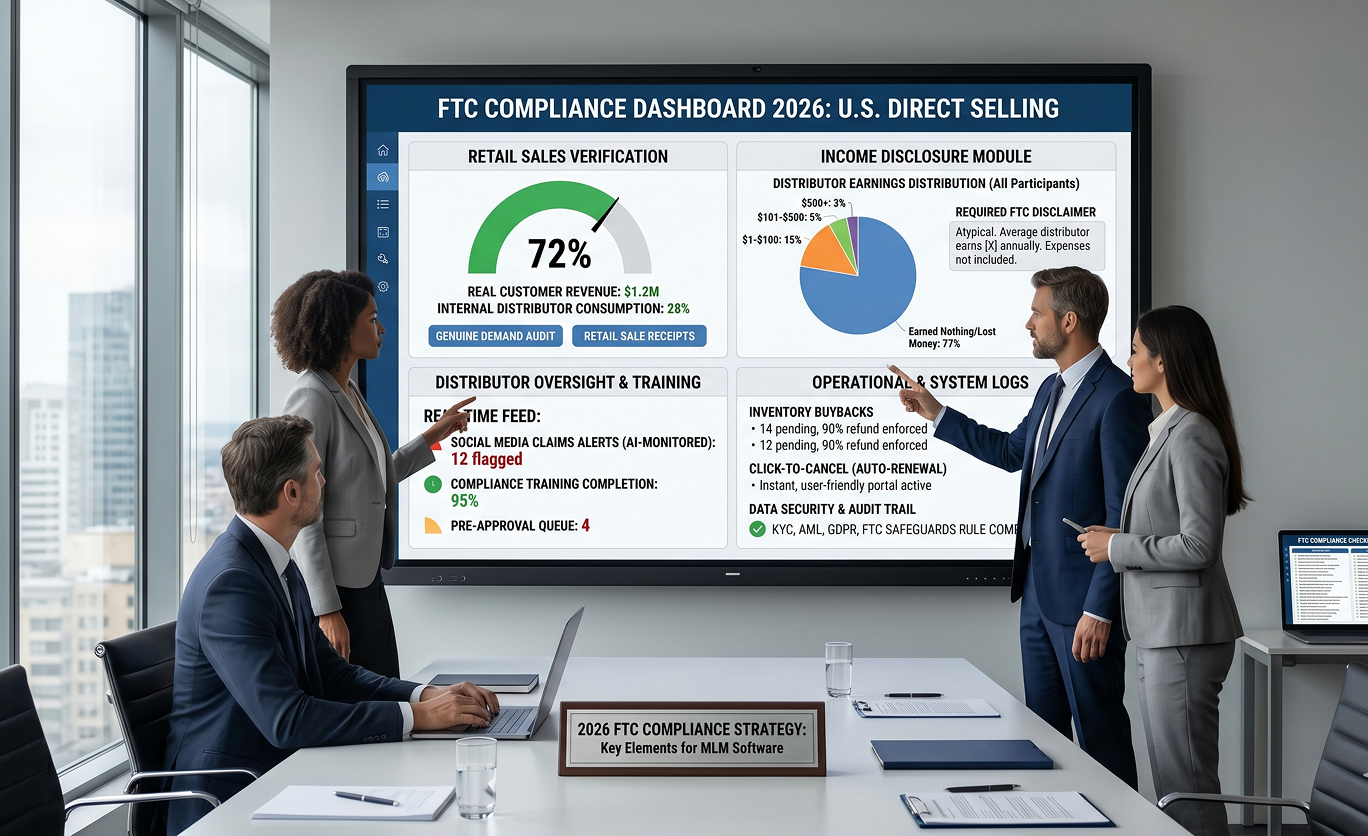
No software makes a direct selling company compliant with FTC rules. The law that applies to you comes from Section 5 of the FTC Act and, for some arrangements, the Business Opportunity Rule. The FTC's MLM earnings-claim rule is still a proposal. MLM software is a way to keep the records and run the reviews your legal team decides you need. This guide keeps those three things apart, then gives you a checklist for the evidence behind earnings claims.
Facts here were checked against FTC sources on October 10, 2026. This is general information, not legal advice. Ask U.S. counsel to review before you change enrollment, compensation or disclosure practices.
| Topic | Status on October 10, 2026 | Classification |
|---|---|---|
| Pyramid-scheme assessment and truthful, substantiated earnings claims | Section 5 of the FTC Act. The FTC's April 2024 staff guidance explains its approach and is expressly non-binding. | Existing law, explained by guidance |
| Seven-day disclosure document, earnings claim statement, three-year records | Business Opportunity Rule (16 CFR Part 437). Applies to an MLM only if its arrangement fits the rule's definition. | Existing rule, case-by-case coverage |
| Earnings Claim Rule Regarding Multi-Level Marketing | Proposed in January 2025. We found no final rule on the check date. The proposal would require substantiation on request and record retention, and would exempt MLM sellers from the Business Opportunity Rule. | Proposal |
| Mandatory earnings disclosure statements, waiting or cooling-off periods | Raised as questions in an advance notice. No proposed rule text. | Proposal stage only |
| Automated monitoring, AI scanning, enrollment lockouts, compliance dashboards | Design choices. We found no source making them a legal requirement. | Software evaluation criteria |
Sources: the FTC's Business Guidance Concerning Multi-Level Marketing, its Earnings Claim Rule rulemaking page, and its Business Opportunity Rule guide. Confirm the rule's status again on the day you act.
FTC staff describe the question as fact-specific: how the compensation structure as a whole works in practice, including marketing messages, participant experience, the plan and the incentives it creates. The guidance says no percentage-based test decides it, that having real products or many retail customers is not a safe harbor, and that a buyback policy is not a defense. Fixed rules of thumb, such as a minimum number of retail customers or a share of inventory sold, therefore do not protect a plan, and a ratio on a dashboard is not proof of compliance. See also our explainer on MLM versus pyramid scheme.
What the guidance does point to is incentives. It names purchase quotas that participants can meet with their own orders, recruits steered into "preferred customer" status before joining, large starter purchases that recruits are told to repeat, upline pay for downline purchases regardless of whether product was used or sold, and purchases made in the names of fake customers. Quota-driven buying of this kind is what the guidance calls inventory loading, and it is why inventory controls matter.
Under Section 5, earnings claims made to current or prospective participants must not be false, misleading or unsubstantiated, wherever they are made. The staff guidance turns that into practical points:
On income disclosure statements, the guidance says an MLM that is not covered by the Business Opportunity Rule is not required to publish one, but anything it does publish must be truthful and not misleading. It says a statement should not omit participants who lost money or earned nothing, should not drop participants because the company labels them "inactive", should not annualize income that was never earned, should say whether figures are net of expenses, and should not report a participant who lost money as earning $0.
The guidance asks about the typical participant and does not prescribe a particular statistic, so record why the measure you choose reflects typical results.
For transactions covered by the Business Opportunity Rule, the seller must give the buyer a one-page disclosure document at least seven days before the buyer signs a contract or pays. If the seller makes an earnings claim, a separate earnings claim statement is also required. FTC staff say an MLM is not exempt from the rule if it otherwise fits the definition, and that coverage is decided case by case.
The January 2025 rulemaking package points the other way for MLMs: it would revise the Business Opportunity Rule to exempt MLM sellers, and would add a separate earnings claim rule for them. Its advance notice asked whether to require a waiting or cooling-off period, but it did not propose one. None of this establishes a universal seven-day enrollment rule for MLMs. Before you configure an enrollment lock, get counsel's view on whether your arrangement is covered and what the current rule text says.
This checklist is an editorial recommendation built from the FTC's guidance and proposals. It is not a prescribed legal test.
| # | Step | What to record |
|---|---|---|
| 1 | List every claim | Include implied claims (images, "replace your income") and claims in recruiting events, social posts, videos, emails and compensation-plan documents. |
| 2 | Keep the exact wording | The text, medium, intended audience, and the dates it was first and last shown. |
| 3 | Define the data behind it | The population, the reporting period and the query or export used. Include participants who earned nothing or lost money. |
| 4 | Net out expenses | Where expense data came from and what it covers. If you cannot support a typical-expense figure, do not make the claim. |
| 5 | Test for typicality | Compare the claim with the typical participant. If it describes an atypical result, pair it with typical revenue and expenses. |
| 6 | Check disclosure placement | Qualifying information that is part of the claim should sit next to it, not behind a link or hover. |
| 7 | Record the review | The reviewer, the date, the decision and the version approved. Record when a claim is retired. |
| 8 | Route participant claims through approval | Submitted copies, and records of takedown requests and what happened. |
| 9 | Set a retention schedule with counsel | The Business Opportunity Rule requires three years of records for covered sellers. The proposed MLM rule also uses three years and asked about five. |
| 10 | Plan for requests | The proposed rule would require providing substantiation to anyone on request, in the language of the claim. That is not yet binding, but you can test whether you could retrieve a claim's file quickly. |
| 11 | Set a review date | Recheck when rule status changes and after any change to the compensation plan. |
Net earnings. The figures below are invented to show the arithmetic, not real data.
| Participant | Commissions | Product orders | Event and tool costs | Net |
|---|---|---|---|---|
| A | $300 | $120 | $60 | $120 |
| B | $0 | $95 | $0 | -$95 |
Commissions alone show A at $300 and B at $0. Net of documented expenses, A is at $120 and B is at a $95 loss. Reporting B as "earned $0" would misstate the result.
For each sale you rely on, keep the order ID, whether the buyer holds a non-participant account created with the company or the sale was only reported by a participant, payment and delivery confirmation, return or refund status, and whether the order counted toward anyone's qualification.
A checkbox saying "this was a retail sale" is weaker evidence than a customer account and a delivered order.
For each earnings claim, a useful log shows the claim ID and exact text, who submitted and who approved or rejected it with timestamps, where each version was shown and when, what changed and why, and any takedown request with its completion date.
Check that the log can be exported for counsel. See also our overview of MLM audit trails.
FTC staff say companies are liable for the violations of their agents, including statements on social media and in small meetings, even where the company tried to prevent them or the agent broke instructions. The guidance says there is no safe harbor for training or monitoring alone. It lists steps a company may take: training, monitoring and discipline, requiring approval before income or product claims, and asking participants for copies of their advertisements and access to groups where they discuss the business. That applies to social media and influencer content as much as live meetings.
Enforcement has reached individual participants as well as companies. In April 2026 the FTC announced a proposed order with Forever Living and two executives, requiring substantiation for earnings claims, and a separate action against a high-level participant in two MLMs, Stormy Wellington. Read the FTC's releases on Forever Living and Wellington for the allegations and terms. For endorsements and testimonials in distributor content, see the FTC's revised Endorsement Guides.
A feature list shows what a platform says it does. Ask for a demonstration with your own sample data:
Treat any answer as a product demonstration, not legal approval.
Bring the checklist above to a demo and test it with your own sample data. Licence pricing is on the pricing page.
We found no FTC program that certifies software. Compliance depends on how your compensation plan works in practice and on what you and your participants say about earnings. Software can help you keep records, review claims and report on orders, but it does not make a business compliant on its own.
Not as a general rule for every MLM. The Business Opportunity Rule requires a disclosure document at least seven days before a buyer signs or pays, but only for transactions that fall within the rule, and MLM coverage is decided case by case. The FTC's January 2025 proposals would exempt MLM sellers from the revised Business Opportunity Rule, and the agency only asked for comment on whether to require a waiting or cooling-off period for MLMs.
FTC staff guidance says an MLM that is not covered by the Business Opportunity Rule is not required to give earnings information to prospects, but any earnings information it does give must be truthful, substantiated and not misleading. If the rule covers the MLM, a specific earnings claim statement is required when earnings claims are made.
According to FTC staff guidance, it should not leave out participants who lost money or earned nothing, should not exclude participants merely because the company calls them inactive, should not annualize income that was not earned, and should make clear whether figures are net of expenses.
FTC staff guidance says companies can be held liable for the violations of their agents, including statements on social media, and that there is no safe harbor for training or monitoring alone. The guidance lists steps such as training, monitoring, discipline and claim approval that a company may take.
FTC staff guidance says the FTC Act does not require MLMs to retain sales receipts, but records of real sales to customers who do not participate in the network are relevant evidence. Direct documentation is more persuasive than participant attestations or checkboxes.
Product Specialist & Research Head

Looking for a certified, enterprise-ready platform with advanced features for your MLM business? Infinite MLM Software might just be the thing for you.
Connect with Us