
Upline and Downline in MLM: The Complete Guide to Network Structure, Commissions, and Growth


Every MLM business is built on relationships, and those relationships are organized through the upline and downline in MLM structure.
Whether you're a distributor looking to understand how commissions are earned or a business owner designing an effective compensation plan, understanding how uplines and downlines function is essential.
The position of every distributor within the MLM genealogy tree influences sales tracking, commission distribution, team development, and long-term business growth.
In this guide, we'll explain what an upline and downline are, how commissions flow through the network, how different compensation plans affect these relationships, the role of spillover, and how modern MLM software simplifies network management.
An upline in MLM refers to the distributor or sponsor who introduced another member into the network. It also includes every distributor positioned above that sponsor within the genealogy tree.
The upline plays a significant role in mentoring new distributors, providing product training, guiding recruitment strategies, and supporting team development.
When a new distributor joins an MLM company, their sponsor automatically becomes their direct upline. Everyone above the sponsor forms the indirect upline, creating a structured hierarchy within the organization.
In this case:
Once assigned during enrollment, this relationship typically remains fixed within the MLM genealogy tree unless the company allows administrative adjustments.
An effective upline does much more than recruit. They help their team achieve sales targets, understand the compensation plan, stay motivated, and build a sustainable business. Their leadership often determines how quickly new distributors become productive members of the organization.
A downline in MLM consists of all distributors recruited beneath an individual. This includes both the people they personally sponsor and everyone recruited by those members at subsequent levels.
There are two primary categories of downlines:
A direct downline includes distributors personally recruited by a member. These individuals form the first level of the network and often contribute directly to personal leadership bonuses or referral commissions.
An indirect downline consists of distributors recruited by the direct downline and continues across multiple organizational levels. Depending on the compensation plan, commissions may be earned from several of these levels.
David's direct downline is Lisa, while Mark and Olivia become part of David's indirect downline.
The overall sales generated by a distributor's entire downline are commonly measured as Group Volume (GV). This differs from Personal Volume (PV), which represents the sales made directly by an individual distributor.
Together, PV and GV determine commission eligibility, rank advancement, bonuses, and incentive qualifications in most MLM compensation plans.
A productive and engaged downline is one of the most valuable assets in any MLM business because long-term growth depends on consistent sales activity rather than recruitment alone.
Understanding how commissions and bonuses move through an MLM network is essential for both distributors and business owners. While every compensation plan follows its own rules, most plans reward both personal sales and team performance through a structured commission system.
At the individual level, distributors earn commissions based on their own product sales, commonly measured using Personal Volume (PV). As their downline grows and generates sales, additional commissions, often called override commissions or team commissions, flow upward through the genealogy structure.
Consider this simple example:
Alex joins the company and recruits Brian.
Brian recruits Chris.
Chris sells products worth 300 PV during the month.
Commission distribution may work like this:
| Distributor | Commission Type | Example Earnings |
|---|---|---|
| Chris | Personal Sales Commission | Earns commission on 300 PV |
| Brian | Direct Override Commission | Receives a percentage of Chris's sales |
| Alex | Leadership Override | Receives a smaller commission based on company rules |
Although Chris generated the sale, both Brian and Alex may receive override commissions because they contributed to building and supporting the network.
Understanding the distinction between PV and GV helps distributors maximize earnings.
| Metric | Meaning |
|---|---|
| Personal Volume (PV) | Sales generated directly by an individual distributor |
| Group Volume (GV) | Combined sales generated by the distributor and their entire downline |
Many MLM compensation plans use PV to determine distributor activity while GV determines leadership bonuses, rank qualifications, and team commissions. As the network expands, software automatically calculates commissions across multiple levels, ensuring accurate payouts without manual calculations.
The relationship between uplines and downlines exists in every MLM compensation plan, but the way commissions are earned, team structures are organized, and network depth is managed varies significantly. Choosing the right compensation plan directly impacts distributor motivation, earning potential, and business scalability. Understanding these differences helps both MLM business owners design effective compensation strategies and distributors better understand how their efforts translate into earnings.
| Compensation Plan | Downline Width | Downline Depth | How Commissions Are Calculated |
|---|---|---|---|
| Binary Plan | Maximum of 2 frontline members | Unlimited depth | Commissions are typically based on the weaker leg's sales volume, with bonuses paid according to balanced team performance. |
| Unilevel Plan | Unlimited frontline recruits | Usually limited to 5–10 commissionable levels | Distributors earn commissions from a fixed number of downline levels while enjoying unlimited direct recruitment. |
| Matrix Plan | Fixed width (e.g., 3 recruits) | Fixed depth (e.g., 3×5 matrix) | Earnings are generated within the predefined matrix structure, making spillover more common. |
| Breakaway (Stairstep) Plan | Unlimited recruitment | Unlimited until breakaway occurs | Once leaders reach specific sales or rank thresholds, they form independent organizations while the original sponsor earns leadership bonuses. |
In a Binary MLM Plan, every distributor can directly recruit only two frontline members—one on the left leg and one on the right leg. As additional members join, they are placed deeper within the two legs. Commissions are generally calculated based on the sales volume of the weaker leg, encouraging distributors to develop both teams rather than focusing on a single side. Since there is no depth limitation, strong leadership and balanced growth become essential for maximizing earnings.
The Unilevel compensation plan allows distributors to recruit an unlimited number of frontline members. While there is no restriction on width, commissions are usually paid only for a specified number of levels, such as five, seven, or ten levels. This structure is simple to understand and ideal for businesses that want straightforward commission calculations while encouraging broad customer and distributor acquisition.
Matrix plans introduce fixed limits on both width and depth. For example, a 3×5 Matrix allows each distributor to recruit three frontline members with commissions paid across five levels. Since each position has limited frontline slots, new distributors are often placed beneath existing members, creating opportunities for spillover. Matrix plans encourage teamwork while maintaining a controlled organizational structure.
Breakaway or Stairstep plans reward leadership development. As distributors reach predefined performance milestones, they "break away" from their sponsor's organization and manage their own independent teams. Although these leaders operate independently, their original upline may continue receiving leadership or generation bonuses based on the compensation plan. This model is commonly used by large direct-selling organizations focused on long-term leadership growth.
Take the complexity out of managing uplines, downlines, and commissions. Explore Infinite MLM Software and discover a more efficient way to scale your network. Start growing your MLM business with Infinite MLM Software today.
One of the most frequently misunderstood concepts in network marketing is spillover. While many distributors expect spillover to generate passive income, understanding how it actually works helps set realistic expectations.
Spillover occurs when a new distributor is placed into another distributor's downline instead of directly under the recruiter. This placement usually happens because of the rules of Binary or Matrix compensation plans, where the number of frontline positions is limited.
For example, imagine John already has two frontline positions filled in a Binary plan. When he recruits another distributor, the company places the new recruit somewhere beneath one of his existing team members. This creates a spillover for that team member.
Spillover can provide several benefits, including:
Despite its advantages, spillover is often misunderstood. Receiving additional team members does not automatically guarantee higher commissions. Earnings still depend on factors such as:
Distributors who rely solely on spillover without actively selling products or building their own teams often struggle to achieve sustainable income. Successful MLM businesses encourage distributors to view spillover as a bonus, not a replacement for personal effort.
A successful MLM organization depends on both uplines and downlines fulfilling their respective responsibilities. While the upline provides guidance and leadership, the downline contributes through consistent sales activity, learning, and business development. Strong collaboration creates higher customer retention, better productivity, and long-term network stability.
| Upline Responsibilities | Downline Responsibilities |
|---|---|
| Recruit and onboard new distributors | Learn company products and compensation plan |
| Provide training and mentorship | Actively sell products and recruit ethically |
| Offer ongoing business guidance | Participate in training sessions |
| Support team motivation and engagement | Maintain required Personal Volume (PV) |
| Share proven sales strategies | Develop leadership skills over time |
| Monitor team performance | Build and support their own downline |
Many disputes in MLM organizations arise because distributors assume responsibilities that were never clearly defined. Establishing structured onboarding processes, documented training programs, and transparent communication helps reduce misunderstandings and improves distributor retention. Modern MLM software further strengthens these relationships by providing real-time visibility into genealogy trees, commission reports, rank progression, and team performance metrics.
Misunderstandings about uplines and downlines often create unrealistic expectations among new distributors. Clarifying these misconceptions helps individuals approach MLM with a more informed and sustainable mindset.
Reality: While uplines provide mentorship, coaching, and support, every distributor is responsible for their own sales performance and business growth. Success ultimately depends on individual effort and consistency.
Reality: Simply having a large number of distributors does not guarantee substantial earnings. An active, engaged downline that consistently generates product sales contributes far more value than a large but inactive organization.
Reality: Spillover can increase network size, but commissions still depend on product sales, qualification requirements, compensation rules, and distributor activity. Personal effort remains essential for long-term success.
Reality: Legitimate MLM companies generate revenue through the sale of genuine products or services. A compliant compensation plan rewards product sales and customer value, whereas illegal pyramid schemes primarily compensate recruitment without meaningful retail sales. Understanding these distinctions enables distributors to build realistic expectations while helping MLM companies operate transparently and ethically.
The strength of an MLM organization depends on more than compensation plans or commission structures, it relies on productive relationships between uplines and downlines. A supportive network encourages distributor retention, improves sales performance, and creates future leaders. While both parties have different responsibilities, mutual trust, communication, and accountability are essential for sustainable growth.
For new distributors, selecting the right sponsor can significantly influence their MLM journey. An experienced and engaged upline provides onboarding assistance, product training, sales guidance, and motivation that help new members become productive more quickly.
Regular communication strengthens team relationships. Hosting webinars, team meetings, product demonstrations, and coaching sessions ensures distributors remain informed about company updates, promotional campaigns, and effective selling strategies.
While spillover can help expand a network, successful distributors understand that consistent personal effort drives long-term success. Building customer relationships, maintaining Personal Volume (PV), and recruiting quality team members create a stronger and more sustainable business than relying solely on network placement.
As MLM organizations grow, manually tracking genealogy structures, commissions, and distributor performance becomes increasingly difficult. Using MLM software ensures every distributor has visibility into their network, commissions,rank progress, and organizational growth, reducing confusion and improving trust across the organization. Strong upline-downline relationships are built through leadership, collaboration, and transparency, not simply organizational hierarchy.
Managing a growing MLM network manually quickly becomes challenging. As distributors expand across multiple levels, calculating commissions, monitoring genealogy structures, tracking promotions, and managing team performance can become time-consuming and prone to errors. This is where modern MLM software becomes indispensable. An advanced MLM software solution automates complex network operations while providing business owners and distributors with complete visibility into their organizations.
A visual genealogy tree allows distributors and administrators to view the complete network hierarchy in real time. Users can easily identify uplines, direct downlines, indirect downlines, placement positions, and organizational depth without navigating complex spreadsheets.
Whether your business operates on any compensation plan, MLM software automatically calculates commissions, bonuses, rank advancements, and overrides based on predefined business rules, ensuring accuracy and eliminating manual calculations. Modern MLM software has calculators such as; Binary MLM Calculator, Matrix MLM Calculator, Unilevel MLM Calculator for respective plans.
Proper distributor placement is critical, especially in Binary and Matrix compensation plans. MLM software automates spillover management according to company-defined placement rules while maintaining a transparent genealogy structure for all distributors.
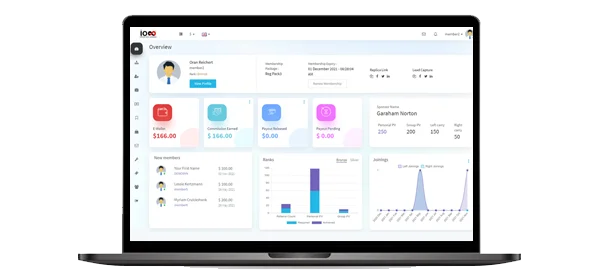
Business owners can monitor distributor activity, sales performance, Group Volume (GV), Personal Volume (PV), retention rates, and leadership development through comprehensive dashboards and reports. These insights help identify high-performing teams while highlighting areas that require additional support.
Many MLM software platforms include built-in messaging systems, notifications, announcements, training modules, and event management tools that improve collaboration between uplines and downlines. Centralized communication helps distributors stay informed and engaged throughout their business journey. As your network grows from hundreds to thousands of distributors, automation becomes essential. A reliable MLM software solution ensures transparency, improves operational efficiency, minimizes administrative workload, and creates a better experience for both business owners and distributors.
Your MLM business deserves more than manual genealogy tracking and complex commission calculations. Infinite MLM Software automates upline-downline management, commission processing, genealogy visualization, and distributor performance tracking, helping you scale your network with confidence.
The upline and downline in MLM structure forms the foundation of every successful network marketing business. It defines how distributors are connected, how mentorship flows through the organization, and how commissions are distributed across multiple levels.
By understanding the roles of uplines and downlines, the differences between compensation plans, the mechanics of spillover, and the importance of Personal Volume (PV) and Group Volume (GV), both distributors and MLM business owners can make better strategic decisions.
As your organization grows, managing complex genealogy structures and commission calculations manually becomes increasingly difficult. Investing in a powerful MLM software solution with automated genealogy management, commission processing, and real-time reporting ensures accuracy, transparency, and long-term scalability for your business.
An upline refers to the sponsor or distributors positioned above a member in the MLM genealogy tree, while a downline includes all distributors recruited beneath them. The upline typically provides guidance and support, whereas the downline contributes to team sales and network growth.
No. Every distributor has one direct upline—the person who sponsored them. However, they may also have several indirect uplines positioned higher in the genealogy structure.
Spillover occurs when new distributors are placed under existing members instead of directly beneath the recruiter. It commonly appears in Binary and Matrix compensation plans due to limited frontline positions.
No. Spillover can increase your team's size, but commissions depend on product sales, Personal Volume (PV), Group Volume (GV), distributor activity, and the company's compensation rules.
It depends on the compensation plan. Binary plans limit direct recruits to two, Matrix plans have fixed width and depth, while Unilevel plans usually allow unlimited frontline recruits.
Most MLM compensation plans reward uplines through override commissions, leadership bonuses, or team performance incentives generated from the sales activity of their downline.
The genealogy tree visually represents the entire distributor network. It helps track sponsorship relationships, placement positions, rank progression, commission eligibility, and organizational growth.
In most MLM businesses, sponsorship relationships remain permanent after enrollment. However, some companies may allow administrative adjustments based on company policies or placement rules.
MLM software automates genealogy management, commission calculations, spillover placement, rank advancement, distributor reporting, and communication, making network management faster and more accurate.
Spillover is most common in Binary MLM and Matrix MLM compensation plans because both structures limit the number of direct frontline positions available to distributors.
Co-founder and Chief Marketing Officer at iOSS

Looking for a certified, enterprise-ready platform with advanced features for your MLM business? Infinite MLM Software might just be the thing for you.
Connect with Us