
MLMs: Scams or Entrepreneurial Opportunities? The Truth Behind Network Marketing


Is MLM a scam or a real business opportunity? It’s one of the most searched and debated questions in network marketing. While some participants build sustainable income streams, many others struggle to make profits, leading to ongoing skepticism around the model.
This blog takes a clear, balanced look at multi-level marketing, breaking down how MLM works, why it’s often confused with pyramid schemes, and what separates legitimate businesses from risky ones. You’ll also explore the role of MLM software, key success factors, and whether MLM is still a viable entrepreneurial path in 2026.
By the end, you’ll have a practical, no-hype understanding of MLM so you can make an informed decision based on facts. Let’s break it down.
Multi-level marketing (MLM), also called network marketing, is a business model where distributors earn income both from personal sales and by recruiting a downline of distributors. Unlike traditional direct selling, MLMs incorporate a recruitment-based compensation layer that can significantly impact earnings.
Many well-known brands, such as Amway, Herbalife, Avon, and Nu Skin, operate using MLM models. While the structure itself is legal in most countries, execution varies widely and directly affects participants’ outcomes.
Members earn from their own sales and the sales generated by their recruited network (downline), creating multi-level income potential.
Legitimate MLMs rely on real product sales to customers, ensuring revenue isn't driven purely by recruitment.
Expanding a network increases earning potential, but over-dependence on recruitment can make the model unsustainable.
MLM compensation plans outline how distributors earn through sales, bonuses, and team performance.
Earnings are influenced by both personal sales and the performance of the network hierarchy.
Vary across models (percentage-based, binary, tiered) and determine how income is calculated and scaled.
MLMs have earned a negative reputation, often being confused with pyramid schemes or criticized for unrealistic earnings claims. Understanding these concerns is crucial for anyone researching network marketing.
Many assume all MLMs are illegal pyramids, though the line is legally defined. The distinction is subtle, but critical: pyramid schemes rely primarily on recruitment for revenue, while legitimate MLMs generate income from actual product sales.
Some distributors exaggerate earnings to recruit more members, creating unrealistic expectations. These inflated claims often lead newcomers to invest significant time and money without understanding the actual earning potential.
The majority of participants earn minimal or negative income. Many join without adequate training, support or realistic projections, which can result in financial losses and dissatisfaction.
Manual processes, outdated reporting methods, and inconsistent communication can make it difficult for distributors to understand their earnings and performance metrics. This opacity fosters distrust and skepticism toward the company.
Without proper systems in place, MLM operations face serious challenges that compound negative perceptions — and drive distributors away before they ever gain traction.
Calculating commissions manually across large networks increases the risk of errors, delayed payouts, and disputes. When a distributor notices a discrepancy in their payout — even a small one — it damages trust immediately and often triggers wider disengagement across the team.
Without real-time analytics, neither management nor distributors can verify sales data or monitor network performance accurately. This creates a vacuum of information that fuels rumors, frustration, and the kind of disillusionment that pushes active distributors to quit.
Inadequate guidance, inconsistent updates, or delayed feedback from uplines or company leadership leave distributors feeling unsupported. In a model that depends on motivation and momentum, poor communication is one of the fastest ways to stall a network's growth.
A critical factor in evaluating MLMs is distinguishing them from illegal pyramid schemes. While both involve multi-level structures, understanding the legal and operational distinctions is essential for potential participants.
Legal when primary income comes from actual product sales to real customers, not just recruitment. Companies must provide transparent compensation plans and follow regulations that protect participants from exploitative practices.
Illegal when income depends primarily on recruitment rather than product sales. Pyramid schemes often pressure participants to buy inventory or pay fees to advance, creating an unsustainable financial structure.
| Feature |
MLM ✦ Legitimate
|
Pyramid Scheme Illegal
|
|---|---|---|
| Revenue Source | Product sales |
Recruitment fees |
| Sustainability | Long-term |
Collapses quickly |
| Legal Status | Legal |
Illegal |
| Participant Risk | Variable but measurable |
High, often catastrophic |
| Business Focus | Real product demand |
Recruitment growth |
Legitimate MLMs generate revenue through real product sales, making them potentially sustainable if there's genuine customer demand.
In contrast, pyramid schemes depend on constant recruitment and collapse when new members stop joining.
Warning signs: High upfront inventory requirements, rewards focused on recruitment, and lack of real customers.
Evaluating legitimacy goes beyond legal definitions. Certain characteristics signal a trustworthy MLM and help participants make informed decisions.
A legitimate MLM provides a clear, well-structured compensation plan that outlines exactly how distributors earn income. This includes direct sales commissions, bonuses for team performance, and any other incentives.
Legitimate MLMs focus on offering high-quality goods or services that consumers want to buy. This reduces reliance on recruitment and ensures that earnings come from actual retail sales rather than merely adding new distributors.
Operations must be open and accessible to build trust. This includes timely and accurate reporting of sales, commissions, and bonuses. Companies that provide dashboards, regular updates, and responsive support foster a professional and credible environment.
Adherence to FTC guidelines, local laws, and industry regulations is a hallmark of a legitimate MLM. Compliance demonstrates that the company prioritizes ethical practices, protects distributors from exploitative schemes, and reduces legal risk.
In practice, meeting these standards consistently requires more than good intentions — it requires structured systems. This is where MLM software makes a measurable difference, turning transparency from a stated value into a verifiable, real-time reality for every distributor in the network.
Technology has fundamentally changed how MLM companies manage commissions, track networks, and maintain distributor trust.
This section highlights how software solutions address challenges that have traditionally held the industry back and create real opportunities for sustainable growth.
Relying on spreadsheets or manual calculations increases the risk of mistakes, missed commissions, and disputes.
Without payout automation, processing commissions for large distributor networks is slow, reducing satisfaction and trust.
Inconsistent reporting and limited visibility into downline activity make it difficult to resolve conflicts and ensure fairness.
MLM software instantly calculates commissions, bonuses, and overrides, ensuring accuracy and reducing administrative burden.
Detailed visualizations of upline and downline structures make it easy to manage networks and understand team performance.
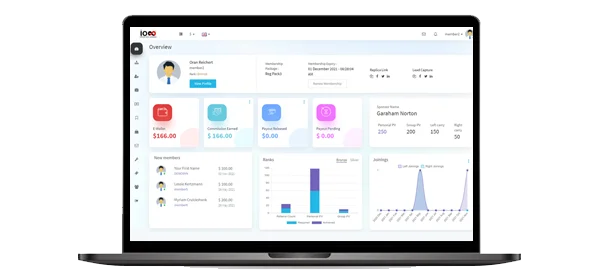
Personalized dashboards provide real-time insights into earnings, sales, and team activity, empowering distributors to make informed decisions.
Data-driven insights allow companies to optimize strategies, reward high performers, and identify potential issues before they escalate.
Modern MLM software often integrates with e-commerce platforms, payment gateways, and communication tools, simplifying operations and improving distributor experience.
Participants can see their earnings, rank progress, and team performance in real time, reducing skepticism and fostering confidence.
Automated systems minimize human error and ensure fair, consistent payouts.
Software supports growing networks efficiently, enabling companies to expand operations without sacrificing operational integrity.
Many solutions include features that ensure adherence to regulations and maintain audit-ready records, reinforcing legitimacy and trust.
By utilizing technology, MLM companies can turn traditional challenges into opportunities for efficiency, transparency, and sustainable growth.
Use structured systems that support transparency, reporting and regulatory alignment.
MLM opportunities continue to exist in 2026, but success depends heavily on realistic expectations, structured execution, and utilizing modern tools and strategies.
Individuals can start a business without investing in product development, manufacturing or complex logistics. This makes MLM accessible for those with limited capital.
MLM businesses can grow exponentially through network duplication. Distributors who build strong teams can increase earnings without proportional increases in personal effort.
Technology enables distributors to reach international markets, expanding their customer base beyond local limitations. Social media, e-commerce, and digital marketing further amplify reach and growth potential.
Participants often acquire valuable skills in sales, marketing, communication, and leadership, which are transferable to other entrepreneurial ventures.
MLM allows individuals to work part-time or full-time according to their lifestyle and goals, making it an attractive option for parents, students, or those seeking supplemental income.
With many distributors in the same market, standing out requires effective branding, marketing and relationship-building skills.
Public perception of MLMs as scams can impact recruitment and customer trust, making credibility and transparency essential.
Passive income is possible but not guaranteed; consistent effort, structured planning, and leveraging technology are key to success.
Without MLM software or structured operations, managing commissions, tracking downlines and ensuring transparency can become overwhelming.
Those who want a low-cost entry into business ownership with real scalability potential. MLM suits entrepreneurs who are comfortable with self-directed work and building income progressively rather than expecting immediate returns.
Individuals comfortable with sales, building relationships, and mentoring teams. If you enjoy connecting with people and can sustain consistent outreach, the MLM model rewards those skills directly.
People adept at using social media, e-commerce, and digital marketing to reach broader audiences. An established online presence removes one of the biggest barriers to MLM growth — finding and retaining customers at scale.
By understanding both the opportunities and challenges, aspiring MLM participants can approach the industry strategically and maximize their chances of long-term success.
MLM offers flexibility and scalability, but success depends on effort, strategy and the right systems.
MLM is neither inherently a scam nor a guaranteed path to success. It sits somewhere in between, depending on how the business is structured and operated.
Legitimate MLMs focus on real product sales, transparent compensation plans, and compliance with regulations, making them potentially sustainable.
The key takeaway is that success in MLM depends on realistic expectations, ethical practices, and the right systems in place. Businesses that prioritize transparency, use technology for accurate tracking and payouts, and focus on genuine customer value are far more likely to lead you to success.
Yes, MLMs are legal in most countries as long as they primarily generate revenue through the sale of real products or services to end consumers. They must also follow regulatory guidelines, maintain transparency in their compensation plans, and avoid practices that overly incentivize recruitment over sales.
Profitability in network marketing varies significantly. Income disclosure statements from major MLM companies consistently show that the large majority of distributors earn modest returns or none at all — in many cases under $1,000 per year.
A small percentage do earn substantial income, but this typically reflects years of consistent effort, strong team-building, and operating within a well-structured company. Success depends on the company's model, genuine product demand, individual effort, and the ability to build and retain a productive customer base.
MLM companies earn revenue mainly through product sales to customers and distributors. Additional income may come from distributor enrollment fees, training programs, or events. In legitimate MLMs, product sales should be the primary source of revenue.
The main difference between MLM and a pyramid scheme lies in how income is generated. MLMs focus on selling products and reward distributors based on sales performance, making them legal. Pyramid schemes rely primarily on recruiting new members and collecting fees, with little or no real product value, making them illegal and unsustainable.
Yes, starting an MLM business is possible, but it requires careful planning. You need a strong product with real market demand, a transparent compensation plan, legal compliance, and reliable technology to manage commissions, distributor networks, and reporting effectively.
You can identify potential scams by looking for warning signs such as a heavy emphasis on recruitment, lack of genuine product demand, unclear or overly complex compensation plans, and high upfront costs. A legitimate MLM will be transparent about earnings and focus on customer sales.
Recruitment can enhance earning potential, but it should not be the sole focus. Sustainable success in MLM comes from consistently selling products and building a loyal customer base. A balanced approach between sales and team building is essential.
Many people fail due to unrealistic expectations, insufficient training, lack of consistent effort, or poor understanding of the business model. Choosing a company with weak products or unclear systems can also contribute to low success rates.
Product Specialist & Research Head

Looking for a certified, enterprise-ready platform with advanced features for your MLM business? Infinite MLM Software might just be the thing for you.
Connect with Us