
What Is a Crowdfunding MLM Plan: How It Works, Plan Types & Key Considerations


As network marketing evolves, businesses are exploring compensation models beyond traditional product-driven systems.
A crowdfunding MLM plan combines community funding with network-building principles, allowing participants to earn through contributions, referrals, and structured payout mechanisms.
Supported by modern MLM software, these plans can automate matrix tracking, cycle management, and commission calculations.
This guide explains how crowdfunding MLM plans work, the different plan structures available, income opportunities, compliance considerations, and the software features required to manage them effectively.
A crowdfunding MLM plan is a compensation structure where participants contribute funds to join a network and become eligible for rewards based on recruitment activity, level participation, matrix completions, or cycle progression. Instead of focusing primarily on product sales, earnings are generated through contribution-based network growth.
Traditional MLM plans depend heavily on product or service sales. Commissions are typically linked to retail volume, customer purchases, and distributor performance. Crowdfunding MLM plans, on the other hand, focus on contribution flows and network participation.
Platforms like Kickstarter or Indiegogo facilitate one-time fundraising campaigns. Contributors support a project but do not participate in a multi-level compensation structure. Crowdfunding software includes recruitment and network-based reward systems.
Donation plans usually involve direct transfers between individuals without structured compensation layers. Crowdfunding MLM plans use defined matrices, levels, or cycles that determine how contributions move through the network.
Several factors contribute to the growing adoption of crowdfunding MLM plans:
Most crowdfunding MLM plans follow a structured process that determines how contributions are collected and distributed throughout the network.
A participant joins the platform by making an entry contribution. Depending on the compensation design, this contribution may be directed to a sponsor, distributed across network levels, allocated to a matrix structure, or placed into a central system pool.
Many crowdfunding MLM plans require members to recruit two or more direct referrals before qualifying for certain commissions or bonuses. This requirement helps expand the network and populate matrix positions.
As new members join, contributions move through predefined levels, stages, or matrix positions. These contribution flows trigger various commission and bonus opportunities for qualified participants.
When a matrix reaches its capacity or a cycle stage is completed, the participant becomes eligible for a predefined payout.
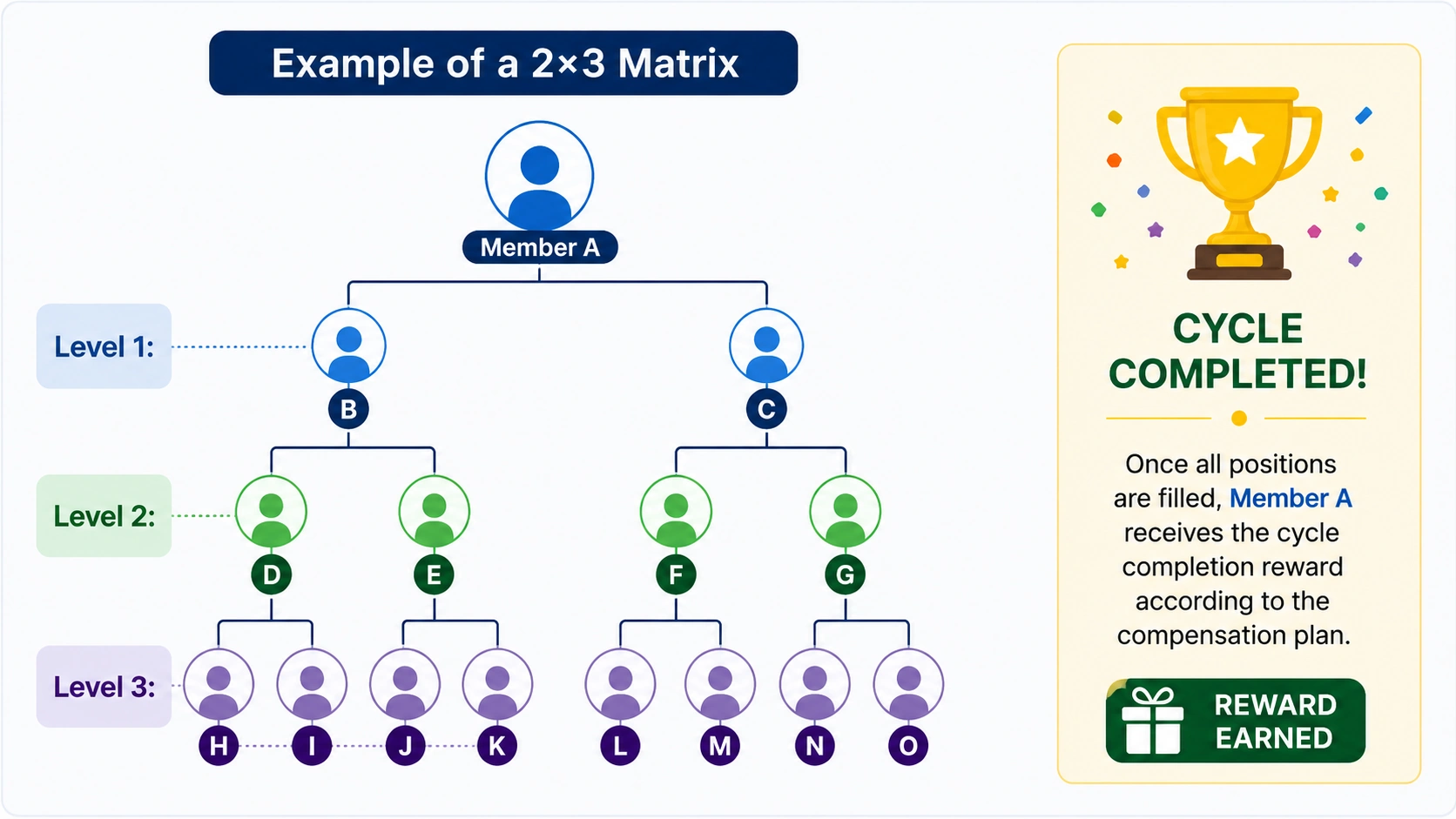
Once all positions are filled, Member A receives the cycle completion reward according to the compensation plan.
Many crowdfunding plans automatically place members into a new matrix after completing a cycle. This re-entry process creates ongoing earning opportunities and helps sustain network activity.
Various crowdfunding MLM structures exist, each designed with a different contribution flow, payout logic, and network-building approach to suit different business models.
Forced Matrix crowdfunding is a structured plan where participants are placed into a fixed grid system that defines how the network expands and how earnings are distributed.
Cycler or re-entry models are designed around repeated earning cycles, where participants move through stages and rejoin new cycles after completion.
Donation or peer-to-peer crowdfunding structures enable direct value exchange between participants without relying heavily on centralized control systems.
Binary crowdfunding organizes participants into a two-leg structure, creating a balanced network that influences earning potential based on team performance.
Hybrid crowdfunding models combine multiple compensation and contribution structures to create more flexible and scalable earning systems.
A crowdfunding MLM plan typically includes multiple income streams designed to reward both direct participation and long-term network growth. Each income type is triggered at a different stage of user activity, ensuring continuous earning opportunities across the structure.
Direct contribution income is earned immediately when a new participant joins through a referral link or placement. This income is triggered at the moment of onboarding, making it one of the fastest payout components in the system. The referring sponsor or upline typically receives this reward as an incentive for direct acquisition of new members.
Level contribution income is generated across multiple downline levels based on the structure of the MLM or crowdfunding tree. It is triggered when participants within a defined level make contributions, and it is earned by uplines who qualify for those levels. The deeper the network grows, the broader the earning potential becomes for eligible participants.
The cycle completion bonus is triggered when a participant's assigned matrix or stage is fully completed. This income is usually earned by the individual whose position or cycle reaches completion first, rewarding structured participation and team filling efficiency. It acts as a milestone incentive within the system.
Re-entry income is generated when a participant completes a cycle and re-enters a new one. It is triggered each time the user starts another cycle, allowing both the system owner and upline (depending on plan rules) to earn repeatedly from continued participation. This ensures recurring engagement-driven revenue flow.
Team growth bonus is a milestone-based income triggered when a participant's downline reaches predefined size or performance targets. It is typically earned by uplines who contribute to long-term team expansion. This reward encourages sustained recruitment and organizational development.
The global pool bonus is shared among top-performing members based on overall contribution, rank, or performance metrics. It is triggered periodically and distributed from a collective reward pool. Only qualified high performers receive this income, making it a competitive and prestige-based reward.
Crowdfunding MLM models operate in a sensitive regulatory environment, and proper compliance planning is essential before launching or scaling such systems. While these models can be powerful for structured fundraising and network growth, they must align with legal frameworks to avoid operational risks.
A key requirement is the presence of a genuine product or value layer. Pure contribution-based systems without any tangible product or service exchange may be classified as pyramid schemes in several jurisdictions. Ensuring clear value exchange helps establish legitimacy and reduces regulatory exposure.
Income disclosure is another critical factor. All earnings claims must be transparent, realistic, and supported by documented disclosures. Regulatory authorities in regions such as the United States, United Kingdom, and India actively monitor misleading income representations, making honest communication essential for compliance.
In the United States, certain crowdfunding structures may fall under securities regulations if they resemble investment-based offerings. In such cases, Regulation Crowdfunding (Reg CF) under the SEC may apply, requiring proper filings and legal oversight. Businesses should seek qualified legal counsel rather than relying solely on platform design.
KYC (Know Your Customer) and AML (Anti-Money Laundering) processes are mandatory for platforms handling cross-user financial flows. Identity verification, transaction monitoring, and fraud prevention systems help ensure secure and compliant operations, especially in multi-currency environments.
Jurisdiction-specific laws vary significantly across countries. A model acceptable in one region may be restricted or heavily regulated in another, such as Germany or Australia. Therefore, thorough legal review across target markets is essential before launching or scaling any crowdfunding MLM platform.
Choosing the right crowdfunding MLM software is critical because the entire model depends on accurate automation, transparent tracking, and reliable payout execution. Poor system design can directly impact trust, compliance, and long-term scalability.
Poorly designed crowdfunding MLM software is one of the primary reasons such systems fail in real-world operations. When automation is inaccurate or payout logic is inconsistent, it leads to errors in commission distribution, delays in cycle completion, and loss of user confidence. Since these platforms rely heavily on trust and precision, even small technical flaws can escalate quickly and destabilize the entire network structure.
A crowdfunding MLM plan is a structured network-based model where participants contribute funds into a system and earn returns through MLM mechanisms such as matrices, cycles, or referral-based structures. Earnings depend on participation, placement, and network growth.
Income is generated through multiple streams such as direct referral income, level-based contributions, cycle or matrix completion bonuses, and team performance rewards. Each income activates based on specific triggers like joining, filling positions, or completing stages.
MLM software automates core operations like genealogy tracking, commission calculations, contribution management, cycle progression, and payout processing. It ensures real-time accuracy and removes manual errors from the system.
A matrix is a fixed structure (such as 2×3 or 3×3) where participants are placed in predefined positions. Earnings are triggered once all positions are filled, and spillover often helps accelerate completion.
Re-entry allows participants to join a new cycle after completing one. It enables continuous participation and repeated earning opportunities through fresh cycles or stages.
Legality depends on structure and jurisdiction. Systems with real value exchange and compliance are more acceptable, while pure contribution-based models without products or services may face regulatory issues.
Automation ensures accurate calculations, real-time updates, and transparent operations. It prevents human errors in payouts and maintains consistency across all user transactions and cycles.
Poor software can cause payout errors, broken tracking systems, delayed transactions, and incorrect cycle management, which ultimately leads to loss of trust and system instability.
Product Specialist & Research Head

Looking for a certified, enterprise-ready platform with advanced features for your MLM business? Infinite MLM Software might just be the thing for you.
Connect with Us