
Building an MLM Around an Existing E-commerce Brand: What to Change Before Launch


Your existing e-commerce business already has products, customers, brand trust, order systems, and valuable sales data. Turning it into an MLM business, however, requires more than adding a referral button. You need to rethink your pricing, compensation plan, distributor experience, technology, operations, and compliance while keeping the existing shopping experience intact.
The right MLM software can help connect your e-commerce platform with distributor management, commissions, orders, and network operations. This guide explains what to review, change, integrate, and test before launching your distributor network.
Before introducing an MLM model, take a close look at the eCommerce business you have already built. Your existing products, customers, margins, and sales data can help determine whether an multi-level marketing model is the right fit.
Not every product in your store necessarily needs to become part of your MLM program. Start by identifying products with repeat-purchase potential, healthy margins, and clear customer value.
Review your product-level margins and determine how much revenue can reasonably be allocated to commissions without affecting profitability. You can also create an MLM-specific product range, allowing selected products to carry distributor commissions while other products remain part of your standard e-commerce model.
Your existing customer base can be one of your strongest starting points. Look for customers who purchase repeatedly, recommend your products, engage with your brand, or have already referred friends.
These customers already understand your products and may be natural candidates for an early distributor program. Starting with existing customers can also help you validate the model before investing heavily in cold recruitment.
Your MLM structure should solve a specific business problem. Your goal may be to increase product sales, enter new markets, build a stronger brand community, reduce dependence on paid acquisition, or create a network of independent distributors.
The goal should influence your compensation model. If your primary objective is direct customer acquisition, an affiliate structure may be enough. If you want distributors to build teams and generate sales through a network, an MLM model may be more appropriate.
Before building a multi-level network, determine whether your business actually needs one. The right choice depends on whether you want simple referral sales or a structured distributor network.
An affiliate program can work well when you simply want people to promote your products and receive commissions for direct referrals. You may not need a genealogy tree, rank management, team volume, or multiple commission levels. This makes an affiliate model simpler to operate and easier for participants to understand.
An MLM model becomes relevant when distributors are expected to generate personal sales while also building teams. In this case, you may need distributor registration, referral attribution, genealogy, rank management, team-volume calculations, multiple commission levels, wallets, and payout management.
More levels do not automatically create a better business model. A complicated compensation plan can make your program harder to explain, more expensive to operate, and more difficult for distributors to understand. Choose the simplest structure that supports your actual sales strategy.
Your pricing and compensation plan should be designed as one connected business model rather than separate decisions. The goal is to create attractive distributor earnings while protecting your product margins and overall profitability.
Start with the numbers your store already generates. Review:
Your compensation plan should be tested against real historical orders rather than theoretical sales scenarios.
You may have several pricing options. A retail customer could pay the standard product price while an eligible distributor receives a member price. Alternatively, distributors may purchase at the standard price but earn commissions on qualifying sales.
You could also introduce preferred customer pricing for customers who want member benefits without becoming distributors.
Define how discounts affect commissions. Decide whether commissions are calculated on the original price, discounted selling price, or a specific commissionable volume.
A Unilevel plan provides a relatively simple and wide structure. It can work well when the business wants to reward personal sales and team sales across multiple levels.
A Binary plan organizes distributors into two legs. This can suit businesses that place greater emphasis on team building and network development.
A Matrix plan uses a predefined width and depth, creating a more controlled network structure.
A Hybrid plan combines elements of different compensation structures to meet specific business requirements.
The right plan depends on your products, margins, customer behavior, sales strategy, and growth goals.
Before launch, define every commissionable event. Potential earning events can include:
Keep genuine customer and product sales at the center of the model. Avoid making recruitment or unnecessary self-purchases the primary qualification mechanism.
Once your business model is defined, your next priority is connecting the existing store with the right technology. The goal is to add distributor and network functionality without disrupting the customer shopping experience.
Depending on your setup, the e-commerce platform and MLM system may need to exchange:
The objective is to prevent the two systems from maintaining disconnected versions of the same transaction.
Referral → Order → Attribution → Commission Calculation → Commission Credit → Refund Check → Distributor Balance
Useful distributor tools can include:
These tools allow distributors to promote products while giving them visibility into the customers and qualifying sales associated with their activity.
An e-commerce platform is primarily designed to manage products, customers, shopping carts, orders, payments, and fulfillment.
An MLM platform adds specialized capabilities such as genealogy, multi-level commissions, ranks, team volume, distributor wallets, referral attribution, and payouts.
Basic plugins may be sufficient for simple referral programs, but complex MLM requirements often need a more specialized platform and reliable API or data synchronization.
For businesses using specific platforms, consider Woocommerce, Magento, Shopify and MLM API Integration when planning your technology architecture.
Adding distributors changes more than your technology; it also introduces new operational and compliance responsibilities. Your order policies, legal documents, marketing guidelines, and support processes should all be ready before launch.
Define what happens when:
For example, if a distributor receives a commission on an order and the customer later receives a refund, your compensation rules should specify whether the commission is reversed.
Depending on your jurisdiction and business model, review documents such as:
Because MLM and direct-selling regulations vary between jurisdictions, obtain appropriate legal advice before launching or expanding your program.
Product claims should be supported by appropriate evidence and should not promise benefits that the product cannot substantiate.
The same principle applies to earnings claims. Avoid presenting exceptional income examples as typical distributor outcomes. Give distributors clear guidance on what they can and cannot claim when promoting the products or business opportunity.
Customer support may continue handling:
Distributor support may handle:
Clear support workflows can prevent distributor-related questions from overwhelming your standard e-commerce support process.
A controlled testing phase can reveal technical, financial, and operational issues before they affect a larger distributor network. Testing should cover the complete journey, from distributor registration and customer purchase to commission and payout.
Avoid opening the program to thousands of distributors immediately. Start with a controlled pilot of around 20–50 distributors, a selected group of products, and one market or region.
The pilot should use the same compensation rules, order processes, and payout workflows planned for the full launch.
Run controlled scenarios covering:
Do not test only successful purchases. Refunds, failed payments, cancellations, and chargebacks can expose problems between e-commerce and MLM systems.
Track metrics such as:
These numbers can help determine whether the compensation model, onboarding process, products, and overall economics are ready for wider deployment.
Your established e-commerce business already provides the foundation needed to support an MLM model. Instead of replacing what works, add the distributor, referral, genealogy, commission, and payout layer around your existing store.
You do not necessarily need to replace your current infrastructure. Connect distributor management, referral tracking, genealogy, commissions, ranks, wallets, and payouts while keeping the customer shopping experience familiar.
Validate the economics before scaling, define clear commission and refund rules, and test the complete order-to-payout journey with a controlled group of distributors.
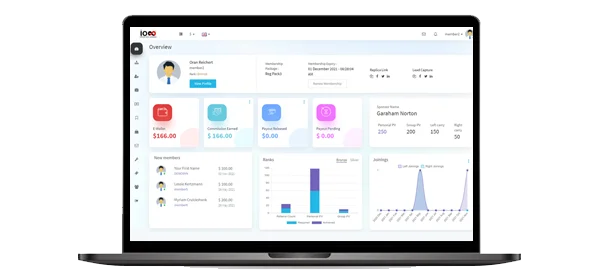
Connect your existing store with MLM software for referral tracking, genealogy, commissions, distributor dashboards, and payout management.
Yes. An existing e-commerce business can introduce an MLM model without necessarily replacing its current store. The e-commerce platform can continue managing products, customers, orders, payments, and fulfillment while MLM software manages distributors, referrals, genealogy, commissions, ranks, and payouts.
First, define your compensation plan and identify which products and sales are commissionable. Then connect the e-commerce platform with MLM software so customer referrals, distributor attribution, orders, refunds, and qualifying sales can be synchronized.
An e-commerce platform alone may not provide the specialized functionality required for a multi-level network. If you need genealogy, multiple commission levels, rank advancement, team-volume calculations, distributor wallets, referral tracking, and payout management, dedicated MLM software can provide these capabilities while your existing store continues handling the shopping experience.
Yes. Shopify and WooCommerce stores can be connected with MLM systems through integrations or APIs, depending on the requirements of the implementation. The integration should synchronize the information needed for referral attribution, order processing, commission calculation, refunds, and other network operations.
Start with the business model rather than the name of the compensation plan. Review your product margins, average order value, repeat purchases, customer acquisition strategy, distributor behavior, and growth objectives. Then compare Unilevel, Binary, Matrix, and Hybrid structures to determine which fits your requirements.
Yes. Existing customers can be strong candidates for an initial distributor program because they already know your products and have experience with your brand. Customers who repeatedly purchase, recommend products, or demonstrate strong engagement may be suitable for a pilot program.
Your compensation rules should define what happens when a commissionable order is refunded, cancelled, or charged back. Depending on the plan, the related commission may be reversed, adjusted, or deducted from a future distributor balance.
Neither is automatically better. An affiliate program may be the better choice if you only want to reward direct referrals. MLM can make sense when you want distributors to build teams and earn from qualifying sales across a defined network. The right choice depends on your business objective, compensation requirements, product economics, and desired distributor structure.
Co-founder and Chief Marketing Officer at iOSS

Looking for a certified, enterprise-ready platform with advanced features for your MLM business? Infinite MLM Software might just be the thing for you.
Connect with Us