
MLM Affiliate Marketing Software: How Hybrid Models Work and Why Businesses Need Specialized Tools


Running MLM and affiliate programs separately may work initially, but as businesses scale, disconnected systems lead to duplicate commissions, tracking gaps, and reporting issues.
This is where MLM affiliate marketing software becomes essential.
By combining both models into a unified system, businesses can simplify operations and support both recruiters and referral-based affiliates. In this blog, we’ll cover the differences between MLM, affiliate, and hybrid models, why businesses are adopting this approach, how the software works, key use cases, and why specialized MLM software is necessary.
To understand why MLM affiliate marketing software is necessary, it’s important to break down the differences between these three models.
MLM operates on a network-based structure where growth is driven through recruitment and team building. Participants earn commissions not only from their own sales but also from the sales generated by their downline (people they recruit).
Key characteristics:
While highly scalable, this model depends heavily on participants actively building and managing a downline.
Affiliate marketing is a performance-driven model focused on direct referrals. Participants promote products using unique tracking links and earn commissions when conversions occur.
Key characteristics:
This model is easy to adopt and attracts a wide range of users, including influencers, content creators, and customers.
The hybrid model combines the strengths of both MLM and affiliate marketing into a single system. It offers flexibility by allowing participants to choose how they want to earn.
Key characteristics:
This flexibility expands the partner system and improves engagement. However, it also introduces complexity in tracking, commission structures, and payouts, making MLM affiliate marketing software essential for managing operations efficiently.
Businesses are increasingly shifting toward hybrid models because they solve key growth challenges.
Combining MLM and affiliate strategies allows companies to generate income from multiple channels. MLM drives network-based expansion, while affiliate marketing brings in performance-driven traffic, creating a more balanced and scalable revenue model.
Not all participants are interested in recruitment. In traditional MLM systems, this often leads to distributor churn. Hybrid models allow users to continue earning as affiliates, improving retention and keeping more participants active over time.
Affiliate programs attract influencers, content creators, and customers who prefer simple referral-based earning. By integrating both models, businesses can engage a wider audience beyond traditional MLM distributors.
Hybrid systems give participants the freedom to choose how they earn, through referrals, team building, or both. This flexibility increases engagement, improves partner satisfaction, and encourages long-term participation.
MLM affiliate marketing software is designed to merge two fundamentally different systems into one platform. It ensures accurate tracking, fair commission distribution and unified reporting.
One of the most important features of MLM affiliate marketing software is flexible commission configuration. In hybrid systems:
The software maps these structures together. For example, a Tier 1 affiliate commission can align with a Level 1 MLM payout without requiring recruitment.
Admins can:
This ensures both affiliates and distributors are rewarded fairly, without overlapping commissions or conflicts.
Affiliate marketing relies on cookies to track user behavior like clicks, visits, and conversions. MLM systems, however, rely on genealogy trees to track relationships between distributors.
This is where MLM affiliate marketing software becomes highly technical. Hybrid software integrates both systems into a unified tracking engine.
How it works:
This integration ensures every sale is accurately attributed.
Without this capability, businesses face:
MLM affiliate marketing software eliminates these risks through intelligent attribution logic.
Payout reconciliation is one of the most critical functions of MLM affiliate marketing software. In hybrid models, a single transaction can trigger:
Without proper controls, this leads to double commissions and revenue loss. Hybrid software solves this by applying strict rules:
This creates a transparent and accurate payout system that is easy to manage and scale.
Businesses across industries are adopting hybrid models to improve growth and distribution efficiency. Here are the most common use cases of MLM affiliate marketing software:
E-commerce companies often start with affiliate programs to drive initial sales and traffic. By introducing an MLM layer, they can promote deeper engagement and improve growth through network expansion.
Top affiliates can:
The key challenge is moving affiliate data into an MLM genealogy without losing tracking history. MLM affiliate marketing software ensures a smooth transition while preserving past performance and enabling multi-level commissions.
Traditional MLM companies often face challenges attracting users who are not interested in recruitment. Adding an affiliate model allows them to appeal to a broader audience and lower entry barriers.
With affiliate integration:
The main challenge is managing two participant types in one system. MLM affiliate marketing software solves this by supporting dual roles like distributors and affiliates with separate rules and payouts.
SaaS companies use hybrid models to balance fast customer acquisition with long-term recurring revenue. Affiliates help drive signups, while MLM-style resellers focus on deeper market penetration.
Typical structure:
The complexity lies in managing subscription billing, recurring payouts, and multi-level commissions over time. MLM affiliate marketing software is designed to handle these requirements efficiently, ensuring accurate tracking, automated payouts, and scalable commission management.
Choosing the right MLM affiliate marketing software is essential for hybrid models. Using separate MLM and affiliate tools often leads to tracking issues and complex payouts.
A unified solution handles both smoothly. The comparison below shows how purpose-built software outperforms standalone affiliate tools.
| Feature |
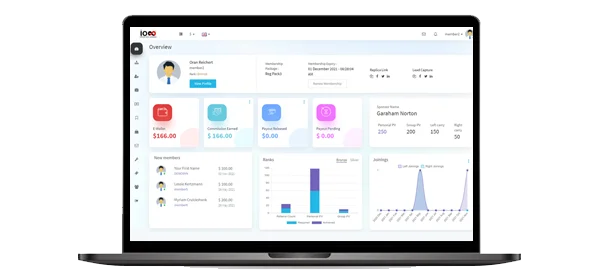
Infinite MLM Software + Affiliate Module
|
Standalone Affiliate Platforms
|
|---|---|---|
| Commission Flexibility | High (MLM + affiliate combined) |
Limited to affiliate-only |
| Cookie-Based Tracking | Yes |
Yes |
| MLM Genealogy Support | Full support |
Not available |
| API Integrations | Extensive and customizable |
Limited |
| Reporting Depth | Unified reporting |
Fragmented reporting |
| Hybrid Payout Reconciliation | Built-in |
Not supported |
A purpose-built MLM affiliate marketing software solution clearly outperforms standalone tools by offering integrated tracking, unified reporting, and accurate payout management. Instead of managing multiple systems, businesses can simplify operations, reduce errors, and scale more efficiently with a single platform.
Simplify operations and grow faster with a unified MLM-affiliate solution.
As businesses grow, managing MLM and affiliate programs separately becomes inefficient. A hybrid approach solves this by combining both models to improve reach, retention, and revenue.
In this blog, we covered the differences between MLM, affiliate, and hybrid models, why businesses are adopting them, how MLM affiliate marketing software works, and key use cases across industries.
With the right MLM affiliate marketing software, businesses can simplify operations, ensure accurate commissions and grow more effectively.
MLM affiliate marketing software is a platform that combines multi-level marketing (MLM) and affiliate marketing into one system. It enables businesses to manage both downline-based commissions and referral-based earnings with unified tracking and reporting.
It integrates two systems- affiliate cookie tracking and MLM genealogy tracking- into one platform. The software attributes sales correctly, manages commissions, and ensures accurate payouts without duplication.
A hybrid MLM-affiliate model allows users to earn commissions through referrals, team-building, or both. It combines the flexibility of affiliate marketing with the scalability of MLM structures.
Businesses use it to simplify operations, reduce tracking errors, prevent duplicate commissions, and manage both MLM and affiliate programs within a single platform.
Yes. It uses rules like genealogy priority and deduplication logic to ensure that each sale is counted only once and commissions are distributed correctly.
Key features include commission flexibility, cookie tracking, MLM genealogy support, payout reconciliation, reporting tools, and integration capabilities.
Yes. Startups can benefit from hybrid models by reaching a wider audience and offering flexible options, making it easier to scale without relying solely on recruitment.
Affiliate software focuses only on referral tracking, while MLM affiliate marketing software supports both referral tracking and multi-level commission structures within a unified system.
Co-founder and Chief Marketing Officer at iOSS

Are you on the lookout for a cost-effective software solution with advanced features for your MLM business? Infinite MLM software might just be the thing for you.
Connect with Us