

Spillover Management in Binary MLM Networks: Keeping Auto-Placement Fair and Transparent for All Distributors


Spillover is a core feature of binary MLM plans that helps distribute new members throughout the network once direct placement positions are filled. While it can increase team volume and support network growth, poor spillover management often leads to confusion, placement disputes, and concerns about fairness.
The success of a binary MLM plan depends on having clear placement rules, transparent tracking, and reliable software controls.
In this guide, we'll explain how spillover works, explore the different spillover placement methods, discuss common challenges, and highlight how MLM software helps maintain transparency and distributor trust.
Spillover occurs when a distributor's two direct positions in a binary MLM plan are already filled, and new recruits are automatically placed deeper within the downline.
While spillover can help distributors build team volume and increase earning opportunities, it often leads to confusion when members receive different levels of spillover or do not understand placement decisions.
The issue is not spillover itself but how it is managed. Without clear placement rules and transparency, distributors may question placements, commissions, and network growth.
Understanding how spillover works and using the right binary MLM software can help maintain fairness, consistency and distributor trust across the network.

In a binary MLM plan, each distributor has two front-line positions: one left leg and one right leg. Once these positions are filled, additional recruits are automatically placed in the next available position within the downline. This process is known as spillover.
As spillover continues, one leg often receives more volume than the other, creating:
Since binary commissions are typically based on matched volume between both legs, maintaining balance is important for maximizing earnings.
Spillover is designed to encourage team growth and collaboration. However, it works effectively only when placement rules are transparent, consistent, and clearly communicated to distributors.
Binary MLM software can use different spillover placement rules to determine where new members are positioned once direct placement slots are filled. Each method affects network growth, leg balance, and commission opportunities differently.
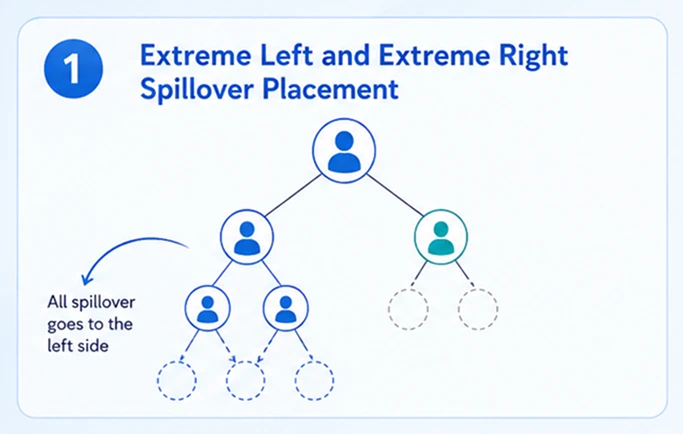
All spillover is directed to one fixed side of the network, either the left leg or the right leg.
Key points:

The binary MLM software automatically places new recruits in the leg with lower volume.
Key points:
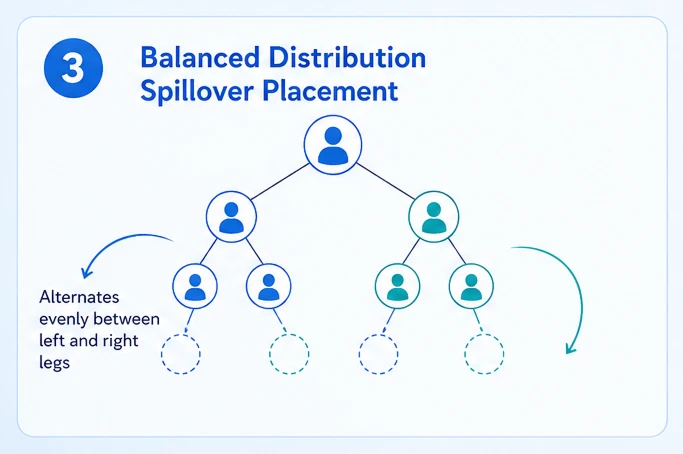
New members are distributed evenly between the left and right legs based on placement count.
Key points:
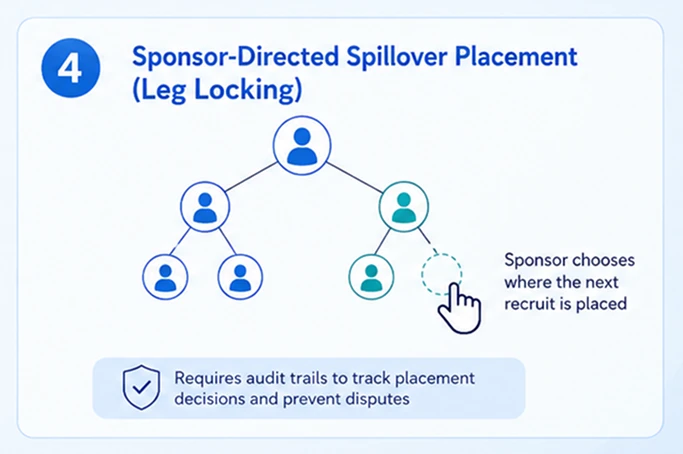
Distributors manually choose where their next recruit will be placed.
Key points:
The right spillover placement method depends on the company's compensation strategy, network structure, and distributor management.
While spillover can support network growth, many distributor complaints arise from poor configuration, limited visibility, or unclear placement rules rather than the binary plan itself.
Distributors closer to active recruiters often receive more spillover than those deeper in the network.
Some distributors become overly reliant on spillover instead of building their own teams.
Distributors may question placements when they cannot see how decisions were made.
Unmatched volume can accumulate on one leg and eventually be removed under the plan's flush rules.
Proper spillover management depends on transparent placement rules, visible network structures, and MLM software features that allow distributors to understand how their organization is growing.
Effective spillover management requires more than automatic placement. The right software features help ensure every placement is transparent, traceable, and easy for distributors and administrators to understand.
Companies should define a single spillover rule for the entire network, such as extreme left, extreme right, weak leg, or balanced placement.
Leg locking allows distributors to choose where their next recruit will be placed while maintaining accountability.
A visual genealogy tree allows distributors to track placements and organizational growth in real time.
Distributors should always know their current volume status and upcoming flush events.
When commission caps are applied, distributors should clearly understand their earnings status.
These features help create a transparent binary MLM environment where distributors can understand placements, track volume and trust the commission calculation process.
While MLM software automates spillover placement, administrators play an important role in ensuring the system remains fair, transparent and properly managed.
The spillover placement rule should be finalized before the network begins growing.
Clear communication helps prevent misunderstandings and unrealistic expectations.
Administrators should regularly review network performance and leg growth.
Routine audits ensure that placements follow the configured rules and company policies.
Proper administration, combined with transparent software features, helps maintain distributor trust and ensures spillover management remains consistent across the entire binary network.
Spillover plays an important role in binary MLM plans by helping distribute network growth and support commission generation.
However, its success depends on transparency and consistency.
Clear placement rules, real-time genealogy visibility, audit trails, and carry-forward tracking help distributors understand how placements occur and build trust in the system.
For MLM companies, effective spillover management is essential for improving distributor satisfaction, retention, and network stability.
Track spillover placements, monitor genealogy structures, manage commissions accurately, and maintain complete transparency with powerful binary MLM software.
Spillover happens when a distributor's two direct positions are already filled, so any additional recruits are automatically placed deeper in the downline, usually under an existing member who still has an open left or right position.
Spillover is generally beneficial since it adds team volume without direct recruiting effort. It becomes a problem only when distributors rely on it entirely instead of building personally, since placement isn't guaranteed, consistent, or within their control.
The power leg is the side that grows mainly through spillover and tends to expand faster. The profit leg (also called the pay leg or weak leg) is built through personal recruitment and is the leg commissions are actually calculated on, since binary payouts match volume on the weaker side.
Spillover itself can't be switched off, since it's a structural part of how binary trees fill positions once both direct slots are taken. Companies can configure how it's placed, however, choosing extreme left/right, weak leg, balanced, or sponsor-directed rules, and some plans allow leg locking so distributors can choose placement within those rules.
Unmatched volume sits on the stronger leg until matching volume appears on the weaker leg. If it stays unmatched beyond the plan's defined cycle, it's typically carried forward for a limited period and then removed once the flush date passes.
A flush is the removal of unmatched carry-forward volume once it passes its eligibility window. Companies use flush rules to prevent indefinite volume accumulation on one leg and to keep commission calculations sustainable over time.
Leg locking lets a distributor choose which leg their next recruit will be placed on, rather than leaving placement entirely automatic. It's not universal. MLM companies that offer it usually pair it with an audit trail, since manual placement control can otherwise lead to disputes.
There's no universal best option; each method suits a different priority. Extreme left/right is simplest and most predictable, weak leg placement supports faster commission matching, balanced distribution focuses on even member counts, and sponsor-directed placement gives distributors strategic control. Companies typically choose one method based on their compensation goals and stick with it consistently.
Most placement disputes come from poor visibility, not actual errors. When distributors can't see how or why a placement happened, they tend to assume favoritism or mistakes. Real-time genealogy views, placement logs and audit trails resolve most of these disputes without escalating to support tickets.
No. Spillover adds volume to a downline, but actual commissions still depend on matched volume between both legs, applicable commission caps, and meeting any activity requirements the company sets. Spillover without personal activity or a built profit leg often results in little to no payout.
Product Specialist & Research Head

Are you on the lookout for a cost-effective software solution with advanced features for your MLM business? Infinite MLM software might just be the thing for you.
Connect with Us