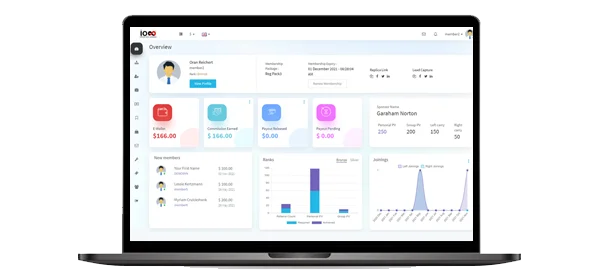

How to Start an MLM Business in the USA: The Complete Registration and Compliance Guide

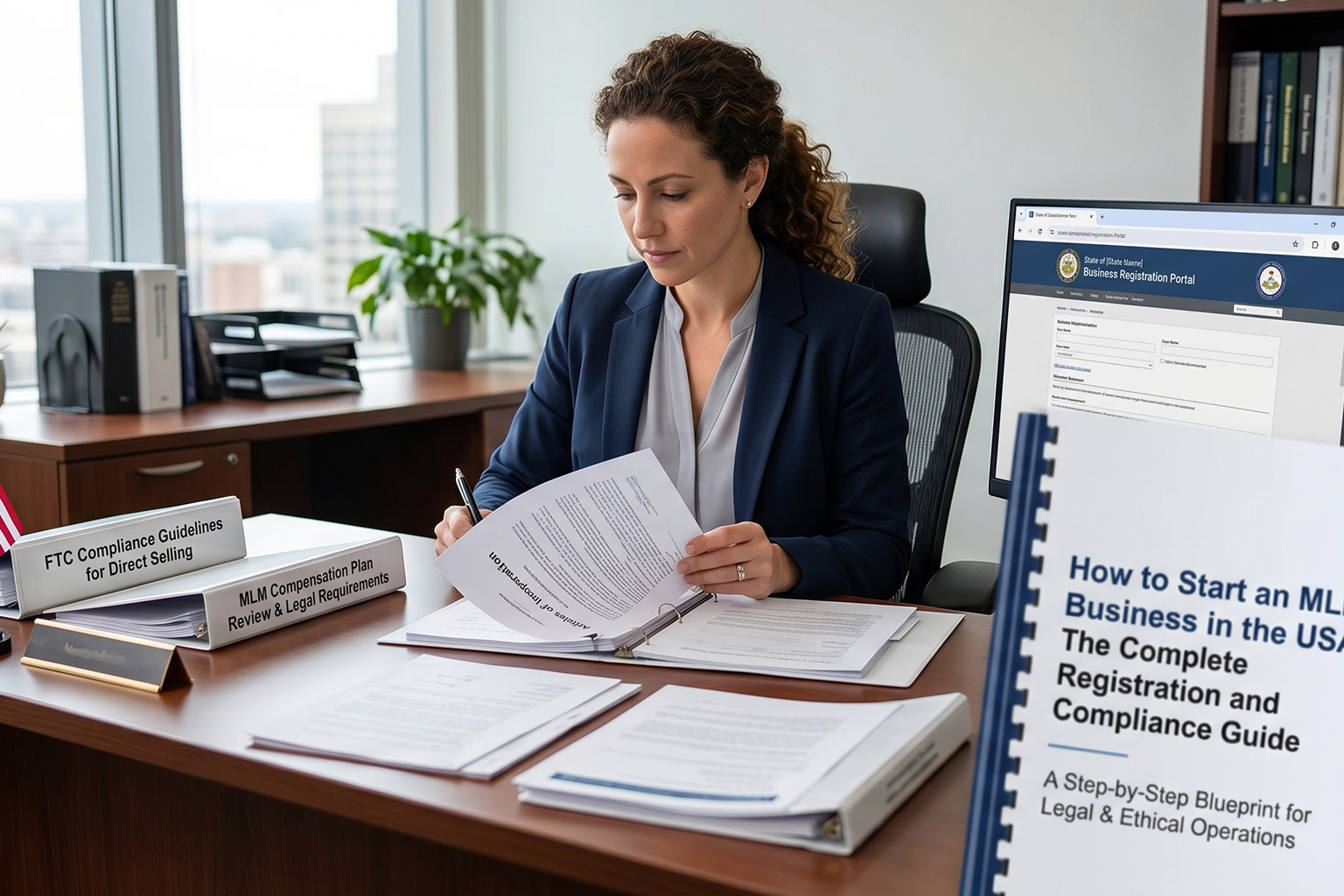
Starting an MLM company is not just about registering a business and launching a product. It requires handling two parallel systems from day one: standard business formation and MLM-specific regulatory compliance.
Unlike a traditional company, MLM founders must design compensation structures, meet FTC expectations, and prepare merchant processing documentation before they even begin recruitment, while also planning for the right MLM software to manage commissions, compliance records, and operational tracking from the beginning.
Every business begins with legal formation, but MLM businesses add an extra compliance layer that changes the entire setup process. This dual-track structure is what makes MLM formation more complex than standard company registration.
Standard business registration covers incorporation, taxation, and basic operational setup. MLM businesses, however, must also comply with FTC rules, direct selling laws, compensation plan validation, and financial processing requirements. These systems must be built in parallel, not one after another.
MLM formation operates on two parallel tracks from day one. The first is standard legal formation, which includes incorporation, taxation setup, and basic licensing requirements that apply to all businesses.
The second is the MLM-specific compliance layer, which includes FTC-aligned compensation design, distributor agreements, income disclosure statements, refund policies, and merchant underwriting preparation.
Many founders make the mistake of completing legal registration first and postponing compliance planning. This often results in rejected merchant applications, compensation plan revisions, and delays in distributor onboarding once the business becomes operational.
This sequential approach creates operational friction, extends launch timelines, and increases legal rework because compliance requirements are not aligned with the initial business structure from the beginning.
Preparation before registration determines how fast and smooth the entire MLM setup process will be. Missing foundational elements at this stage often leads to redesigns after legal formation is complete.
This stage is where most compliance failures originate, not after launch. Strong preparation here reduces legal risk, banking delays, and compensation restructuring later.
A compensation plan is the foundation of an MLM structure, and it is also the first thing regulators and payment processors examine. It must clearly prove that earnings are driven by real product movement rather than recruitment incentives, while remaining simple enough to calculate, explain, and audit.
The FTC evaluates whether distributor income is primarily generated through retail customer purchases rather than recruitment-based earnings. A plan that cannot demonstrate strong retail activity is considered high-risk regardless of product category.
A compliant structure includes defined retail sales thresholds, transparent commission calculations, a documented buyback or refund policy, and a clear income disclosure methodology. These elements ensure that earnings can be traced back to legitimate customer transactions.
Plans that rely heavily on entry fees, compulsory starter kits, or recruitment-based bonuses create regulatory exposure. Even if product sales exist, compensation tied primarily to onboarding activity can trigger compliance concerns.
Product validation ensures that the offering has real, independent market demand before it is connected to an income opportunity. Without this separation, regulators may interpret the model as incentive-driven rather than product-driven.
Products must demonstrate genuine customer demand outside of the MLM structure through real-world sales, pricing validation, and competitive market analysis. This proves that the product can survive without distributor recruitment.
Different product categories require different compliance documentation. Health and wellness products need substantiated claims, cosmetics require safety and ingredient compliance, and digital products must follow strict advertising and income claim regulations.
All marketing statements must be verified and documented before distributor onboarding begins. Uncontrolled income or product claims made by early distributors often become the biggest source of regulatory risk.
Strong legal and operational documentation ensures the business is structurally ready for banking, compliance reviews, and distributor onboarding. These documents also define how the company will function at scale and protect it during audits or disputes.
This includes distributor agreements, policies and procedures, return and buyback policies, privacy policies, and terms of use. Together, they define distributor rights, responsibilities, and compliance expectations.
Financial institutions require a complete compliance package before approving merchant accounts. This typically includes formation documents, compensation plan details, income disclosure framework, and operational policies.
Having all documentation prepared early reduces friction during onboarding with banks, payment gateways, and compliance reviewers. It also ensures faster approval cycles and fewer revision requests during launch.
Registering an MLM business is a structured legal process that lays the foundation for compliance, banking, and long-term scalability. Each step must be completed carefully to avoid delays in operations, payouts, or regulatory approvals.
Start by selecting the legal structure. Most MLM companies begin as an LLC for flexibility, while larger or investment-driven businesses often move to a C-Corporation later.
State selection matters. Delaware is preferred for corporate structure, Wyoming for privacy, and home states for simpler local operations. If business activities span multiple states, foreign qualification may be required.
File Articles of Organization or Incorporation with the Secretary of State. Prepare an Operating Agreement or Bylaws covering ownership, IP rights, and compensation plan governance. Also conduct a USPTO trademark search and secure your domain and social handles early.
Apply for an EIN through the IRS. U.S. founders receive it instantly online, while foreign founders must submit Form SS-4, which may take several weeks. Keep the CP 575 confirmation letter safe, as it is required for banking and compliance.
Most states require a general business license. Depending on the product or model, additional permits may apply, such as health or home-based business approvals. Sales tax registration is required in all states where the business has economic presence.
File the BOI report with FinCEN within 30 days of formation. Register for payroll and tax accounts if hiring employees. MLM businesses must also collect W-9 forms from distributors before commission payouts.
Choose a bank familiar with MLM or direct selling models. Required documents include formation papers, EIN, and operating agreement. MLM companies in the USA may also need to present their compensation plan. Maintain separate accounts for operations, taxes, and commissions to ensure clean financial management.
Certain U.S. states add extra MLM compliance rules beyond standard business registration, affecting compensation plans, disclosures, and onboarding, and ignoring them can lead to penalties or expansion delays.
MLM is legal in the USA when it is a genuine direct selling model focused on real product sales, but it is evaluated case-by-case by the FTC. It becomes illegal when it relies mainly on recruitment, lacks retail sales, or involves mandatory inventory loading. Compliance requires transparent disclosures, refund/buyback policies, and proper documentation across all states.
Most U.S. states only require standard business licensing for MLM operations. However, a few states impose extra MLM or pyramid scheme regulations:
| State | Key Requirement | Notable Details |
|---|---|---|
| Georgia | Registration required before soliciting distributors | Under the Georgia Multilevel Distribution Companies Act. Annual renewal is mandatory and compensation plan must be filed with the state. |
| Louisiana | Strict retail sales focus enforcement | Enforced under its Pyramid Promotional Scheme Law. Models heavily based on recruitment risk regulatory action. |
| Maryland | Enhanced income disclosure statement (IDS) access | Must be provided to prospects before enrollment. |
| Massachusetts | Strong consumer protection enforcement | Standards similar to FTC. Income claims and product claims are closely monitored. |
| Wyoming | Retail sales as primary income driver | Required under state statute. Compensation structures must demonstrate retail sales emphasis. |
Practical note: If launching in these states, factor additional filings, disclosures, and legal review into your timeline and budget before formation.
Merchant processing is one of the most critical and sensitive steps in MLM operations. Financial institutions evaluate MLM companies differently due to perceived risk exposure and regulatory complexity.
Approval delays or rejections often occur when compliance documentation is incomplete or compensation structures appear unclear.
MLM businesses are often classified as high-risk merchants by banks and payment processors due to the structure of multi-level commissions and bonuses, recurring payouts, and regulatory sensitivity around direct selling models. This classification does not mean the business is illegal, but it signals higher underwriting scrutiny before approval.
Payment processors evaluate several risk indicators before onboarding an MLM company, including chargeback ratios, refund patterns, recruitment-driven revenue models, and any prior regulatory complaints. Businesses with unclear compensation structures or aggressive earning claims are flagged for additional review.
High-risk classification typically results in higher processing fees, rolling reserves held by the processor, and stricter contract conditions. Some providers may also impose transaction caps or delayed fund settlements to reduce exposure.
To secure merchant approval, MLM companies must present a complete compliance and operational package that demonstrates legitimacy and transparency. Missing or unclear documents are a primary reason for rejection.
A standard underwriting submission includes the compensation plan, distributor policies, refund and cancellation terms, income disclosure statement, and key legal agreements. These documents help processors assess whether revenue is primarily product-based rather than recruitment-driven.
Incomplete, inconsistent, or outdated documentation often leads to immediate rejection or long delays in approval. Clear alignment between the compensation plan, website claims, and legal disclosures is essential for smooth onboarding.
Payment processing in MLM businesses must adhere to PCI DSS (Payment Card Industry Data Security Standards) to protect customer financial data and reduce fraud risk.
All customer payment information must be handled through secure, PCI-compliant systems such as encrypted gateways and tokenized processing. Direct storage of card data by the MLM platform is not allowed, and failure to comply can result in penalties, processor termination, or security breaches.
A structured MLM launch follows predictable phases, but each stage carries its own dependencies. For realistic planning, it helps to view every phase as equal in weight and effort rather than overlapping or rushing them.
Product validation, compensation plan design, and drafting core legal and operational documents. This phase defines the business model and prevents structural changes later.
Company incorporation, EIN setup, trademark filing, and operating agreement creation. Foreign founders typically require additional verification steps, extending timelines slightly.
Business licenses, state permits, sales tax registration, and BOI filings. Proper documentation ensures regulatory readiness before financial onboarding begins.
Bank account setup, merchant underwriting, and payout infrastructure configuration. Merchant approval is highly variable and often determines overall launch speed.
Platform configuration, compensation plan integration, testing, and system validation. This ensures commissions and workflows function correctly before user onboarding.
Initial distributor onboarding, controlled recruitment, and commission verification. Operations are refined gradually while scaling begins in a controlled environment.
Total timeline: Typically 4–7 months for prepared US founders and 6–10 months for foreign founders or complex structures.
Avoid costly compliance mistakes. Get guidance on formation, merchant approval, and regulatory setup before you register your company.
Compliance does not end after launch; it becomes a continuous operational responsibility. MLM companies must maintain financial transparency, reporting accuracy, and distributor activity oversight throughout their lifecycle.
Failure to maintain ongoing compliance can create regulatory exposure even if initial setup was correct.
Annual compliance requirements such as business reports, tax filings, and jurisdiction-specific disclosures must be submitted on time. These filings ensure the company remains in good standing and maintains legal visibility across operating regions.
Income Disclosure Statements (IDS) must be reviewed and updated regularly, typically annually, to reflect actual distributor earnings data. This helps ensure transparency in income representation and reduces the risk of misleading claims in recruitment or marketing materials.
Companies must continuously monitor the balance between retail customer sales and distributor-driven activity. This ensures the business maintains a legitimate commercial foundation rather than relying solely on internal network transactions.
All income-related claims made by distributors must be actively reviewed and controlled. Unverified or exaggerated earnings statements can create compliance risks and should be corrected or restricted through policy enforcement and monitoring systems.
MLM operations require built-in compliance mechanisms from the start, as regulatory expectations depend heavily on traceable financial activity, transparent reporting, and enforceable rules. Software systems are typically responsible for enforcing these requirements consistently across all distributor and transaction levels.
The system must continuously track the ratio between retail customer purchases and distributor self-purchases. This data is essential for maintaining proof of retail-driven activity, which is often required in regulatory compliance documentation.
Commission engines should generate structured earnings records for each distributor across defined time periods. This ensures accurate and auditable data is available for producing annual Income Disclosure Statements without manual reconciliation.
Every critical system event, including commission calculations, rank changes, payouts, and administrative edits, must be logged with timestamps. These logs must remain retrievable for audits, dispute resolution, and regulatory review purposes.
The platform should capture tax documentation such as W-9 forms during onboarding and automatically compile 1099-related data at year-end. This reduces manual processing errors and ensures tax reporting readiness.
When product returns occur, the system must automatically reverse associated commissions. This maintains accurate payout records and prevents inflated income reporting.
Commission rules must be configurable by region, allowing compliance with state or jurisdiction-specific regulations without requiring technical redevelopment.
Power your business with Infinite MLM Software's SOC 2 certified platform for secure, compliant, and scalable MLM operations.
Starting an MLM company requires handling business formation and regulatory compliance together, as both are closely interconnected. Key areas like compensation planning, banking, and software setup must align with compliance requirements from the beginning.
When these steps are approached in a structured way, the launch process becomes more predictable and efficient. Building compliance into the foundation early helps reduce delays and supports stable long-term growth.
Most MLM companies do not require a special federal MLM license and can operate under standard business registration rules like any other company. However, depending on the state you operate in and the type of products you sell, you may still need additional permits such as sales tax registration, business activity licenses, or industry-specific approvals for regulated categories like health supplements or cosmetics.
A complete MLM setup typically takes 4–7 months because registration is only one part of the process. Along with entity formation, founders must also complete compliance documentation, compensation plan validation, banking approvals, merchant underwriting, and software setup. International founders or businesses dealing with regulated products may require additional time due to extended verification and approval cycles.
While most US states follow general business laws, some states have stricter direct selling or consumer protection rules that impact MLM operations. States such as Georgia, Louisiana, Maryland, Massachusetts, and Wyoming are often referenced due to additional requirements around disclosures, retail sales emphasis, or compensation plan scrutiny. These rules are not uniform and may change, so legal review is important before expansion.
Yes, non-US citizens can legally form an MLM company in the United States by registering a US-based entity. However, the process can take longer due to additional steps such as EIN application via Form SS-4, international banking verification, and enhanced merchant underwriting checks. Many foreign founders also face longer timelines when opening business bank accounts and payment processing systems.
The Federal Trade Commission primarily evaluates whether distributor earnings are driven by genuine retail sales to real customers rather than recruitment or internal purchases. A compliant compensation plan must clearly demonstrate that income is tied to product movement in the open market, not just enrollment activity. This is one of the most critical factors in determining whether an MLM structure is legally sustainable.
Banks classify MLM businesses as high-risk due to factors such as higher chargeback rates, regulatory uncertainty, and potential liability linked to income claims made by distributors. Because of this classification, MLM companies often face stricter underwriting, higher processing fees, rolling reserves, and longer approval timelines compared to standard e-commerce businesses.
After launch, MLM companies must maintain continuous compliance rather than treating it as a one-time setup task. This includes annual state filings, tax reporting obligations, updated income disclosure statements based on real earnings data, retail sales monitoring to ensure regulatory balance, and oversight of distributor marketing claims to prevent misleading or unverified income statements.
MLM software must support compliance-driven operations by accurately tracking retail customer sales separately from distributor purchases and generating reliable commission records. It should also maintain detailed audit logs of all payouts, rank changes, and administrative actions. Additional essential features include income disclosure reporting, refund and buyback automation, W-9 collection, 1099 tax reporting support, and configurable rules to handle geographic or regulatory restrictions.
Product Specialist & Research Head

Are you on the lookout for a cost-effective software solution with advanced features for your MLM business? Infinite MLM software might just be the thing for you.
Connect with Us