
How to Choose the Right MLM Software in 2026: A Practical Guide for Network Marketing Businesses

Choosing the right MLM software in 2026 is crucial for managing growth, automating operations, and ensuring compliance. As distributor networks expand and compensation plans become more complex, the right platform can significantly improve efficiency and scalability. This guide covers the key factors to consider, including features, security, pricing, and vendor reliability, helping you choose an MLM software solution that supports long-term business growth.

What Is MLM Software?

MLM software is a digital platform that automates and manages the core operations of a multi-level marketing business, including distributor management, commission calculations, payouts, network tracking, and business reporting.

Why Choosing the Right MLM Software Matters?

Selecting the right MLM software is critical for sustainable growth. The wrong platform can create operational challenges, while the right one improves efficiency and distributor satisfaction.

Risks of Choosing the Wrong MLM Software

  • Inaccurate or delayed commission payouts
  • Poor distributor experience and higher churn
  • Limited scalability for growing networks
  • Security and data protection risks
  • Compliance and regulatory challenges

Benefits of Choosing the Right MLM Software

  • Greater operational efficiency through automation
  • Improved distributor retention and engagement
  • Accurate, real-time reporting and transparency
  • Easier expansion into new markets
  • Better long-term ROI and business growth

Why MLM Software Is the Backbone of Network Marketing in 2026

As MLM businesses grow, manual systems and spreadsheets quickly become unreliable. Tracking thousands of distributors, calculating multi-level commissions, managing payouts, and ensuring compliance across regions is simply not feasible without automation.

In 2026, successful network marketing companies are shifting toward:

  • Fully automated commission and payout systems
  • Mobile-first distributor experiences
  • Real-time analytics and reporting
  • Compliance-ready platforms for global operations

How to Evaluate and Choose the Right MLM Software

Choosing MLM software involves more than comparing features and pricing. A successful selection process starts with understanding your MLM business requirements and then evaluating vendors against the factors that impact performance, scalability, security, and long-term growth.

Step 1: Clarify Your Business Requirements Before You Start Comparing MLM Software

Before you begin evaluating MLM software vendors, take time to define what your business actually needs. Many MLM companies make the mistake of focusing on features, pricing, or marketing promises before understanding their own operational requirements. This often leads to paying for functionality that is never used or selecting a platform that cannot support future growth. Before scheduling demos or requesting proposals, answer the following four questions:

1. What Is Your Compensation Plan?

Your compensation plan is the foundation of your MLM business. Different MLM plans require different commission calculation logic, reporting structures, and payout mechanisms. Confirm that the software has proven support for your specific plan type, including:

Avoid vendors that claim they can "configure" a plan without demonstrating successful real-world deployments of that plan structure.

2. What Is Your Expected Network Size and Growth Trajectory?

The software you choose should not only support your current distributor network but also accommodate future expansion. Consider:

  • Current distributor count
  • Expected growth within the next 12–24 months
  • Geographic expansion plans
  • Multi-currency requirements
  • Multi-language support needs
  • E-commerce requirements for physical or digital products

Choosing a platform built for long-term scalability helps avoid costly migrations later.

3. What Existing Tools Need to Be Integrated?

Most MLM businesses already rely on multiple systems to manage operations. Create a list of tools that must connect with your MLM software, such as:

  • CRM platforms for lead management and customer relationship tracking.
  • Payment Gateway Requirements for secure transactions and commission payouts.
  • E-commerce Requirements for selling physical or digital products.
  • Accounting Requirements for financial reporting and tax management.
  • Marketing Automation Requirements for campaign management and lead nurturing.
  • SMS and Communication Requirements for notifications, alerts, and distributor updates.

Strong integration capabilities reduce manual work and eliminate data silos across your organization.

4. What Is Your Realistic Total Budget?

The software license fee is only one part of the overall investment. When budgeting, consider:

  • Initial implementation costs
  • Customization requirements
  • Training and onboarding
  • Ongoing maintenance
  • Technical support
  • Future upgrades
  • Potential migration costs

Evaluating total cost of ownership provides a much clearer picture than comparing software prices alone.

Step 2: 7 Key Factors to Consider When Choosing MLM Software in 2026

Once your requirements are clearly defined, use the following framework to evaluate and compare MLM software vendors.

1. Data Security, Compliance, and Privacy

Data security should be one of the first criteria you assess. MLM software stores sensitive distributor information, financial records, commission data, and payment details. A weak security framework can expose both your business and your distributors to significant risk. Look for:

  • SSL/TLS encryption
  • Two-factor authentication (2FA)
  • Role-based access controls
  • GDPR compliance support
  • PCI DSS compliance capabilities
  • Secure database architecture
  • Automated backups and disaster recovery
  • Multi-factor authentication for financial transactions

Ask vendors to explain their security practices, compliance standards, and incident response procedures rather than relying solely on feature lists.

2. Compensation Plan Compatibility

Your MLM software should support your compensation structure without extensive customization. Key evaluation points include:

  • Native support for Binary, Unilevel, Matrix, Board, Generation, Stair Step, and Hybrid plans
  • Automated commission calculations
  • Complete commission audit trails
  • Support for matching bonuses and rank advancement
  • Flexible handling of spillover and placement rules
  • Ability to operate multiple compensation plans simultaneously

Whenever possible, request a live demonstration using your actual compensation rules.

3. Scalability and Customization

A system that performs well with a few hundred distributors may struggle as your network grows. Consider scalability and MLM customization when evaluating software. Evaluate:

  • Maximum supported distributor volume
  • Performance under heavy transaction loads
  • Concurrent user capacity
  • Modular architecture
  • Configuration-based customization options
  • Future upgrade and expansion capabilities

The right platform should support growth without requiring major system replacements.

4. Integration Ecosystem

Ensure the MLM software supports seamless integration with the tools and platforms your business relies on for daily operations. Verify compatibility with:

Integration Type What to Evaluate
CRM Platforms Integration with existing CRM systems or built-in CRM functionality
Payment Gateways Support for traditional gateways, e-wallets, and cryptocurrency payments
E-commerce Platforms Integration with Woocommerce, Magento, Shopify and similar platforms
Marketing Tools Email marketing, SMS gateways, and communication platforms
APIs Availability of public APIs for custom integrations

Strong integrations improve efficiency while reducing manual administration.

5. Mobile-First Distributor Experience

Today's distributors expect to manage their business through a mobile app, making mobile accessibility a critical factor when evaluating MLM software. Assess the platform's mobile capabilities carefully, including:

  • Fully responsive dashboards
  • Native iOS and Android mobile apps
  • Real-time notifications and alerts
  • Mobile commission tracking
  • Team activity monitoring
  • Offline accessibility where applicable

During product demonstrations, ask vendors to showcase the complete distributor journey through their mobile app to ensure it delivers a smooth and efficient user experience.

6. Real-Time Reporting and Business Intelligence

Reliable reporting provides visibility into network performance and helps leaders make faster, more informed decisions. Look for:

  • Real-time sales reporting
  • Commission tracking dashboards
  • Revenue analytics
  • Downline performance monitoring
  • Team growth metrics
  • Exportable reports
  • Financial reconciliation tools
  • Predictive analytics and AI-powered insights

Transparency in reporting also helps build distributor trust and reduce payout disputes.

7. Vendor Experience and Support Quality

Even the most feature-rich software can become a problem if the vendor lacks MLM industry expertise. Assess:

  • Years of experience in MLM software development
  • Industry-specific case studies
  • Customer references
  • Support availability and SLAs
  • Implementation methodology
  • Data migration assistance
  • Training programs
  • Product update policies

A knowledgeable vendor becomes a long-term technology partner rather than simply a software provider.

Final Evaluation Tip

Do not evaluate MLM software based on features alone. The best platform is the one that aligns with your compensation plan, growth strategy, operational requirements, compliance obligations, and long-term business goals. By clarifying your requirements first and then evaluating vendors against these seven criteria, you can make a confident investment that supports sustainable network growth for years to come.

Build Your MLM Business on the Right Foundation

Finding the right MLM software doesn't have to be complicated. With the right technology partner, you can simplify operations, strengthen distributor engagement, and focus on growing your network.

Talk To Our Experts See How It Works Get Pricing

Essential MLM Software Features Checklist

After evaluating the key selection factors, use this checklist to ensure the platform covers the MLM features and operational requirements your business needs for sustainable growth.

Must-Have Features

  • Compensation Plan Engine automates commission calculations across multiple compensation plans with accuracy and consistency.
  • Genealogy Tree Management provides a real-time view of distributor networks and team structures.
  • E-Wallet & Payout Automation simplifies earnings management, withdrawals, and payout processing.
  • Multi-Language & Multi-Currency Support supports seamless operations across different regions and markets.
  • Mobile Optimization ensures distributors can access essential business tools from any device.
  • API & Third-Party Integrations enables smooth connectivity with existing business systems and applications.

Advanced Features Worth Evaluating

  • AI-powered analytics and forecasting
  • Replicated distributor websites
  • Lead capture and marketing automation
  • Cryptocurrency payment integration
  • Configurable bonus and incentive programs

MLM Software Pricing Models Explained

Understanding pricing structures is just as important as evaluating features. The same platform can vary significantly in cost depending on the deployment model.

Pricing Model What It Means and When It Makes Sense
One-Time License Fee A one-time upfront payment that grants long-term software ownership. This model is often preferred by businesses seeking greater control over their platform and infrastructure.
SaaS Subscription A recurring monthly or annual payment that typically includes hosting, software updates, maintenance, and support. It offers lower upfront costs and faster deployment.
Custom Enterprise Pricing A customized pricing model based on business requirements, user volume, integrations, and customization needs. This approach is common among large-scale MLM organizations.

Why Cheap MLM Software Usually Costs More Long-Term

Low-cost solutions may reduce initial expenses, but they often create operational and financial challenges as the business grows.

    Common Hidden Costs

  • Additional charges for updates, maintenance, and technical support
  • Security vulnerabilities that increase business risk
  • Limited scalability as distributor networks expand
  • Expensive migrations to more advanced platforms later

Rather than focusing solely on the purchase price, evaluate the platform's total cost of ownership over the long term.

Smart Questions to Ask Before You Buy

Beyond feature lists and sales presentations, asking the right questions can reveal how well a platform aligns with your business requirements.

    Questions for MLM Software Vendors

  • Can you demonstrate commission calculations using my compensation plan?
  • How does the platform perform with large distributor networks?
  • What security measures and certifications do you maintain?
  • How is data migration handled if I switch platforms in the future?
  • What service-level agreements are available for critical issues?
  • Can I speak with existing clients operating a similar business model?
  • What does the onboarding and implementation process involve?

Final Thoughts: Choosing MLM Software That Grows With Your Business

The best MLM software is not necessarily the most affordable or the one with the longest feature list. It is the platform that supports your compensation structure, scales with your network, protects sensitive data, and delivers consistent performance as your business evolves.

When evaluating MLM software, prioritize factors such as scalability, security, integration capabilities, reporting accuracy, mobile accessibility, and vendor expertise. A structured evaluation process will help you select a solution that supports both current operations and long-term business growth.

Ready to Grow Your MLM Business?

See how Infinite MLM Software automates commissions, simplifies payouts, manages distributor networks, and supports scalable growth.

Request A Personalized Demo Explore The Advanced MLM Features

FAQs

Data security and compensation plan compatibility should be your top priorities. Strong security safeguards distributor and customer data, while compensation plan compatibility ensures accurate commission calculations from the start. Even the most feature-rich platform can create operational issues if either of these areas is compromised.

Evaluate the vendor's experience in the MLM industry, not just software development. Request client references, review case studies, verify support commitments through SLAs, and ask about security standards. Reliable vendors are transparent about their infrastructure, support processes, and implementation history.

Key questions include:
  • Can you demonstrate my exact compensation plan in a live demo?
  • How does the platform perform at my expected network size?
  • Who owns the data, and how can it be exported?
  • What support is available if the commission engine fails?
  • Can you provide references from businesses similar to mine?
The depth and clarity of the vendor's answers often reveal more than the feature list itself.

Cloud-based MLM software is hosted by the vendor and accessed through a web browser or mobile app. It offers lower upfront costs, automatic updates, and easier scalability. On-premise software is installed on your own servers, providing greater control over infrastructure but requiring dedicated IT resources for maintenance and security.

Implementation can range from a few weeks to several months depending on compensation plan complexity, data migration requirements, third-party integrations, and customization needs. Always request a written implementation timeline and discuss potential factors that could affect delivery.

SaaS MLM software operates on a subscription model that typically includes hosting, updates, and technical support. Licensed MLM software is purchased outright, but ongoing maintenance, hosting, and upgrades are often billed separately. SaaS is ideal for businesses seeking lower upfront investment, while licensed solutions may offer better long-term value for established organizations.

Enterprise-grade MLM software is designed for international expansion and typically supports multiple currencies, languages, tax structures, and regional compliance requirements. Before purchasing, verify which global features are included by default and which require additional customization.

Focus on scalability, flexibility, and long-term vendor support. Request performance benchmarks, confirm data portability, review the product roadmap, and ensure the platform can support future compensation plan changes. Many businesses are forced to migrate because their software cannot scale with network growth or adapt to evolving business requirements.
Meet The Author
Pavanan Ghosh
Pavanan Ghosh

Co-founder and Chief Marketing Officer at iOSS

LinkedIn

A seasoned analyst with a passion for innovative marketing ideas and trends in software development, Artificial Intelligence, and Multi-Level Marketing trends. Specializes in spotting major trends at the intersection of multiple new technologies. Has years of experience planning and delivering compelling projects which combine two or more of these increasingly popular technologies.

Infinite MLM Software 1M-user network demo

Checkout Our 1M-User Network Demo!

Boost profits 10x times with Infinite MLM Software.


Looking for an MLM software?

Are you on the lookout for a cost-effective software solution with advanced features for your MLM business? Infinite MLM software might just be the thing for you.

Connect with Us
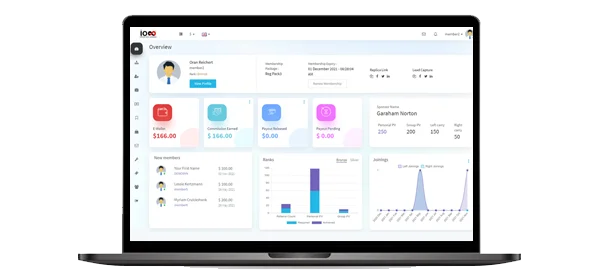

Infinite MLM Software dashboard