
Cryptocurrency MLM Software: How It Works, What to Know, and What to Watch Out For


Multi-level marketing (MLM) businesses often face challenges related to commission transparency, payment delays, and cross-border transactions.
Blockchain technology offers a new approach by automating commission calculations through smart contracts and enabling secure cryptocurrency payouts.
As a result, many organizations are adopting MLM software with cryptocurrency integration to simplify operations, automate rewards, and facilitate global transactions.
This guide explores how cryptocurrency MLM software works, its key features, benefits, risks, and the factors businesses should consider before adopting it.
Cryptocurrency MLM software is a blockchain-powered platform designed to manage the complete operation of a network marketing business. It handles member registration, referral tracking, genealogy management, commission calculations, payout processing, and administrative reporting while integrating cryptocurrency-based transactions.
What differentiates cryptocurrency MLM software from traditional MLM software is where the business logic resides. In conventional MLM systems, compensation calculations and transaction records are typically stored in a company-controlled database. This means participants must trust the organization to maintain accurate records and execute payouts correctly.
In cryptocurrency MLM software, much of this logic can be embedded within smart contracts running on a blockchain network. These contracts automatically execute predefined rules when specific conditions are met, reducing the need for manual intervention.
Although the term "Bitcoin MLM software" is often used, modern platforms generally support multiple cryptocurrencies and blockchain networks, including Ethereum, TRON, Binance Smart Chain, and stablecoins such as USDT.
A simple way to understand it is this: Imagine an MLM platform where the compensation rules are publicly visible, cannot be altered without authorization, and execute automatically according to predefined conditions. That's essentially how blockchain-enabled MLM systems operate.
Although the technology behind cryptocurrency MLM software is advanced, the user journey is surprisingly simple. Here's how the process typically works from registration to commission payouts:
A new distributor creates an account on the platform. Depending on regulatory requirements, they may complete identity verification procedures such as Know Your Customer (KYC) checks. The user then connects a cryptocurrency wallet that will be used for receiving commissions and managing transactions.
Once registered, the platform assigns a unique referral link linked to the distributor's account or wallet address. This link becomes the foundation of their recruitment and customer acquisition activities.
When a new participant joins using the referral link, the software automatically places them within the chosen compensation structure, whether it is a binary, matrix, unilevel, or hybrid plan. The smart contract records this relationship immediately and permanently.
As network activity occurs, such as product purchases, subscription renewals, or qualified referrals, the system evaluates whether commission conditions have been met. If they have, the compensation is calculated automatically according to the predefined compensation plan.
After commissions are generated, cryptocurrency payments can be distributed directly to participant wallets through integrated crypto payment gateways. Because payouts are automated, there is often no need for administrative approval or manual processing, helping businesses deliver faster and more efficient rewards.
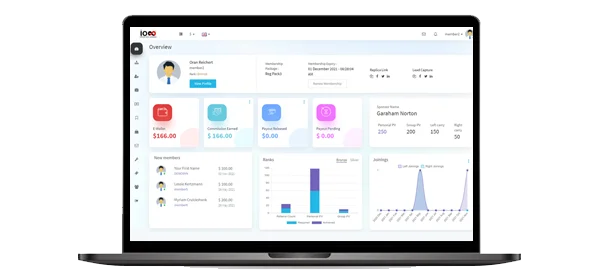
Business owners can monitor the entire MLM network through a centralized dashboard that provides real-time insights into network growth, member activity, commission distributions, wallet transactions, performance metrics, and revenue trends. This centralized visibility helps administrators track business performance, identify trends, and make informed decisions while maintaining oversight of all operational activities from a single interface.
The compensation plans form the foundation of any MLM business. Most cryptocurrency MLM software platforms support multiple compensation structures, allowing organizations to choose a model that aligns with their growth strategy and distributor engagement goals.
A binary plan organizes distributors into two network legs: a left leg and a right leg. New members are placed within one of these two structures, and commissions are typically calculated based on the sales volume generated in both legs. This plan encourages teamwork, balanced network growth, and active participation across the organization.
A unilevel plan allows distributors to personally sponsor an unlimited number of members on their first level. Commissions are then earned from a predefined number of levels within the downline structure. Its straightforward design makes it easy to understand, manage, and implement while supporting consistent network expansion.
A matrix plan limits both the width and depth of the network structure. For example, a 3×8 matrix allows three direct recruits per level and a maximum depth of eight levels. Once a level reaches capacity, additional recruits are placed in lower positions, creating controlled growth and a structured compensation environment.
A board plan operates through a series of boards or stages that participants progress through over time. When a board is filled according to predefined criteria, members advance to the next stage and become eligible for bonuses or rewards. This model is often used to create milestone-based incentives and ongoing engagement.
A generation plan rewards distributors based on leadership generations rather than traditional organizational levels. Generations are typically defined by rank advancements or leadership qualifications within the network. This structure promotes mentorship, leadership development, and long-term organizational growth across multiple levels.
A hybrid plan combines features from two or more compensation structures within a single system. For example, a business may use a binary commission model alongside unilevel leadership bonuses. This approach provides greater flexibility, allowing organizations to create customized compensation strategies that support diverse business objectives.
Ultimately, choosing the right compensation plan is a critical strategic decision for any MLM business. Once the structure is selected, the cryptocurrency MLM software can be configured to automate commission calculations, manage network growth, and support the organization's specific operational requirements.
Not all cryptocurrency MLM software solutions are built equally. Certain features play a critical role in ensuring transparency, operational efficiency, scalability, and long-term business success. The following capabilities are commonly considered essential when evaluating a cryptocurrency MLM platform.
Smart contracts automate commission calculations and auto-payout execution based on predefined compensation rules. Instead of relying on administrators to verify and process transactions manually, the system executes them automatically, reducing human error, increasing transparency, and improving payment efficiency.
Supporting multiple cryptocurrencies and integrated e-wallet functionality allows businesses to serve a broader global audience and provide greater payment flexibility. Many cryptocurrency MLM platforms support popular digital assets such as Bitcoin, Ethereum, TRON, BNB, and stablecoins like USDT, enabling users to store, send, receive, and manage funds through a secure e-wallet while transacting in their preferred currencies.
A real-time genealogy tree provides distributors with a visual representation of their network structure. It allows users to track team growth, monitor downline activity, analyze performance, and better understand how commissions are generated throughout the organization.
As cryptocurrency regulations continue to evolve, compliance features have become increasingly important. Integrated Know Your Customer (KYC) verification and Anti-Money Laundering (AML) controls help businesses validate user identities, reduce fraud risks, and comply with regulatory requirements across different jurisdictions.
An advanced administrative dashboard gives business owners complete visibility into network operations. Administrators can monitor member activity, commission distributions, wallet transactions, revenue performance, and overall network health from a centralized management interface.
Global MLM businesses often operate across multiple regions and markets. Multi-language and multi-currency capabilities improve accessibility for international users, creating a localized experience that enhances user engagement and simplifies global business expansion.
Blockchain technology creates permanent and tamper-resistant transaction records that remain accessible for verification. This immutable audit trail improves transparency, simplifies dispute resolution, and helps build trust among distributors by providing a verifiable history of all network transactions.
Build a secure, scalable cryptocurrency MLM platform with automated payouts, smart contracts, and global payment capabilities.
As MLM businesses expand globally, managing fast, secure, and cost-effective distributor payouts becomes increasingly important. Bitcoin and other cryptocurrencies offer several advantages over traditional banking systems, making them well-suited for modern MLM payment operations.
| Feature | Traditional Bank Payments | Bitcoin & Cryptocurrency Payments |
|---|---|---|
| Processing Time | Can take several days, especially for international transfers | Often processed within minutes or hours |
| Global Accessibility | Limited by banking networks and regional restrictions | Accessible to users worldwide with a crypto wallet |
| Transaction Costs | May involve banking fees, intermediary charges, and currency conversion costs | Generally lower transaction fees, depending on the blockchain network |
| Transparency | Payment tracking may be limited and require third-party verification | Transactions are recorded on the blockchain and can be independently verified |
| Automation | Often requires manual approval and payment processing | Can be automated through smart contracts and predefined rules |
| Currency Conversion | Subject to exchange rates and conversion fees | Users can transact directly in supported cryptocurrencies |
| Availability | Restricted by banking hours and holidays | Available 24/7 without traditional banking limitations |
| Security | Relies on centralized financial institutions | Protected through blockchain technology and cryptographic security mechanisms |
| Scalability | Managing large international payout networks can be complex | Supports efficient payouts to distributors across multiple countries |
| Distributor Experience | Delays and payment uncertainties may occur | Faster, transparent, and easily trackable reward distribution |
While cryptocurrency MLM software offers significant advantages in terms of smart contract automation, transparency, and global payments, businesses should also understand the potential risks associated with blockchain-based operations. Evaluating both technological and business-related risks is essential before adopting any platform.
Poorly written or insufficiently audited smart contracts may contain coding errors or security flaws that can lead to financial losses. Since blockchain transactions are generally irreversible, fixing mistakes after deployment can be difficult and costly.
Cryptocurrency values can fluctuate significantly within short periods. Distributors who receive commissions in digital assets may experience gains or losses depending on market conditions. Many businesses use stablecoins to reduce exposure to price volatility.
Cryptocurrency regulations continue to evolve across different countries and jurisdictions. In some regions, legal frameworks governing blockchain-based MLM operations remain unclear, making compliance and regulatory planning an important consideration for businesses.
No legitimate MLM business can guarantee profits regardless of market conditions or participant performance. Promises of fixed or risk-free returns should be viewed with extreme caution and thoroughly investigated.
Legitimate organizations typically have identifiable founders, management teams, and verifiable business registrations. A lack of transparency regarding company ownership or leadership is often considered a significant warning sign.
If participants earn primarily from recruiting new members rather than from the sale of legitimate products or services, the business model may resemble a pyramid scheme rather than a sustainable MLM operation.
A credible MLM business should provide real products, services, or measurable value to customers. Businesses that focus solely on recruitment incentives without a genuine offering may present significant risks.
Platforms that delay withdrawals, impose excessive conditions, or require additional payments before releasing earnings should be approached carefully. Transparent and reliable withdrawal processes are essential for maintaining trust.
The most important distinction is that cryptocurrency MLM software is simply a technology platform. It can support a legitimate, product-driven network marketing business or be misused to disguise an unsustainable pyramid scheme. The software itself is neutral; the legitimacy of the operation ultimately depends on the underlying business model and how it is implemented.
Before investing in a cryptocurrency MLM platform, businesses should conduct thorough due diligence. Consider asking:
The answers to these questions often reveal whether a provider is focused on long-term business success or simply selling software.
Cryptocurrency MLM software addresses several longstanding challenges within network marketing, including transparency, international payments, and commission automation. By using blockchain technology and smart contracts, businesses can create more efficient and verifiable compensation systems for global distributor networks.
However, technology alone does not guarantee success. The compensation structure, regulatory compliance strategy, product offering, and software quality remain equally important. Whether you're launching a new network marketing business or exploring blockchain integration, careful research and due diligence should always come before selecting a software provider or development partner.
Get a customized solution tailored to your compensation plan, business goals, and growth strategy.
Not exactly. Bitcoin MLM software is generally considered a subset of cryptocurrency MLM software. While Bitcoin-focused platforms primarily support transactions using Bitcoin, modern cryptocurrency MLM software often supports multiple digital assets such as Ethereum, TRON, BNB, and stablecoins like USDT. This broader support provides greater flexibility for businesses and distributors operating across different regions and blockchain ecosystems.
There is no single compensation plan that works best for every business. Binary, unilevel, matrix, generation, and hybrid plans can all be effectively integrated with cryptocurrency-based systems. The right choice depends on factors such as company goals, distributor incentives, growth strategy, and the type of products or services being offered.
The legality of cryptocurrency MLM businesses varies by country and regulatory environment. A legitimate MLM company that generates revenue through genuine products or services and complies with applicable laws may operate legally. However, schemes that rely primarily on recruitment rather than product sales can be classified as pyramid schemes and may violate local regulations regardless of whether cryptocurrency is involved.
Yes. A professional smart contract audit is highly recommended before launching a cryptocurrency MLM platform. Audits help identify coding errors, security vulnerabilities, and potential exploits that could impact transactions or commission calculations. Investing in a thorough audit can significantly reduce operational and financial risks.
Most cryptocurrency MLM platforms support major digital currencies such as Bitcoin, Ethereum, TRON, BNB, Litecoin, and popular stablecoins including USDT and USDC. Some advanced solutions also allow businesses to integrate additional blockchain networks or custom tokens based on their specific requirements.
Yes. One of the key advantages of cryptocurrency MLM software is its ability to facilitate international payouts without the delays and restrictions often associated with traditional banking systems. Distributors can receive commissions directly in their crypto wallets, enabling faster and more efficient cross-border transactions.
Smart contracts serve as the automation engine of a cryptocurrency MLM platform. They automatically execute predefined rules related to commission calculations, bonus distributions, rank advancements, and payouts. This reduces manual administration, improves transparency, and ensures that compensation plans operate consistently.
Yes. Most modern cryptocurrency MLM solutions include integrated e-wallet functionality. These wallets allow users to securely store, receive, transfer, and manage their cryptocurrency earnings within the platform. E-wallet integration also simplifies transactions and provides users with convenient access to their funds.
The security of a cryptocurrency MLM platform depends on its architecture, development standards, and security measures. Features such as encrypted transactions, secure wallet integration, smart contract audits, multi-factor authentication, and role-based access controls help protect both business owners and distributors from unauthorized access and potential cyber threats.
Yes. Many businesses successfully transition from traditional MLM systems to cryptocurrency-enabled platforms. Software providers often offer customization and migration services that allow organizations to retain their existing compensation plans, distributor networks, and operational processes while adding blockchain-based payments and automation capabilities.
Development timelines vary depending on the complexity of the compensation plan, blockchain integrations, customization requirements, and security features. A basic platform may take a few weeks to deploy, while a fully customized cryptocurrency MLM solution with smart contracts, e-wallets, and compliance features can require several months of development and testing.
Stablecoins such as USDT and USDC are widely used because they are designed to maintain a relatively stable value compared to highly volatile cryptocurrencies. By using stablecoins for commission payouts, businesses can reduce the impact of market fluctuations and provide distributors with more predictable earnings.
Product Specialist & Research Head

Are you on the lookout for a cost-effective software solution with advanced features for your MLM business? Infinite MLM software might just be the thing for you.
Connect with Us